Making Ends Meet in Our Communities 2011
There are many Americans who believe that those in poverty are there due to an unwillingness to work. The current recession; however, has highlighted the fact that there are many adults who are willing to work but are not able to secure full time employment. This economic downturn has resulted in more people becoming interested in issues related to employment and income issues. The economy impacts how much money is being spent in our communities.
Unemployment Rates
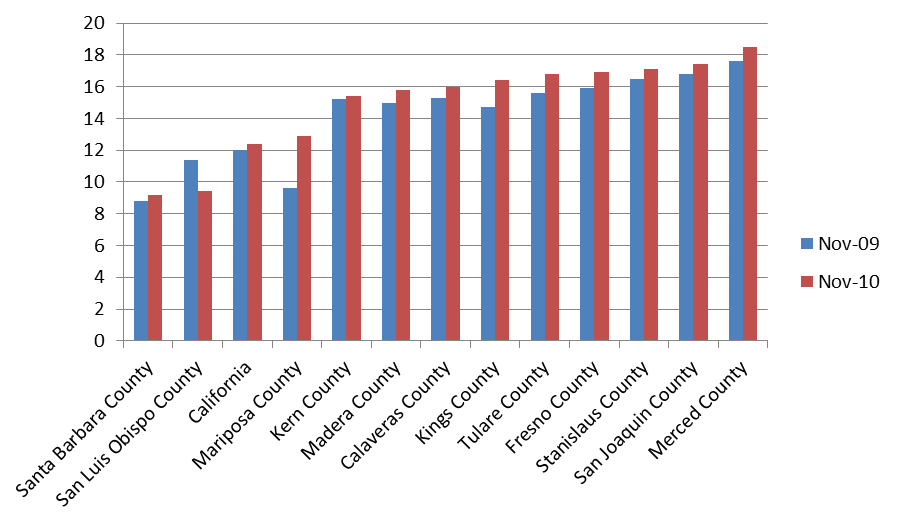
Unemployment figures for the State of California illustrate how residents in the twelve CCASSC Counties fare compared to the State average. A report released in January 2011 by the U.S. Labor Department shows that the San Joaquin valley accounts for 6 of the 10 metropolitan areas with the worst unemployment rates in the country. These cities are from Stockton to Visalia-Porterville and also include Modesto, Merced, Fresno and Hanford-Corcoran. The Central Valley counties have historically had higher unemployment rates than that of the state as a whole. While a few of the CCASSC counties have lower unemployment rates than the state average, these counties still have families struggling to meet their everyday expenses. The unemployment rates do not include those persons who are discouraged and no longer looking for work as well as those not in the labor force such as retirees and students.
How Much Does It Take?
| Measure | Annual income |
|---|---|
| Self Sufficiency Income | $26,304 |
| California Minimum Wage | $16,896 |
| Federal Poverty Line | $11,161 |
Rising Costs Are Impacting Families
The recent depression has impacted residents living in our counties. Families struggle to cover the costs of basic necessities such as housing, food, and transportation. Many are unemployed, are working fewer hours, or have had their salaries reduced. As more of the population has become impacted by the economic conditions, there is an opportunity for a better understanding of what being poor really means.
Calaveras County, Fresno County, Kings County, Kern County, Madera County, Mariposa County, Merced County, San Joaquin County, San Luis Obispo County, Santa Barbara County, Stanislaus County, and Tulare County
Defining Poverty
Persons who are classified as “living in poverty” may differ depending on the measure used to define poverty. Two of the most widely recognized and used measures of poverty are:
(1) The federal poverty threshold, also known as the “official poverty measure”
(2) The Self-Sufficiency Standard.
The federal poverty measure has been criticized as not including variables such as access to assets. Several states in recent years have passed legislation and created task forces to study this issue and to come up with a better measurement of poverty. The federal government has also acknowledged that a different standard may be in order.
The Self Sufficiency Standard
Using the Self-Sufficiency Standard developed by Dr. Diana M. Pearce of the School of Social Work at the University of Washington, average monthly budgets were calculated. The budget includes only housing/utilities, child care, food, transportation, health care, taxes as well as miscellaneous items such as clothing and telephone. Not included in the budget were other items such as entertainment, insurance or savings. County specific graphs depict four different budgets representing distinct households. The family budgets include items such as child care. Both single parents as well as two working households have child care expenses that would mean they would need to earn even more to cover these expenses.

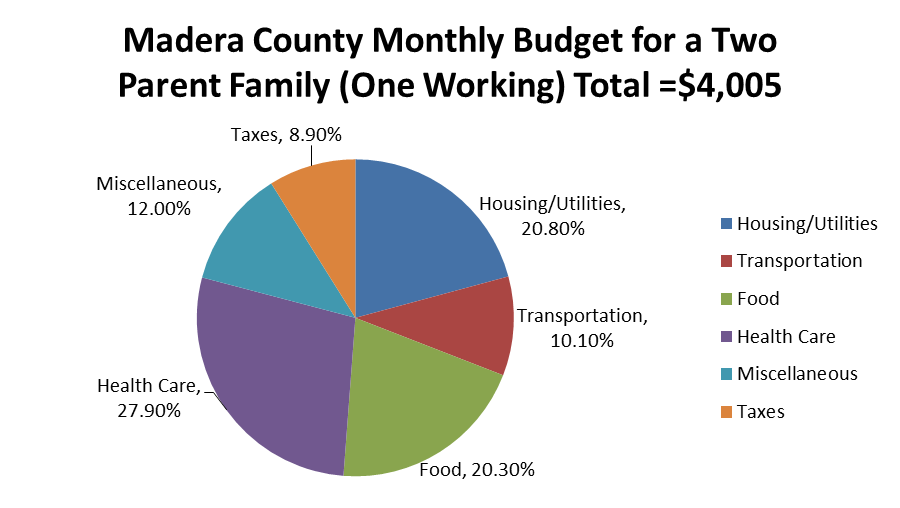
In two parent families where only one adult is working full time, he/she would need to earn $23.10 per hour to reach the Self Sufficiency standard. If both adults worked full time outside the home then their combined hourly wage would have to be $31.62 per hour to reach the Self Sufficiency Standard. Two working parents earning minimum wage would only earn $2,816 /month.
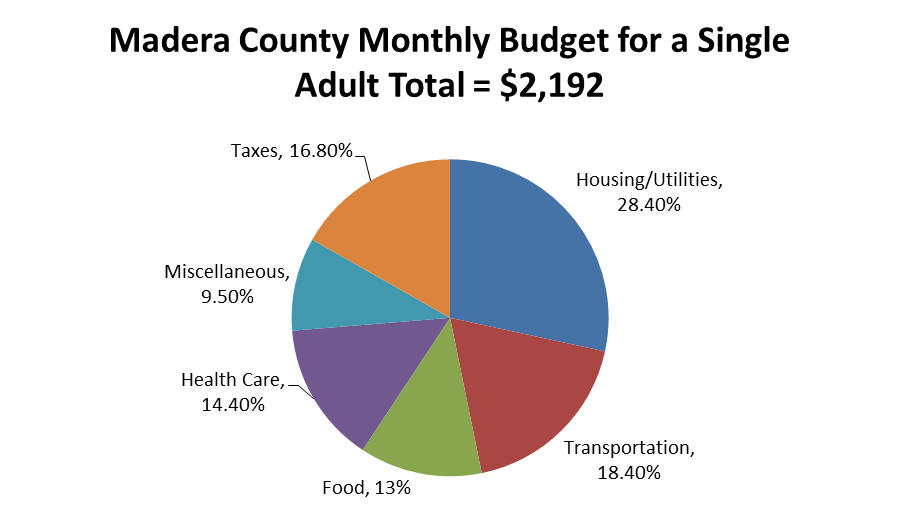
Assuming a single adult works 40 hours a week, 52 weeks per year, he she would need to earn $12.65 per hour to reach the Self Sufficiency standard. Yet, he/she only would earn $1408 per month if they held a full time minimum wage job.
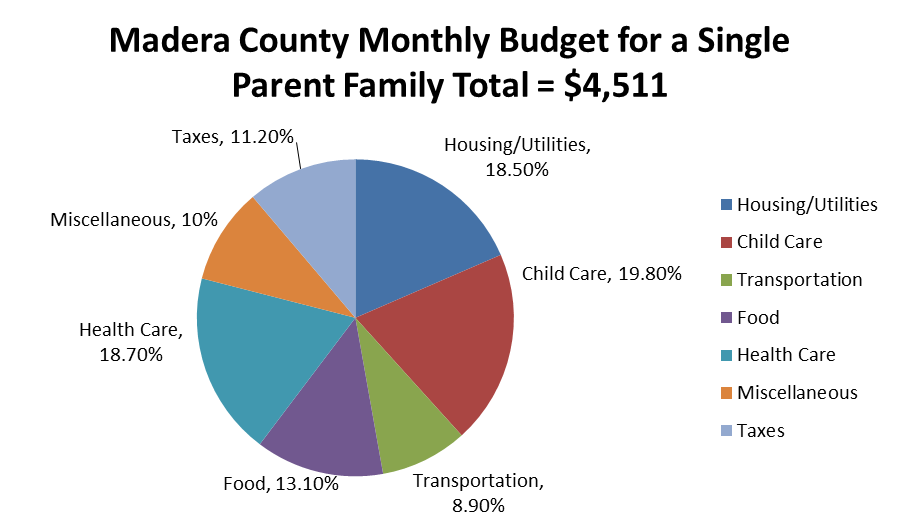
A working single parent working full time would need to earn $26.03 per hour to reach the Self Sufficiency Standard.
Source California Budget Project Making Ends Meet June 2010
1625 E. Shaw Ave Suite 106 Fresno, CA 93710
Contact Patricia Poulsen Research Associate 559.228.4084
www.csufresno.edu/swert
This HTML version was generated with AI assistance and may contain errors or omissions. The original approved PDF remains the official document of record. An alternative accessible format is available upon request from the document creator in accordance with Title II of the ADA.