Hunger and Food Insecurity
2012 UPDATE FOR THE CCASSC REGION
Hunger and Food Insecurity in the Central Region
According to the U.N. Food Price index, food costs have gone up month over month since August 2010.
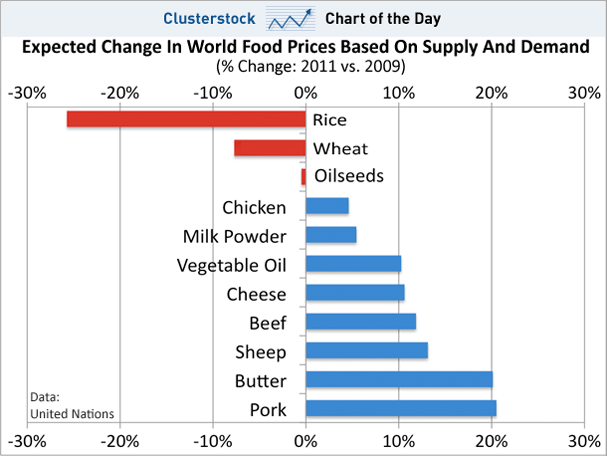
The Central Valley is experiencing a similar trend. Throughout the region, food distribution sites have seen an increase in the number of persons asking for food assistance. In fact a February 21, 2012 article by a Fresno news agency reported that local residents have seen prices for some foods rise as much as 30 percent over the past year. Further with gas prices rapidly rising, many believe that it’s just a matter of time before prices of food also go up.
It is amazing that hunger is so prevalent in the Central California Area Social Services Consortium (CCASSC) counties when you consider that this region produces so much of the agricultural products for our state/nation. In 2010 the counties of San Joaquin, Stanislaus, Merced, Madera, Fresno, Kings, Kern, and Tulare dominated the state with overall gross food production which accounted for 56.1% of the total according to the USDA National Agricultural Statistics Service (NASS--- CA 2010). The value of these agricultural products ranges from $1.3 billion in Madera County to $5.9 billion in Fresno County. Further, Santa Barbara County had a gross agricultural production of nearly $1.2 billion in 2010 and San Luis Obispo County had a gross production of $712,815,000 ranking it 15th in the state. Both Calaveras and Mariposa counties also contribute to the agricultural production in the state but to a much lesser extent.
The state’s 18th and 20th Congressional Districts( which include most of the San Joaquín Valley) experienced the highest levels of food hardship from 2010 to 2011, per the Food Research and Action Center. Rebecca Plevin , the community health reporter for Vida en el Vallee, has written that “ The San Joaquín Valley produces the milk, grapes, and almonds that nourish the nation. But the region’s agricultural bounty is not reaching the area’s low income residents.”
National food insecurity data reveal that about 45% of those struggling with hunger actually have incomes above the federal poverty level. Thus, it is important to not just simply rely on poverty thresholds when estimating the degree to which people are struggling to be food secure. Food insecurity is a reality for many residents living in our counties. There are those individuals who do not know where they will get their next meal and may in fact go to bed hungry. While hunger impacts not just those in poverty; it is still a fact that if we could reduce poverty in our counties we could help individuals combat hunger and food insecurity.
One can get a more detailed profile of those adults with income <200% of the Federal Poverty Level. The UCLA Center for Health Policy Research has published data based on the 2009 California Health Interview Survey (CHIS). The following table illustrates the food insecurity rate for this population among CCASSC counties:
| Location | Food insecurity rate |
|---|---|
| CALIFORNIA | 40.4% |
| CALAVERAS | 31.9% |
| FRESNO | 41.9% |
| KERN | 33.9% |
| KINGS | 43.3% |
| MADERA | 36.6% |
| MARIPOSA | 31.9% |
| MERCED | 40.4% |
| SAN JOAQUIN | 38.7% |
| SAN LUIS OBISPO | 23% |
| SANTA BARBARA | 37.1% |
| STANISLAUS | 37% |
| TULARE | 37.5% |
Food Banks and food pantries are being utilized in our communities to a greater extent during the past year. These agencies serve as a means to distribute food to those who are in need of food assistance.
The following is a sampling of those local organizations in the CCASSC region:
According to Jeannie Hayward, Director their food bank has experience a 475% increase in persons seeking help from 2008-2011. She reports that the numbers of those seeking help in 2011 did not change significantly from the prior year. Nevertheless, their agency just surveyed 161 clients and 68% reported that they do not have enough to eat during the last 10 days of the month. She reported that many report running out of food before the end of the month even though they utilize the pantries and commodity program earlier in the month. At this time they serve 14 pantries in the county as well as operate 6 mobile pantries. The Food Bank also belongs to the Farm to Family project so that the Food Bank is able to provide clients with fresh produce.
This agency distributes over 24 million pounds of food and grocery products throughout the 3 counties by means of a network of over 170 partner agencies.
The Mobile Pantry Program was established with healthy living and eating in mind. This program distributes fresh produce and other healthy foods directly to those in-need throughout Fresno, Kings, and Madera Counties. The Mobile Pantry visits non-profit organizations serving those in need. Kra Mobile Pantry, provided through a grant, holds as much as 10,000 pounds of food allowing Community Food Bank to serve more families. Fresno Community Food Bank also distributes food at several locations in Sanger and to Catholic Charities in downtown Fresno. According to Rick Palermo the food bank conducts a survey of participants every four years. Staff from the Food Bank help with Cal Fresh outreach as well as provide a nutrition education program. He also advised that the local agencies have seen an increase in numbers of persons accessing their services and stated that many of the new families are unsure of the process.
This organization distributes emergency food to citizens of Kings County. According to Tim O’Connell, Deputy Executive Director of KCAO, those referred for emergency food receive one grocery bag filled with food obtained for the USDA commodities program. In addition to this food, KCAO also is able to add bread that is donated by Panera Bread. In addition, KCAO also signs up individuals for the commodities distribution program and these individuals receive a one year card that entitles them to obtain food from various locations throughout the county on the 3rd Friday of every month. KCAO is also in the process of attempting to establish a local Food Bank. They have a warehouse location and many of the necessary items needed to operate a food bank. In 2011 the organization distributed 3,835 emergency grocery bags and 22,378 USDA commodities food boxes.
Michelle Ruiz, office manager reports that the Madera county Food Bank gives out 2,000 commodity boxes once a month. In addition they provide 2400 emergency boxes in any given month. The emergency food boxes are distributed at a variety of locations but on Mondays and Tuesdays the emergency food is distributed directly from the food bank itself. In addition, the food bank served 839 seniors through a brown bag program in February 2012. Michelle stated that they have seen a dramatic increase in persons seeking assistance. She stated that during the rainy season the agency will serve more migrant workers/families that are not able to work due to the weather.
Mary Loughran, co-President of the Manna House in Mariposa states that they are feeding more persons who are out of work or just working part time. Many of those coming to their organization for food are young families. In addition, those on SSI will come to obtain food at the end of the month after running out of food. Their organization distributes emergency food and operated M-F from 10-2. Persons in need of emergency food receive three day’s supply of food for each person in the household. Often people return during the month but Manna House tries to limit each person to receiving food twice per month. The agency works closely with the County and refers persons for additional services.
In Jan 2012 Manna House served 946 persons whereas in Jan 2011 served only 722 persons. Mary stated that this increase has been consistent throughout the year. Persons in need of food can also obtain commodities one time per month. Further, the Senior Brown Bag program serves the senior population two times a month. Those in need of hot meals can obtain a hot mean at NOON at the Heritage House and in the evening at a Warming Place location.
The Food Bank provides classes in healthy, economical meal planning and food preparation. Special bags are made for people with specific health problems; those suffering from diabetes, AIDs, high blood pressure, heart trouble, hepatitis and other ailments receive specialized assistance.
Melissa Hill, Community Services Program Manager for San Joaquin County reports that the county agency provides administration for Cal Fresh as well as oversees the commodities warehouse. Their agency distributes the USDA and donated food to 8 county community centers. They distribute commodities on the 3rd Thursday of the month at 15 different sites in the county. The agency has experiences a 30% decrease in donations of food over last year. Ms. Hill reports that part of the decrease is due to the relocation to out of California of one of their major donors . This has been a trend for the county which has lost at least one major donor each of the last five years. Meanwhile, there are more persons seeking help and many have never been seen before but have recently lost jobs. The agency belongs to a local Hunger Task Force. On April 20, 2012 a county wide Hunger survey was launched and the goal was to reach 2,000 county residents.
Barbara England, Executive Director stated that their emergency food pantry operates 8:30-11:30 M-F. They served 30,000 meals in 2011. In addition, they have a warehouse. A coalition of 54 non-profits from throughout the county who serve people food in a variety of ways obtains food from this warehouse. The pantry has moved away from serving processed foods and is obtaining more retail surplus food. It has also started a gleaning program so they can have fresh fruits and vegetables. The summer of 2012 the agency will survey clients seeking additional data as well as client satisfaction.
The Food Bank is in partnership with pantries throughout the county and manages 17 USDA food distribution sites.
Currently there are 80 pantries located throughout Merced County although only 70 are currently active. In addition the Food Bank is in the second year of administering the Senior Brown Bag Program providing food to very low-income elders. There is a $30/year charge to the senior to participate in this food subsidy but for those who cannot afford the fee, the Food Bank has begun an Adopt a senior drive where others in the community can donate the $30 to cover the cost of the program for one senior. According to Phyllis Legg, Volunteer Executive Director, they are seeing a change in persons coming to the pantry. They have experience a 48% increase in persons seeking their services. She also said that at the same time donations have been down. Further, she has seed a different class of persons seeking food assistance including many who would be considered middle/working class.
Nutrition on the Go is a mobile program that serves the rural communities of Tulare County. According to Sandy Beals, director of Food Link, this program brings fresh fruits and vegetables, cooking tips and recipes, and nutrition information. The program has eliminated income guidelines and is open to all persons at no cost to the participant. The mobile truck visits each location once per month. Ms. Beals reports that their agency served 106,000 persons in 2010 and 114,000 in 2011. Informal surveys at the food pantries indicate that many of the new participants are the recently unemployed and had never accessed services in the past. Although there is a greater demand for food assistance, the agency has seen a cut back in the USDA emergency food assistance program. Thus, the Tulare County non-profit used up all of its cash reserves last year in order to meet the growing need. The agency has also had to obtain more food from the private sector which is more costly. Despite these challenges, the agency plans to increase the number of lunches it will provide to children aged 1-18 during the summer time free lunch program. The agency is once again going to begin an Outreach program for Cal Fresh.
This food bank serves 200 member agencies who in 2011 distributed food to 102,000 unduplicated individuals according to Jane Lindsey, Director of Development. During 2011, the Food bank of Santa Barbara County distributed 11 million pounds of food. 44% of those served by the Food bank are under the age of 18. The agency did serve about 2.5% more seniors than in 2010. In addition, the total number of people served last quarter rose by about 7.5% from the same quarter the previous year. According to Jamie Nichols, Agency Relations Manager, many of their organization’s member agencies have seen more long-term unemployed among their clientele, and many of these agencies have developed programs to address the more systemic issue of unemployment in Santa Barbara County. The food bank has an MOU with the County to assist people applying for Cal Fresh and it has a staff member who does Cal Fresh outreach throughout the County.
This organization serves the entire Kern county area. In fact according to Ben Coyle of CAPK it is the 4th largest service area in the state. The Food bank operates 3 trucks and employs 10 full time staff. Last year over 700 persons volunteered their time to help the food bank. They provide food for over 70 pantries as well as commodity sites throughout the county. He has seen a big increase in persons served and in 2011 the duplicated count was 1,537,879 individuals or 439,667 households.
Approximately, 5.5 million pounds of food is distributed each year through more than 200 non-profit agencies. The County operates such diverse programs as the Brown Bag program for seniors; the Lovin’ Lunchbox program for children; a commodities program; as well as emergency food distribution.
The San Luis Obispo county food bank is collaborating with the County Health Department. Through their partnership they will provide nutrition education through cooking demonstrations and tastings at county-wide distribution sites.
FEDERAL NUTRITION PROGRAMS
Many California residents also are able to combat hunger by participating in one or more federal programs. Families may qualify for the following:
CalFresh (Food Stamps)
Nationally there has been increased demand to assist low income families with nutritional assistance. The Agriculture Department has indicated that food stamps or Supplemental Nutrition Assistance Program (SNAP) has helped keep many individuals out of poverty. According to the California Department of Social Services (CDSS) website as of Dec. 2011 there were over 3.9 million participants in the Cal Fresh program. Yet, even with these high numbers, it is estimated that many more California residents qualify for participation. As of January 2012, new legislation in California eliminates the fingerprint image requirement and moves the state to a semi-annual reporting system for Cal Fresh. The federal government has encouraged states to improve their outreach efforts so that more individuals who are eligible apply for SNAP benefits. In October 2011 the federal government announced winners of hunger champion awards that went to those agencies that had the most improvement in their outreach efforts. Fresno County was among the recipients of the bronze award. The February 2012 publication, Lost Dollars, Empty Plates emphasizes that when California residents fail to access Cal Fresh they are not only harming their own well-being but their lack of utilization results in lost federal dollars to the state as well as local communities.
| Location | Number of households |
|---|---|
| CALIRORNIA | 1,735,632 |
| CALAVERAS | 2,414 |
| FRESNO | 86,293 |
| KERN | 54,548 |
| KINGS | 9,339 |
| MADERA | 10,222 |
| MARIPOSA | 825 |
| MERCED | 21,141 |
| SAN JOAQUIN | 41,254 |
| SAN LUIS OBISPO | 8,930 |
| SANTA BARBARA | 13,569 |
| STANISLAUS | 37,825 |
| TULARE | 41,628 |
School Nutrition Programs
Like the Cal Fresh program, research shows that while school nutrition programs are serving many children, there are many more who are eligible but not served. The school nutrition programs include reduced lunches, after school meal supplements, and free breakfast and lunches. According to Food Policy Advocates it is estimated that approximately 70% more low income children could benefit from the school breakfast program. The California Department of Education reports that children whose nutritional needs are met do better in school as their ability to learn is raised. The California Department of Education, Nutrition Services Division publishes yearly data for all counties that illustrate the number of students who are utilizing thee school nutrition programs. The latest report for 2010-2011 was published in March 2012.
STATE AND LOCAL DATA
In 2011 Feeding America published a study based on 2009 statistics compiled by the U.S. Department of Agriculture. The report provides a link to an interactive map so that a reader can view county specific data.
The statistics for the state as well as the CCASSC specific counties are as follows:
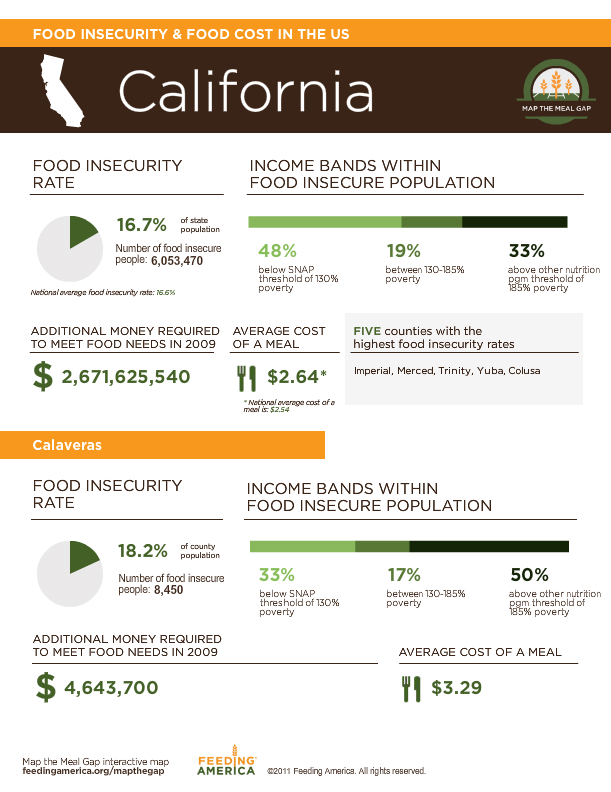
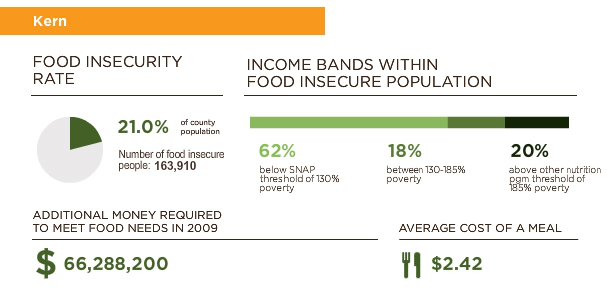
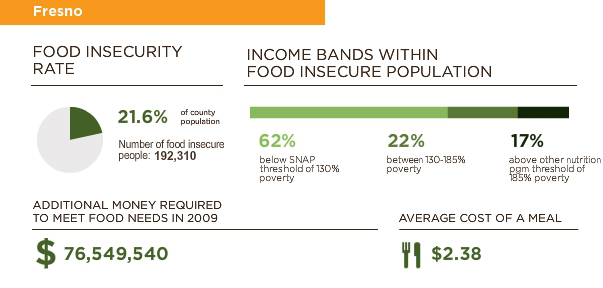
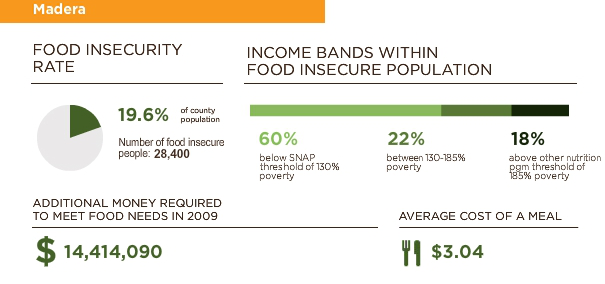
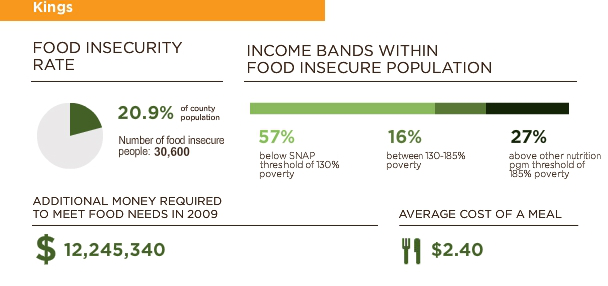
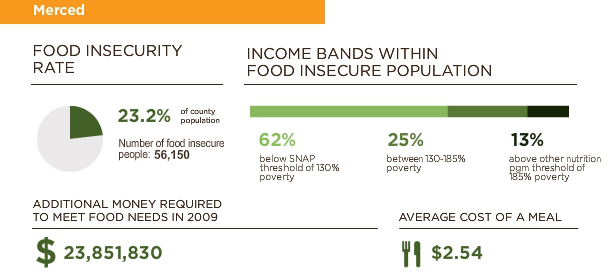
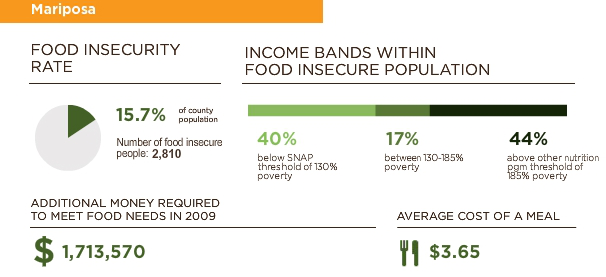
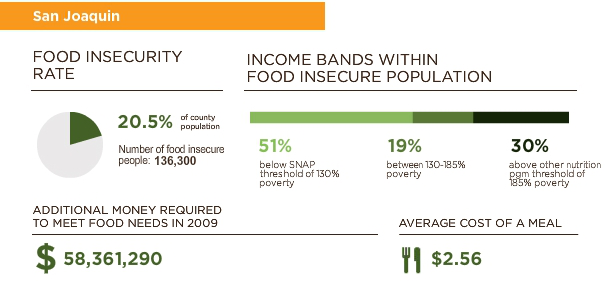
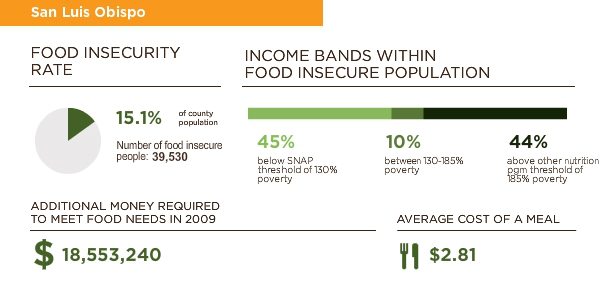
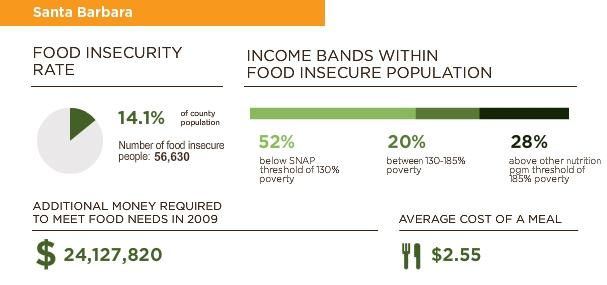
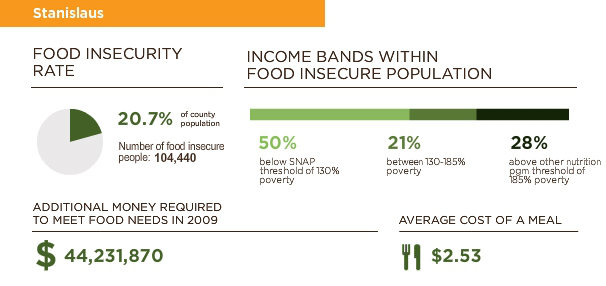
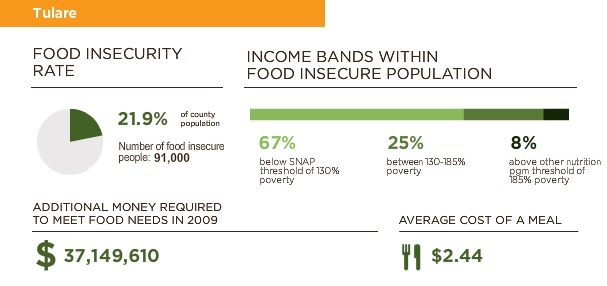
Calaveras County, Fresno County, Kern County, Madera County, Mariposa County, Merced County, San Joaquin County, San Luis Obispo County, Santa Barbara County, Stanislaus County, and Tulare County
Contact Patricia Poulsen, Research Associate 559-22-4084
1625 E Shaw Suite 106 Fresno, CA 9371 www.csufresmo/ediswert
This HTML version was generated with AI assistance and may contain errors or omissions. The original approved PDF remains the official document of record. An alternative accessible format is available upon request from the document creator in accordance with Title II of the ADA.