Building Bridges and Strengthening Support: Establishing an LGBTQ Multidisciplinary Team for Youth Equity in Stanislaus County
Approved
2023-2024
Office of Graduate Studies and Research
A Project Presented to the Faculty of California State University, Stanislaus
In Partial Fulfillment of the Requirements for the Degree of Master of Social Work
By
Courtney Mummert
May 2024
Committee Members
BUILDING BRIDGES AND STRENGTHENING SUPPORT: ESTABLISHING AN LGBTQ MULTIDISCIPLINARY TEAM FOR YOUTH EQUITY IN STANISLAUS COUNTY
By
Courtney Mummert
Dr. Katie Galvin
Associate Professor of Social Work
Dr. Kilolo Brodie-Crumsey
Professor of Social Work
© 2024
Courtney Mummert
ALL RIGHTS RESERVED
Dedication
I would like to dedicate this project to LGBTQ youth in Stanislaus County and beyond. You are seen, and your voices are important. I envision a world where you are free to live authentically without fear or hesitation. Until that dream can be fully realized, I hope you seek comfort, safety, and joy in our beautifully resilient queer community.
Acknowledgements
I would like to extend my deepest thanks to my parents, Richard and Shari Mummert. Words cannot fully express my gratitude for all you have given me. I wish all LGBTQ people knew love like yours, and I am endlessly grateful for your support and encouragement throughout my life.
I would also like to thank my friends: Kelsey, Kami, Kashmir, Adriela, Martha, Brianna, Courtney, Carrie, Roxanne, Taryn, Anita, Amy, Christa, and Elizabeth. I am honored to be surrounded by such a brilliant, compassionate, supportive community.
I am also deeply grateful for Claudia Gonzales and Deja-Marie Crozier, my classmates and friends. You both are going to change the world, and it has been an honor to learn alongside you. Thank you for your support, encouragement, and friendship throughout this program.
I am also so grateful for my girlfriend, MaryAnn. Thank you for the endless supply of Nerds gummy clusters and for the joy you bring to my life. I am so thankful for your support, patience, and humor, especially on difficult days.
I would also like to extend my deepest thanks to my chair, Dr. Katie Galvin. Your support, direction, and positivity were my guiding light during this process. Thank you for trusting me and my vision for this project. I would also like to thank my capstone professor, Dr. Kilolo Brodie-Crumsey. I deeply appreciate your encouragement and guidance.
I would also like to thank Jenell Thompson and Yvonne Berenguer of the Title IV-E program. I am so thankful for your support, and I deeply appreciate the opportunities you provided me. Social workers are better prepared to work in child welfare because of you.
I would also like to extend my deepest thanks to Christine Huber, Dwight Simpson, and Amie Stokes of Stanislaus County Community Services Agency. I am so proud of the work our agency is doing for LGBTQ youth, and this project would not exist without you.
I am also so grateful for Amanda Wood, my colleague and friend. This project is rooted in the change we started in 2018. Thank you for working tirelessly for our community.
Finally, I would like to thank my previous colleagues at Powerful Voices, Big Brothers Big Sisters of Puget Sound, and GSA Network. I began this work 15 years ago, and the lessons I learned from each of you have been the cornerstones of my career.
Table of Contents
Dedication ............................................................................................................... iv
Acknowledgments................................................................................................... v
Abstract ................................................................................................................... 2
Purpose of the Project ............................................................................................. 3
Background Information ............................................................................. 3
Professional Observations and Experience ................................................. 5
Objectives ............................................................................................................... 7
Significance of the Project ...................................................................................... 8
Literature Review.................................................................................................... 10
Systematic Oppression and Adverse Outcomes .......................................... 10
Cross-System Collaboration ....................................................................... 14
The Political Landscape in America ........................................................... 15
Theoretical Frameworks ............................................................................. 16
Case Example: Nex Benedict...................................................................... 17
Methodology ........................................................................................................... 21
Discussion ............................................................................................................... 25
Project Experience ...................................................................................... 25
Implications................................................................................................. 29
References ............................................................................................................... 33
Appendices
A. LGBTQ Multidisciplinary Team (MDT) Flyer .......................................... 39
B. LGBTQ MDT Meeting Agenda 10/23/2023 .............................................. 40
C. LGBTQ MDT Meeting Agenda 11/27/2023 .............................................. 41
D. LGBTQ MDT Meeting Agenda 1/22/2024 ................................................ 42
E. LGBTQ MDT Meeting Agenda 2/26/2024 ................................................ 43
F. LGBTQ MDT Meeting Agenda 3/25/2024 ................................................ 44
Abstract
The purpose of this graduate project was to establish an LGBTQ Multidisciplinary Team (MDT) in Stanislaus County. This project was based on ample research showing that LGBTQ youth experience adverse outcomes in every system with which they interact including the child welfare system, juvenile justice system, mental health system, education system, and healthcare system. Often, LGBTQ youth traverse multiple systems simultaneously, thus increasing their exposure to discrimination based on their sexual orientation, gender identity, and gender expression. These outcomes demonstrate a need for collaborative, cross-system interventions aimed at reducing disparities for LGBTQ youth. The LGBTQ MDT achieves this by unifying youth-serving social service agencies and organizations to bolster the awareness of and responsiveness to LGBTQ youth in Stanislaus County. The project was structured around five objectives: establishing partnerships with youth-serving county agencies and community-based organizations, gathering feedback from identified stakeholders, holding regular implementation meetings, conducting community outreach, and facilitating monthly LGBTQ MDT meetings. The inaugural meeting of the Stanislaus County LGBTQ MDT was held in October 2023. Since then, the LGBTQ MDT has embarked on a collective mission and vision process to further define our work together and is eager to implement strategies to improve outcomes for LGBTQ youth in Stanislaus County. In the future, the LGBTQ MDT could consider implementing a youth advisory board or similar youth-led initiative and securing fiscal support for long-term sustainability. Additionally, future research could evaluate the effectiveness of the LGBTQ MDT and provide a framework from which to replicate the LGBTQ MDT in other jurisdictions.
Purpose of the Project
The purpose of this graduate project was to establish an LGBTQ Multidisciplinary Team (MDT) in Stanislaus County. The goal of creating the LGBTQ MDT was to unify LGBTQ youth-serving social service agencies and organizations to bolster the awareness of and responsiveness to LGBTQ youth in Stanislaus County, especially those involved in one or more systems of care. The LGBTQ MDT is a county-wide collaboration between youth-serving county agencies (i.e., Stanislaus County Child and Family Services, Stanislaus County Juvenile Probation, and Stanislaus County Office of Education), community-based organizations, and LGBTQ youth and families. The LGBTQ MDT will create a space for ongoing education, policy and procedure development/analysis, coordination of service delivery, and bolstering LGBTQ community resources in Stanislaus County. The LGBTQ MDT will also create a space for problem solving disparity issues related to system-involved LGBTQ youth in Stanislaus County with a primary focus on youth involved in or at risk of involvement in the child welfare and juvenile justice systems. Until the creation of the LGBTQ MDT, there were no collaborative, cross-system entities working to address these disparities in Stanislaus County.
Background Information
LGBTQ youth experience adverse outcomes in every system with which they interact including the child welfare system, juvenile justice system, mental health system, education system, and healthcare system (Martin et al, 2016). These outcomes are not inherent to LGBTQ identities; rather, they stem from systematic oppression, harassment, and discrimination based on sexual orientation, gender identity, and gender expression (Youth.gov, n.d.a). Cissexism (also known as cisgenderism) is a system of oppression that impacts people whose gender identity falls outside of the gender binary and whose gender expression differs from normative gender constructs (LGBTQIA Resource Center Glossary, 2023). Similarly, heterosexism is a system of oppression that impacts people who are not heterosexual and unfairly advantages those who are straight (LGBTQIA Resource Center Glossary, 2023). The impact of cissexism and heterosexism cannot be overstated. LGBTQ youth ideate, attempt, and complete suicide at alarming rates, and they experience physical, verbal, and emotional violence in places they should feel safe (Youth.gov, n.d.b). Because these systems of oppression function across multiple systems and at multiple levels (i.e., micro, mezzo, macro), there is a need for collaborative efforts to address and resolve these disparities. The Stanislaus County LGBTQ MDT aims to do exactly that.
Multidisciplinary teams, or MDTs, originally formed in the oncology field in the 1980s (Taberna et al., 2020). Healthcare professionals found that MDTs significantly improved cancer patient quality of care by establishing communication and coordination between several departments and disciplines responsible for treating patients with cancer. MDTs have also been used as a response to child abuse by connecting child and family services agencies, medical services, family and victim services, and law enforcement (National Children’s Advocacy Center, 2023). Westphaln et al. suggest that “the long-term process of healing after child abuse typically occurs in homes and intersects with multiple agencies and community resources; therefore, there is an urgent need to bolster interventions that coordinate services and help support children and families” (2022, p. 13).
The goal of establishing a collaborative, cross-system, county-wide LGBTQ MDT is to improve outcomes for some of Stanislaus County’s most marginalized youth. The Stanislaus County LGBTQ MDT will prioritize addressing and reducing disparities for system-involved LGBTQ youth with a long-term goal of creating a safe, affirming community for all LGBTQ people in Stanislaus County. The original vision for this project followed Stanislaus County Child and Family Services’ participation in Georgetown University’s System-Involved LGBTQ Youth Certificate program, facilitated by Georgetown’s Center for Juvenile Justice Reform. The certificate program was a week-long, virtual program facilitated by renowned professionals in the LGBTQ system-reform field including attorneys, researchers, professors, community organizers, social workers, and physicians. The certificate program was attended by agency teams from across the United States and Canada. A requirement of this program was for participating agencies to vision and implement a project aimed at effecting system change to reduce disparities for system-involved LGBTQ youth at their agencies. After careful consideration, I proposed the creation of a LGBTQ MDT, the implementation of which has served as my culminating experience for the Master of Social Work (MSW) program at California State University, Stanislaus.
Professional Observations and Experience
I have been a social worker for Stanislaus County Child and Family Services for eight years, with over fifteen years of professional experience in the field of youth development. During this tenure, I have observed how compounding adversities impact system-involved LGBTQ youth and highlight a need for a collaborative intervention aimed at holistically addressing disparities across systems including child welfare, juvenile justice, mental health, healthcare, and education. I have observed significant challenges for LGBTQ foster youth in Stanislaus County, especially transgender and nonbinary youth. These challenges include placement denials based on sexual orientation, gender identity, or gender expression (SOGIE), lack access to gender-affirming physical and mental health care, and lack of cultural competence by social workers, foster family agencies, foster parents, and service providers. Additionally, there is a shortage of culturally competent mental health professionals for LGBTQ youth experiencing mental health crises, disproportionate homelessness and criminalization, and educational challenges including bullying, harassment, and discrimination. These professional observations are supported by the literature and will be explored extensively in the literature review section.
Despite significant cultural and systematic barriers, Stanislaus County Child and Family Services has committed itself to better understanding and addressing the diverse needs of LGBTQ foster youth in Stanislaus County. In the past six years, Stanislaus County Child and Family Services has worked diligently to improve outcomes for LGBTQ foster youth by implementing comprehensive training for social workers, policy and resource development, and individualized support for LGBTQ youth in foster care. Stanislaus County Child and Family Services has taken numerous steps to effect systematic change at our agency in recent years, and these reform efforts are the foundation on which this project is built. The establishment of the LGBTQ MDT has served to continue this work by allowing us to work in collaboration with other youth-serving county agencies, community-based organizations, and LGBTQ youth and families.
Objectives
This graduate project was structured around five objectives. The first objective was to build and sustain partnerships with youth-serving county agencies, community-based organizations, and LGBTQ youth and families. Many of these relationships were already established; however, there was community building necessary, particularly with community-based LGBTQ organizations. The second objective was to solicit feedback from county agencies, community-based organizations, and LGBTQ youth and families about the possible benefits and challenges of a LGBTQ MDT. Once this feedback was secured, the third objective was to meet weekly with an internal implementation team at Stanislaus County Child Family Services, which consisted of myself and two managers. The fourth objective was to engage in community outreach to inform the broader community about the formation of a LGBTQ MDT prior to the first meeting. The fifth objective was to begin facilitating monthly LGBTQ MDT meetings, the first few of which were used to build community and to collaboratively identify the collective mission and vision for the LGBTQ MDT.
Significance of the Project
In alignment with the National Association of Social Workers (NASW) Code of Ethics, the LGBTQ MDT prioritizes and uplifts the experiences and voices of some of the most marginalized youth in Stanislaus County. The Stanislaus County LGBTQ MDT embodies all six core values outlined in the NASW Code of Ethics, which include service, social justice, dignity and worth of the person, importance of human relationships, integrity, and competence (NASW, n.d.). The LGBTQ MDT serves LGBTQ youth in Stanislaus County by identifying and addressing the multitude of disparities LGBTQ youth encounter within multiple systems and the broader community. The MDT promotes social justice by prioritizing the experiences of the LGBTQ community’s most marginalized members including LGBTQ youth of color, system involved LGBTQ youth, and transgender and nonbinary youth. The LGBTQ MDT also upholds the dignity and worth of the person by prioritizing the voices of LGBTQ youth in both the formation and direction of the LGBTQ MDT. The collaborative structure of the LGBTQ MDT fosters the importance of human relationships and provides partner agencies with opportunities to utilize their respective expertise and competence in serving LGBTQ youth in Stanislaus County. Lastly, the LGBTQ MDT demonstrates integrity by engaging with complex social justice issues in an ethical, professional manner.
The Stanislaus County LGBTQ MDT is the first of its kind in Stanislaus County and one of few similar entities in California. The inaugural meeting of the Stanislaus County LGBTQ MDT was held in October 2023. I have facilitated monthly meetings since that time, and these meetings will continue indefinitely. While the LGBTQ MDT is a newly formed group and continues to build its foundation, the LGBTQ MDT participants have brought endless experience, passion, curiosity, energy, and ideas. The LGBTQ MDT has the potential to influence system change by collaborating to support LGBTQ youth in Stanislaus County. In the upcoming year, the LGBTQ MDT plans to distribute a needs assessment to LGBTQ youth, caregivers, families, and community service providers. The aim of the needs assessment is to identify existing gaps in services and to gather feedback about the priorities of the LGBTQ MDT. Furthermore, the LGBTQ MDT has explored the possibility of organizing an inaugural conference for LGBTQ youth, families, caregivers, and service providers. The conference would aim to facilitate training, foster community building, and provide a platform for empowerment and local community resources, all within a single environment.
Literature Review
This literature review is organized into five sections. The first section covers the systematic oppression and adverse outcomes LGBTQ youth face in systems including child welfare, juvenile justice, mental health, education, and healthcare. The second section explores cross-system collaboration and the opportunity to improve outcomes for LGBTQ youth. The third section addresses the political landscape in America and the detrimental impact this environment has on the well-being of LGBTQ youth. The fourth section covers this project’s theoretical frameworks including multisystem life course theory and queer theory. The last section discusses the case of Nex Benedict, a 16-year-old nonbinary student from Oklahoma whose death exposed numerous systematic failings that highlights the need for cross-system collaboration for the protection of LGBTQ youth across the country.
Systematic Oppression and Adverse Outcomes
LGBTQ youth experience adverse outcomes in every system with which they interact including the child welfare system, juvenile justice system, mental health system, education system, and healthcare system (Martin et al, 2016). These poor outcomes are exacerbated when multiple systems are traversed simultaneously (Martin et al, 2016). Outcomes are especially dire for LGBTQ youth of color and transgender and nonbinary youth (Martin et al, 2016). These adverse outcomes reflect the impact of systematic oppression based on sexual orientation, gender identity, and gender expression and demonstrate the need to address heterosexism and cissexism across every system.
Child Welfare
LGBTQ youth, especially LGBTQ youth of color, are disproportionately represented in the child welfare system (Huggins et al., 2019; Conron & Wilson, 2019; Wilson & Kastanis, 2015 as cited in Youth.gov, n.d.c). Though research specific to this population is desperately lacking, current research suggests that 30% of youth in foster care identify as LGBTQ and 5% identify as transgender, compared to 11% and 5%, respectively, of youth not in foster care (Baams et al., 2019; Matarese et al., 2021; Sandfort, 2020 as cited in Youth.gov, n.d.c). Obstacles faced by LGBTQ youth in foster care include verbal harassment and physical violence in out-of-home care related to their sexual orientation or gender identity, multiple placement disruptions, increased placement in congregate care settings including Short-Term Residential Therapeutic Programs (STRTP), increased risk of hospitalization for mental health challenges, and increased risk of homelessness and commercial sexual exploitation (Courtney et al., 2009; Mallon et al., 2002; Wilson et al., 2014 as cited in Youth.gov, n.d.c). Additionally, challenges specific to transgender youth in foster care include lack of access to gender-affirming healthcare and mental health care, sex-segregated facilities, discrimination by peers, social workers, and foster parents, and barriers to housing, education, and employment (Mountz et al, 2018).
Juvenile Justice
LGBTQ youth of color are also overrepresented in the juvenile justice system and are more likely to experience discrimination and violence based on their sexual orientation or gender identity (Irvine & Canfield, 2019; Hunt & Moodie–Mills, 2012; Majd et al., 2009 as cited in Youth.gov, n.d.d). Nearly 40% of incarcerated girls identify as LGB, and an estimated 85-90% of incarcerated LGBTQ youth are youth of color (Center for American Progress et al., 2017). In Stanislaus County specifically, an anonymous survey conducted in 2015 found that 78% of girls incarcerated in the Stanislaus County Juvenile Detention facility were LGBTQ (Irvine, 2018). Ramos et al. suggests that the over-criminalization of LGBTQ youth of color “reflects unaddressed structural racism and chronic, pervasive socially based stigma, discrimination, and victimization based on gender and sexual identity...[which] set off a cascade of risk factors for incarceration across the life span, including school dropout, homelessness, and high-risk survival behavior” (2022, p. 118).
Mental Health
Mental health struggles are not inherent to LGBTQ people and can instead be placed in context of ongoing marginalization and oppression based on sexual orientation, gender identity, and gender expression (Youth.gov, n.d.a). According to Trevor Project’s 2023 National Survey on LGBTQ Youth Mental Health, 41% of LGBTQ youth seriously considered attempting suicide in the past year, and nearly one in five transgender and nonbinary youth made a suicide attempt in the past year. Further, LGBTQ youth of color considered suicide and made suicide attempts at a higher rate than their white peers (Trevor Project, 2023). It is imperative to note that the increased risk of mental health challenges is not inherent to youth’s identities and is rather due to bias, discrimination, family rejection, and other stressors (Almeida et al., 2009; Haas et al., 2011; U.S. Department of Health and Human Services, n.d. as cited in Youth.gov, n.d.a). Despite their increased risk of mental health challenges, over half of the 81% of LGBTQ youth who wanted mental health care in the past year did not receive it (Trevor Project, 2023). To further complicate this, LGBTQ youth may not have access to affirming, culturally competent mental health providers. In fact, research has found that mental health professionals with “higher levels of sociopolitical and religious conservatism and lower levels of LGBT interpersonal and professional exposure consistently self-reported increased LGBT prejudicial attitudes, diminished LGBT-knowledge, and poorer LGBT clinical skills” (Bidell & Stepleman, 2017, p. 1313). In combination, these barriers prevent LGBTQ youth from accessing potentially life-saving mental health care to address issues that may have been caused, in part, by anti-LGBTQ bias, harassment, and discrimination.
Education
In GLSEN’s 2021 National School Climate Survey, LGBTQ youth across the country reported experiencing verbal and physical harassment, physical assault, anti-LGBTQ remarks, discriminatory policies, and discriminatory discipline at school. As a result, LGBTQ youth who experienced higher levels of victimization at school were nearly three times as likely to have missed school in the past month and twice as likely to be disciplined (Kosciw et al., 2022). LGBTQ youth are disciplined at higher rates than their straight and cisgender peers and are often blamed and disciplined for their own victimization (Snapp et al., 2015). This excessively harsh discipline and associated entanglement with the juvenile justice system is commonly called the school-to-prison pipeline. Policies that contribute to the school-to-prison pipeline “’zero tolerance’ policies, increased police presence, suspension and expulsion, and harsh and disparate disciplinary practices” (Burdge et al., 2014, p. 4). LGBTQ youth of color are especially impacted by school pushout and are at substantial risk of involvement in the juvenile justice system (Snapp et al., 2015).
Healthcare
Significant research has found that access to gender-affirming healthcare for transgender minors reduces symptoms of depression, anxiety, and suicidality (Kraschel et al., 2022). However, access to gender-affirming healthcare for transgender minors is under attack across the country. In 2023, over 500 anti-LGBTQ laws were proposed in the United States, most of which aimed to restrict gender-affirming care for minors (ACLU, 2023). Some proposed laws sought to criminalize parents who seek gender-affirming care for their children through both criminal and juvenile dependency courts, and some sought to both professionally discipline and criminalize physicians who provide gender-affirming care to minors (Kraschel et al., 2022). This discriminatory legislation and associated anti-transgender bias “prevent[s] the provision of care that is evidence-based, meets clinical guidelines, and takes place in circumstances where parents, adolescents, and healthcare providers are all aligned and supportive of what they view as the best medical treatment” (Kraschel et al., 2022, p. 4).
Cross-System Collaboration
Multidisciplinary teams, or MDTs, have been used as a response to child abuse by connecting child and family services agencies, medical services, family and victim services, and law enforcement (National Children’s Advocacy Center, 2023). While there is limited research regarding the use of MDT models to support system-involved LGBTQ youth, some literature suggests the benefit of cross-system collaboration. Craig et al. explores building strengths-based and empowering continuums of care (CoC) for LGBTQ youth and highlights the importance of building collaboration between youth agencies, health and social services, child welfare agencies, juvenile justice, substance abuse, mental health, and educational systems (Woods et al., 1998 & Miller et al., (2012) as cited in Craig et al., 2023). A successful continuum of care (CoC), also known as a network of care or system of care, integrates diverse service providers from various disciplines, each bringing unique knowledge and expertise, thus establishing a robust foundation for collaborative efforts across systems (Craig et al., 2023). A socially just, inclusive multidisciplinary team (MDT) should prioritize community involvement, center youth voices, demonstrate adaptability and responsiveness, and maintain awareness of the larger sociopolitical context impacting LGBTQ individuals (Stroul et al., 2010, Miller et al., 2012 as cited in Craig et al., 2023).
As evidenced above, LGBTQ youth face enormous disparities in the child welfare system, juvenile justice system, mental health system, education system, and healthcare system. Often, LGBTQ youth are traversing multiple systems simultaneously, thus increasing their exposure to discrimination based on their sexual orientation and gender identity. These disparities are especially dire for LGBTQ youth of color. Mountz (2020) perfectly captures the cyclical nature of cross-system involvement for LGBTQ youth, suggesting that LGBTQ youth of color are less likely to have a safety net including family or other supportive adults. This lack of support increases the likelihood that LGBTQ youth become involved with systems for engaging in survival strategies. This perpetuates further systems involvement. LGBTQ youth then experience hostile environments while involved in the child welfare and juvenile justice systems, causing them to leave or be further criminalized. All the while, school pushout or dropout due to systems involvement prevents the use of education to interrupt this cycle (Mountz, 2020).
The Political Landscape in America
It is imperative to understand the political landscape LGBTQ youth navigate and the impact this has on their mental health. According to the American Civil Liberties Union (ACLU), there were over 500 anti-LGBTQ bills introduced across the nation in 2023. In the first few months of 2024, the ACLU is already tracking over 400 anti-LGBTQ bills. Proposed legislation specifically related to LGBTQ youth include restricting access to gender-affirming healthcare, forced outing by school administrators, school sports and facilities bans, and curriculum censorship (ACLU, 2023 & 2024). The impact of these policies on the mental health of LGBTQ youth cannot be overstated. The Trevor Project, an organization aimed at ending suicide among LGBTQ young people, conducts a nationwide survey of LGBTQ youth every year. The 2023 U.S. National Survey on the Mental Health of LGBTQ Young People found that “nearly 1 in 3 LGBTQ young people said their mental health was poor most of the time or always due to anti-LGBTQ policies and legislation” (Trevor Project, 2023, p. 4). The survey further found that “nearly 2 in 3 LGBTQ young people said that hearing about potential state or local laws banning people from discussing LGBTQ people at school made their mental health a lot worse” (Trevor Project, 2023, p. 4). Mental health struggles are not inherent to LGBTQ people and can instead be placed in context of ongoing marginalization and oppression based on sexual orientation, gender identity, and gender expression (Youth.gov, n.d.a).
Theoretical Frameworks
The theoretical framework on which this project was built is a combination of the multi-systems life course perspective and queer theory. At their core, both multi-systems life course perspective and queer theory challenge dominant paradigms (e.g., heteronormativity and cisnormativity) and provide an alternative approach to understanding the complex relationship between individuals, communities, and systems of power.
Multi-systems Life Course Perspective
According to Murphy-Erby et al., four theoretical frameworks underpin the multi-systems life course perspective: ecological social systems perspective, life course theory, symbolic interactionism, and social change perspective. The multi-systems life course perspective combines these frameworks into a robust approach that considers biological, psychological, social, political, cultural, and historical factors and the impact these factors have on individuals, families, groups, communities, and organizations (2010). The multi-systems life course perspective is foundational to the LGBTQ MDT, as the LGBTQ MDT is a collaborative entity working at the micro, mezzo, and macro levels simultaneously. The multi-systems life course perspective is an “attempt to overcome the false divisions among micro (clinical), mezzo (families, groups), and macro (organizational, community, global) as well as administrative, policy, and research modalities of social work practice levels” (Valandra and Strauss, 2017, as cited in Schriver, 2020, p. 121). The deployment of all four of these theories, the multi-systems life course perspective, allows the LGBTQ MDT to intervene with LGBTQ youth at multiple levels (i.e., micro, mezzo, macro) and within multiple converging systems (e.g., family, schools, community, policy).
Queer Theory
Queer theory is “an interdisciplinary field that encourages one to look at the world through new avenues. It is a way of thinking that dismantles traditional assumptions about gender and sexual identities, challenges traditional academic approaches, and fights against social inequality” (Indiana University Bloomington Libraries, n.d.). Like the multi-systems life course perspective, queer theory provides a lens through which to analyze harmful dominant paradigms including heteronormativity and cisnormativity. The LGBTQ MDT seeks to do this by conscious building around disparities faced by LGBTQ youth in Stanislaus County. Wagaman suggests that “by increasing one’s consciousness regarding social structures and dominant narratives about identity, people come to understand that their experiences of oppression are not related to whether or not they are good or worthy people, but rather are common experiences that are externally imposed upon them” (2023, p. 490). The LGBTQ MDT can work toward effective, youth-centered system change by prioritizing issues identified by LGBTQ youth themselves, as efforts to collaborate with LGBTQ people leads to the implementation of inclusive, effective services (Craig et al., 2023).
Case Example: Nex Benedict
Nex Benedict, a 16-year-old Native, nonbinary high school student, died after being beaten in their school bathroom in Owasso, Oklahoma on February 7, 2024 (Riedel, 2024a). Nex was attacked by three girls in the girls’ restroom following an altercation where the group had made fun of Nex and a friend. Nex responded by splashing water on one of the girls, leading to a physical altercation (Factora, 2024). Nex reported that the girls had previously mocked them “because of the way that [they] dress” (Edmonds & Hassan, 2024). Nex was beaten severely, and school administrators did not call an ambulance or report the incident to law enforcement. Nex was transported to a hospital by their mother, Sue Benedict, who then called law enforcement (Riedel, 2024a). Nex’s mother reported that Nex was suspended from school for two weeks due to the incident (Hurley, 2024). During an interview with law enforcement, Nex was dissuaded from pressing charges. The law enforcement officer indicated that Nex started the altercation by splashing water on the girls and could be charged with assault. The law enforcement officer also called the verbal harassment Nex was experiencing as free speech. The family chose not to press charges. Nex was discharged from the hospital and died the following day after collapsing in the family’s home. On March 13, 2024, the state medical examiner ruled Nex’s death a suicide (Factora, 2024).
Nex’s death has amassed national attention, and school officials and law enforcement have come under fire for the mishandling of Nex’s case. According to Nex’s mother, Nex had been bullied at school due to their gender identify for more than a year, and in the weeks leading up to their death, Nex reported that the three girls who attacked them were throwing things at them, calling them names, and not leaving them alone (Factora, 2024; Hurley, 2024). Following a formal complaint by the Human Rights Campaign (HRC), the US Department of Education announced that it would be investigating whether school “failed to appropriately respond to alleged harassment of students” (Goodman, 2024). In addition to the problematic interview conducted by the law enforcement officer, the Owasso Police Department has also come under scrutiny for initially reporting that Nex “did not die as a result of trauma” (Riedel, 2024b).
Oklahoma is one of the most hostile political environments for LGBTQ youth. Following Nex’s death, Ryan Walters, the Oklahoma State Superintendent of Public Instruction, defended anti-LGBTQ policies in Oklahoma schools (Edmonds & Hassan, 2024). Further, Oklahoma Senator Tom Woods stated, “We are a religious state and we are going to fight it to keep that filth out of the state of Oklahoma because we are a Christian state — we are a moral state” (McHardy, 2024). In 2023, the ACLU tracked 35 anti-LGBTQ bills in Oklahoma, at least 26 of which were related to LGBTQ youth specifically (ACLU, 2023). In the first few months of 2024, there are already over 50 proposed anti-LGBTQ bills pending before the Oklahoma legislature (ACLU, 2024). In 2022, Oklahoma Governor Kevin Stitt signed SB 615 into law, which banned transgender students from using the bathrooms and facilities that align with their gender identity (Martinez-Keel, 2022). Regarding SB 615, Yasemin Smallens of Human Rights Watch reflected that bathroom bans have been found to “exacerbate physical and verbal harassment against transgender children, and adversely affect their physical and mental health, academic achievement, and participation in school” (Smallens, 2022). Smallens further indicated that legislation like SB 615 “further isolate and stigmatize transgender children who are already prone to bullying, rendering schools an unsafe and hostile environment” (Smallens, 2022).
Nex’s death is an example of the ways in which LGBTQ youth are gravely failed by youth-serving systems including the education system and the criminal justice system. LGBTQ youth, particularly LGBTQ youth of color, experience adverse outcomes in educational settings including verbal and physical harassment and excessive discipline (Kosciw et al., (2012) as cited in Burdge et al., (2014). Nex was bullied for over a year for their gender identity and gender expression without intervention by school administrators. When Nex defended themselves against their bullies, they were blamed for instigating the fight that led to their death and were dissuaded from pressing charges against their attackers by law enforcement. Nex was suspended for two weeks for this incident, which is an example of the ways in which LGBTQ youth, particularly LGBTQ youth of color, experience school pushout or the school-to-prison pipeline. These harmful policies place LGBTQ youth at higher risk of involvement in the juvenile justice system where they also face adverse outcomes including harassment and discrimination (Youth.gov, n.d.d). These issues are exacerbated by anti-LGBTQ rhetoric that contribute to hostile environments for some of the most marginalized youth in the country.
The Stanislaus County Multidisciplinary Team (MDT) aims to address these issues by raising awareness about the impact of harmful systems on LGBTQ youth and increasing collaboration between youth-serving county agencies, community-based organizations, and LGBTQ youth and families to improve outcomes for LGBTQ in Stanislaus County.
Methodology
The purpose of this graduate project was to implement a LGBTQ Multidisciplinary Team (MDT) in Stanislaus County. Five objectives were developed to reach this goal. The objectives were to: (1) build and sustain partnerships with youth-serving county agencies, community-based organizations, and LGBTQ youth and families, (2) solicit feedback from county agencies, community-based organizations, and LGBTQ youth and families, (3) conduct weekly meetings with the internal implementation team at Stanislaus County Child Family Services, (4) engage in community outreach to inform the broader community about the formation of a LGBTQ MDT, and (5) facilitate monthly LGBTQ MDT meetings.
The first objective was met by identifying and engaging key community partners. The original vision for the LGBTQ MDT included the following key partnerships: Stanislaus County Child and Family Services, Stanislaus County Juvenile Probation, Stanislaus County Behavioral Health and Recovery Services, Stanislaus County Office of Education, Stanislaus County Health Services Agency, CASA, and community-based organizations including Center for Human Services Youth Navigation Center, Sierra Vista Child Family Services, Aspiranet, MoPRIDE, The Gap LGBTQ Youth Group, The Place, and the LGBTQ Collaborative. Stanislaus County Child and Family Services has established partnerships with many of the above listed agencies and organizations; however, there was opportunity for further partner engagement with LGBTQ-serving organizations including MoPRIDE, The Gap LGBTQ Youth Group, The Place, and the LGBTQ Collaborative. Thus far, participation by county agencies aside from Stanislaus County Child and Family Services has been limited. However, I am optimistic that with increased engagement with community partners, we can encourage more county agencies to join the LGBTQ MDT in the future.
The second objective was met by gathering feedback from identified stakeholders. During my second-year internship, I had the opportunity to serve as a LGBTQ support social worker for LGBTQ youth in foster care in Stanislaus County. This provided an invaluable opportunity to connect with LGBTQ youth, their caregivers, and their families. I had several conversations with LGBTQ youth about barriers they face in Stanislaus County and about improvements they would like to see from Stanislaus County systems of care as well as community-based organizations. Out of this experience and in consultation with senior management, Stanislaus County Child and Family Services also determined that it would be important to solicit feedback from our partner agencies about the LGBTQ MDT. Stanislaus County Child and Family Services distributed a survey to our community partners in June 2023. This feedback provided important guidance and input about the formation of the LGBTQ MDT.
The third objective was met by establishing an implementation team at Stanislaus County Child and Family Services. The implementation team consists of myself and two managers, Dwight Simpson and Amie Stokes. Since the summer of 2023, regular implementation meetings have served as an opportunity to discuss the implementation plan, barriers to implementation, and topics including community partner engagement, creating outreach materials, and technical logistics including scheduling and email communications. The frequency of implementation meetings has decreased since the launch of the LGBTQ MDT; however, Stanislaus County Child and Family Services is currently facilitating the LGBTQ MDT, necessitating ongoing implementation meetings to discuss the project’s trajectory.
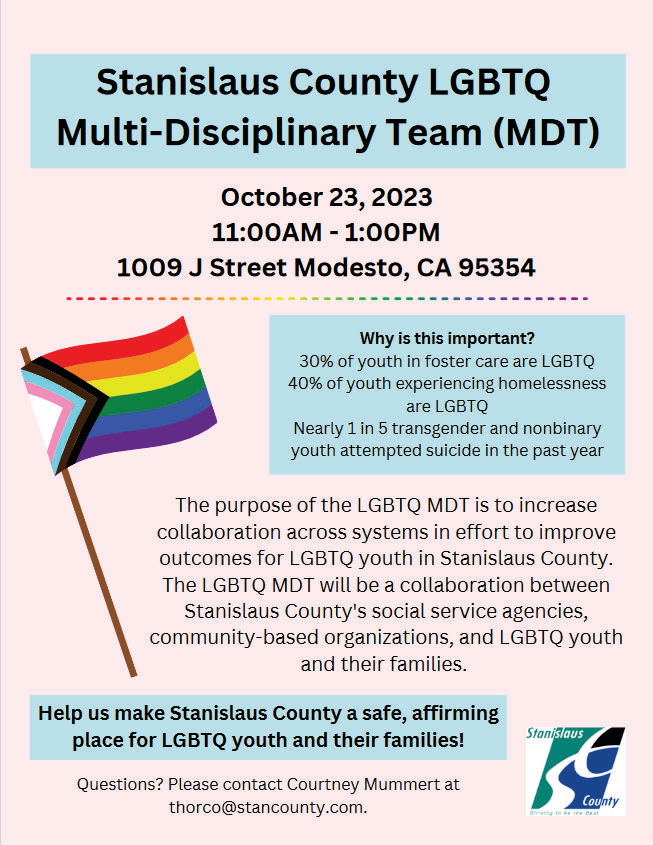
The fourth objective was met by raising awareness about the LGBTQ MDT. Stanislaus County Child and Family Services engaged in community outreach to inform the broader community about the formation of a LGBTQ MDT. Several emails were sent to existing community partners with an informational flyer detailing the need for a LGBTQ MDT (Appendix A). When the first LGBTQ MDT meeting was scheduled, an additional flyer was sent to these community partners to inform them about the inaugural meeting. Furthermore, I shared the flyer on my personal social media accounts. Given my numerous personal and professional connections within the LGBTQ community in Stanislaus County across various social media platforms, this ensured wider visibility.
The fifth objective was met by officially launching the LGBTQ MDT. The first LGBTQ MDT meeting took place in October 2023 and has been held monthly since then. The goal is for the LGBTQ MDT to continue indefinitely, aiming to secure financial resources for its long-term sustainability. I have facilitated the LGBTQ MDT as a representative for Stanislaus County Child and Family Services. I create the monthly agenda, take notes during the meeting, consolidate the notes into meeting minutes, and distribute the minutes to the LGBTQ MDT participants. Over time, the role of facilitation and note taking may rotate between community agencies to foster collaboration. The LGBTQ MDT meetings are held in person at the Aspiranet ILP Center in downtown Modesto with a hybrid option available for those who are not available to meet in person. In the future, the location of the LGBTQ MDT meetings may also rotate between the offices of partner agencies, which will further nurture community collaboration and partnership.
The LGBTQ MDT will be a collaborative team working across systems of care and communities to improve outcomes for LGBTQ youth in Stanislaus County. To best serve this purpose, the input and feedback of all participants is imperative to the direction and success of the LGBTQ MDT. The initial meetings of the LGBTQ MDT have been dedicated to building relationships and collectively identifying the mission and vision of the LGBTQ MDT. This has provided several opportunities to solicit feedback from participants regarding the usefulness, direction, and activities of the LGBTQ MDT. Over time, Stanislaus County Child and Family Services will also solicit regular feedback from partner agencies, youth, and families regarding the LGBTQ MDT.
Discussion
Establishing a LGBTQ Multidisciplinary Team (MDT) in Stanislaus County has been an equally empowering and challenging experience. As a member of the LGBTQ community, the LGBTQ MDT has been a powerful environment that is teeming with ideas, energy, passion, and commitment. This has served as an important reminder that many others are committed to making Stanislaus County a safe, equitable, affirming environment for LGBTQ youth and the broader LGBTQ community. This process has also challenged me in several ways. System change is slow, arduous work, and there are few models from which to base the LGBTQ MDT. However, I am continuously reminded of the power of community, and the Stanislaus County LGBTQ MDT will continue to collectively define and build our work together.
Project Experience
Stanislaus County LGBTQ Multidisciplinary Team (MDT) Meeting Outcomes
The LGBTQ Multidisciplinary Team (MDT) held its inaugural meeting on October 23, 2023 (Appendix B). There were nine participants from agencies including Stanislaus County Child and Family Services, MoPride, Central California LGBTQ Collaborative, Dependency Legal Services, The Gap LGBTQ Youth Group, Center for Human Services Youth Navigation Center, and California Youth Connection. The objectives of the first meeting were to introduce the LGBTQ MDT and its purpose and begin collaborative discussions about LGBTQ youth disparities in Stanislaus County. This was achieved by facilitating an interactive activity that asked participants to explore the following questions through individual reflection and open discussion:
- What unique challenges do LGBTQ youth face in our community, and how can we address them?
- What resources or support networks are currently lacking for LGBTQ youth in our community, and how can we fill these gaps?
- How can we engage and involve LGBTQ youth in decision-making processes that affect their lives?
- What data and research are available on LGBTQ youth disparities in our community, and what gaps in knowledge do we need to address?
- What initiatives or programs have been successful in other communities for supporting LGBTQ youth?
This activity opened a dialogue about pressing issues facing LGBTQ youth in Stanislaus County and provided key topics for future discussions and meetings.
The second LGBTQ MDT meeting was held on November 27, 2023 (Appendix C). Eight individuals participated in this meeting from agencies including Stanislaus County Child and Family Services, The Gap LGBTQ Youth Group, MoPride, Center for Human Services Youth Navigation Center, MoPride, California Youth Connection, and Aspiranet Independent Living Program (ILP). The objectives of the second meeting were to review insights gained from the first meeting and to continue collaborative discussions about LGBTQ youth disparities in Stanislaus County. During this meeting, participants brainstormed additional community partners who should be invited to participate in the LGBTQ MDT. Participants also reflected about how the LGBTQ MDT could be beneficial to their respective agencies. Finally, using insights gained from the first meeting’s activity, the LGBTQ MDT identified seven focus areas for continued discussion including: safety, healthcare, funding, community connections/support, identifying/bolstering community resources, housing, and system accountability/policy development.
The third LGBTQ MDT meeting was held on January 22, 2024 (Appendix D). There were eight participants from agencies including Stanislaus County Child and Family Services, MoPride, Aspiranet ILP, The Gap LGBTQ Youth Group, The Place, and California Youth Connection. The objectives of the third meeting were to review progress made during the first two LGBTQ MDT meetings and to begin discussions about the mission and vision of the LGBTQ MDT. Participants reviewed the seven focus areas identified during the second meeting and added education and training. During this meeting, participants spoke extensively about how to involve LGBTQ youth in the LGBTQ MDT. It was determined that the LGBTQ MDT would conduct a needs assessment to gather input from LGBTQ youth in Stanislaus County. This needs assessment would aim to collect information about the experiences and needs of LGBTQ youth and to gather their opinions regarding the future direction of the LGBTQ MDT.
The fourth LGBTQ MDT meeting was held on February 26, 2024 (Appendix E). Thirteen individuals participated from agencies including Stanislaus County Child and Family Services, The Gap LGBTQ Youth Group, MoPride, Elite Family Systems, Aspiranet ILP, California Youth Connection, Rainbow Resource Center, and Central Valley Gender Health and Wellness. The objectives of the fourth meeting were to continue discussing the needs assessment and to resume discussions about the mission and vision of the LGBTQ MDT. Participants discussed the goal of distributing a needs assessment and highlighted the importance of LGBTQ youth involvement and feedback. Participants also revisited the topic of initiating a collective mission and vision process. It was determined that the LGBTQ MDT should establish a unified mission and vision before embarking on any collaborative community projects.
The fifth LGBTQ MDT meeting was held on March 25, 2024 (Appendix F). There were seven participants from agencies including Stanislaus County Child and Family Services, The Gap LGBTQ Youth Group, California Youth Connection, and the Rainbow Resource Center. The objective of the fifth meeting was to begin a collaborative mission and vision process. This was achieved by facilitating an interactive activity that asked participants to explore the following questions through individual reflection and open discussion:
- What core values do you believe are crucial for an LGBTQ MDT focused on youth?
- How would you like to see Stanislaus County LGBTQ youth’s lives improved in the next year? Five years? Ten years?
- How can the LGBTQ MDT be innovative in addressing the unique needs of LGBTQ youth?
- What positive impact do you envision the LGBTQ MDT having on the lives of LGBTQ youth?
- How will we measure the success of the LGBTQ MDT’s efforts in supporting LGBTQ youth?
Following this brainstorming session, participants proceeded to an activity where they filled in blanks to create mission and vision statements in a madlibs format. This generated multiple draft mission and vision statements to collaborate on during future LGBTQ MDT meetings.
Lessons Learned
This graduate project has served as an incredible learning opportunity, and I am immensely grateful to my numerous mentors and supporters for pushing me through self-doubt and imposter syndrome to fully realize the LGBTQ MDT. First, I learned that just because something does not already exist does not mean it should not exist at all. Establishing the LGBTQ MDT with few similar models to guide me was daunting; however, I relied on the literature, feedback from LGBTQ youth, and my personal and professional observations spanning the last 15 years. I also used the implementation of this project as an opportunity to connect with agencies and individuals attempting similar system change including Santa Clara County Child and Family Services, Los Angeles County Child and Family Services, Family Builders, and the Los Angeles LGBT Center, specifically the RISE program. I also learned that, although challenging, effecting system change for LGBTQ youth is possible. Stanislaus County Child and Family Services has implemented several initiatives in recent years with a goal of improving outcomes for LGBTQ youth in foster care, and I hope this work will continue on a broader scale with the formation of the LGBTQ MDT.
Recommendations for Future Program Development
In the future, I am determined to see the LGBTQ MDT implement a youth advisory board or similar youth-led initiative. It is imperative for LGBTQ youth to guide the direction and decision-making of the LGBTQ MDT. The youth advisory board could operate as a leadership program for LGBTQ youth, offering compensation for their feedback while also providing opportunities to develop leadership and advocacy skills with professional support. Further, I strongly advocate for securing fiscal support for the LGBTQ MDT, whether through Stanislaus County or alternative avenues such as grants. The LGBTQ MDT would have collaborative discretion over the use of this funding, which could include training initiatives and community events. Finally, the Stanislaus County LGBTQ MDT could serve as a model for other jurisdictions seeking to improve outcomes for LGBTQ youth across various systems. Efforts can be made to share the LGBTQ MDT’s successes and challenges at relevant conferences and with entities working to effect system change.
Implications
The success of this project has demonstrated the importance of cross-system collaboration to address the numerous adversities faced by LGBTQ youth in Stanislaus County. Mountz suggests that “investments should be made in community, agency, court, and school-based restorative and transformative justice programs that seek solutions outside of systems in order to build family, youth, and community” (2020, p. 194). The Stanislaus County LGBTQ MDT aims to do this by addressing systematic oppression in various systems including child welfare, juvenile justice, mental health, education, and healthcare. This collaboration also seeks to enhance local community resources, ultimately aiming to support LGBTQ youth and their families and divert them from systems of care like child welfare and juvenile justice. The Stanislaus County LGBTQ MDT will prioritize addressing and reducing disparities for system-involved LGBTQ youth with a long-term goal of creating a safe, affirming community for all LGBTQ people.
This project also demonstrated the social work values of service, social justice, dignity and worth of the person, importance of human relationships, integrity, and competence (NASW, n.d.). The Stanislaus County LGBTQ MDT was established in service to LGBTQ youth, is rooted in social justice, and centers the voices of the most marginalized LGBTQ youth in the county. It also leverages existing community relationships and highlights the importance of collaborative action taken in a professional, informed manner. It has been an immense honor to see the Stanislaus County LGBTQ MDT fully realized. The LGBTQ MDT participants continually inspire me with their unwavering passion, innovative ideas, and queer joy during our meetings. and I am eager to see the lasting change the LGBTQ MDT can make in Stanislaus County. My greatest hope is for Stanislaus County to become a place where LGBTQ youth can live safely, grow up, and thrive as their true selves without reservation or fear. Our collective work will not be done until this is true for every LGBTQ youth in Stanislaus County.
References
American Civil Liberties Union (ACLU). (2023). Mapping attacks on LGBTQ rights in U.S. state legislatures in 2023. https://www.aclu.org/legislative-attacks-on-lgbtq-rights-2023?state=
American Civil Liberties Union (ACLU). (2024). Mapping attacks on LGBTQ rights in U.S. state legislatures in 2024. https://www.aclu.org/legislative-attacks-on-lgbtq-rights-2024?state=&impact=#issues
Bidell, M., & Stepleman, L. M. (2017). An interdisciplinary approach to lesbian, gay, bisexual, and transgender clinical competence, professional training, and ethical care: Introduction to the special issue. Journal of Homosexuality, 64(10), 1305-1329. DOI: 10.1080/00918369.2017.1321360
Burdge, H., Licona, A. C., & Hyemingway, Z. T. (2014). LGBTQ youth of color: Discipline disparities, school push-out, and the school-to-prison pipeline. San Francisco, CA: Gay-Straight Alliance Network and Tucson, AZ: Crossroads Collaborative at the University of Arizona. https://gsanetwork.org/wp-content/uploads/2018/08/LGBTQ_brief_FINAL.pdf
Center for American Progress, Movement Advancement Project, & Youth First. (2017). Unjust: LGBTQ youth incarcerated in the juvenile justice system. Movement Advancement Project. lgbtq-incarcerated-youth.pdf (lgbtmap.org)
Craig. S. L., McInroy, L. B., Eaton, A. D. (2023). Building strengths-based and empowering continuums of care for LGBTQ+ youth. In M. P. Dentato (Ed.) Social work practice with the LGBTQ+ community: The intersection of history, health, mental health, and policy factors. (pp. 515-533). Oxford University Press.
Edmonds, C., & Hassan, A. (2024, March 2). What we know about the death of Nex Benedict in Oklahoma. The New York Times. https://www.nytimes.com/article/nex-benedict-oklahoma.html
Factora, J. (2024, February 26). Nex Benedict describes being “jumped” in school bathroom in new police bodycam footage. Them. https://www.them.us/story/nex-benedict-describes-being-jumped-school-bathroom-new-police-bodycam-footage
Goodman, J. D. (2024, March 2). Regulators to review death of Nex Benedict, a nonbinary student, in Oklahoma. The New York Times. https://www.nytimes.com/2024/03/01/us/oklahoma-student-nonbinary-investigation.html
Hurley, B. (2024, February 22). Nex Benedict: Everything we know about the non-binary student who died after bathroom ‘assault.’ The Independent. https://www.independent.co.uk/news/world/americas/nex-benedict-oklahoma-ossawa-non-binary-b2500209.html
Indiana University Bloomington Libraries (n.d.). Library Research Guides: Philosophy: Introduction to queer theory. https://guides.libraries.indiana.edu/c.php?g=995240&p=8361766
Irvine, A. (2018). Understanding sexual orientation, gender identity, and gender expression (SOGIE) data for Stanislaus County, CA. Ceres Policy Research. sogie.stanislaus.18july2018.1040am (njjn.org)
Kosciw, J. G., Clark, C. M., & Menard, L. (2022). The 2021 National School Climate Survey: The experiences of LGBTQ+ youth in our nation’s schools. New York: GLSEN. NSCS-2021-Full-Report.pdf (glsen.org)
Kraschel, K. L., Chen, A., Turban, J. L., & Cohen, I. G. (2022). Legislation restricting gender-affirming care for transgender youth: Politics eclipse healthcare. Cell Reports Medicine, 3(8), 100719. https://doi.org/10.1016/j.xcrm.2022.100719
LGBTQIA Resource Center Glossary. (2023). LGBTQIA Resource Center. University of California, Davis. https://lgbtqia.ucdavis.edu/educated/glossary
Martin, M., Down, L., & Erney, R. (2016). Out of the shadows: Supporting LGBTQ youth in child welfare through cross-system collaboration. Washington, DC: Center for the Study of Social Policy. https://cssp.org/wp-content/uploads/2018/08/Out-of-the-Shadows-Supporting-LGBTQ-youth-in-child-welfare-through-cross-system-collaboration-web.pdf
Martinez-Keel, N. (2022, May 26). Oklahoma’s Gov. Stitt signs bill restricting school bathrooms to birth sex, effective immediately. Oklahoman. https://www.oklahoman.com/story/news/education/2022/05/25/stitt-signs-oklahoma-bathroom-bill-restricting-transgender-school-access-birth-sex/9900609002/
McHardy, M. (2024, February 27). Republican state lawmaker slammed after referring to LGBTQ+ community as ‘filth.’ The Independent. https://www.the-independent.com/news/world/americas/us-politics/tom-woods-oklahoma-lgbt-nex-benedict-b2503412.html
Mountz, S., Capous-Desyllas, M., & Pourciau, E. (2018). ‘Because we’re fighting to be ourselves’: Voices from former foster youth who are transgender and gender expansive. Child Welfare, 96(1), 103–126. https://www.jstor.org/stable/48628037
Mountz, S. (2020). Remapping pipelines and pathways: Listening to queer and transgender youth of color’s trajectories through girls’ juvenile justice facilities. Affilia, 35(2), 177-199. https://doi-org.lib.proxy.csustan.edu/10.1177/0886109919880517
Murphy-Erby, Y., Christy-McMullin, K., Stauss, K., & Schriver, J. (2010). Multi-systems life course: A new practice perspective and its application in advanced practice with racial and ethnic populations. Journal of Human Behavior in the Social Environment, 20(5), 672-687.
National Association of Social Workers. (n.d.). NASW code of ethics. https://www.socialworkers.org/About/Ethics/Code-of-Ethics/Code-of-Ethics-English
National Children’s Advocacy Center. (2023). Multidisciplinary team. https://www.nationalcac.org/multidisciplinary-team/
Ramos, N., Barnert, E., & Bath, E. (2022). Addressing the mental health needs of LGBTQ youth in the juvenile justice system. Journal of the American Academy of Child and Adolescent Psychiatry, 61(2), 115–119. https://doi.org/10.1016/j.jaac.2021.06.014
Riedel, S. (2024a, February 23). Everything we know about the death of trans Oklahoma teen Nex Benedict. Them. https://www.them.us/story/nex-benedict-death-everything-we-know-nonbinary-oklahoma-teen
Riedel, S. (2024b, February 28). Nex Benedict: Police now say they haven’t ruled out fight as a factor in teen’s death. Them. https://www.them.us/story/nex-benedict-police-say-they-havent-ruled-out-fight-factor-death
Schriver, J. M. (2020). Human behavior and the social environment: Shifting paradigms in Essential Knowledge for Social Work Practice. Pearson Education, Inc.
Smallens, Y. (2022, May 24). Oklahoma’s bathroom ban will endanger transgender children. Human Rights Watch. https://www.hrw.org/news/2022/05/24/oklahomas-bathroom-ban-will-endanger-transgender-children
Snapp, S. D., Hoenig, J. M., Fields, A., & Russell, S. T. (2015). Messy, butch, and queer: LGBTQ youth and the school-to-prison pipeline. Journal of Adolescent Research, 30(1), 57-82. https://doi-org.lib.proxy.csustan.edu/10.1177/0743558414557625
Taberna, M., Gil Moncayo, F., Jané-Salas, E., Antonio, M., Arribas, L., Vilajosana, E., Peralvez Torres, E., & Mesía, R. (2020). The multidisciplinary team (MDT) approach and quality of care. Frontiers in Oncology, 10, 85. https://doi.org/10.3389/fonc.2020.00085
Trevor Project. (2023). 2023 U.S. national survey on the mental health of LGBTQ young people. https://www.thetrevorproject.org/survey-2023/assets/static/05_TREVOR05_2023survey.pdf
Wagaman, A. M. (2023). Practice with the queer+ community. In M. P. Dentato (Ed.) Social work practice with the LGBTQ+ community: The intersection of history, health, mental health, and policy factors. (pp. 477-496). Oxford University Press.
Westphaln, K. K., Manges, K. A., Regoeczi, W. C., Johnson, J., Ronis, S. D., & Spilsbury, J. C. (2022). Facilitators and barriers to children’s advocacy center-based multidisciplinary teamwork. Child Abuse & Neglect, 131, 105710–105710. https://doi.org/10.1016/j.chiabu.2022.105710
Youth.gov. (n.d.a) Behavioral health. https://youth.gov/youth-topics/lgbtq-youth/health-depression-and-suicide
Youth.gov. (n.d.b). Sexual orientation and gender identity. https://youth.gov/youth-topics/lgbt
Youth.gov. (n.d.c). Child welfare. https://youth.gov/youth-topics/lgbtq-youth/child-welfare
Youth.gov. (n.d.d). Juvenile justice. https://youth.gov/youth-topics/lgbtq-youth/juveni1e-justice
Appendices
Appendix A
LGBTQ Multidisciplinary Team (MDT) Meeting Flyer
Appendix B
LGBTQ Multidisciplinary Team (MDT) Meeting Agenda
10/23/2023
- Welcome!!
- Introductions/Community Agreements
- Background of LGBTQ MDT/LGBTQ Youth Disparities
- Open Discussion/Initial Brainstorming – Poster Activity
- Outline Meeting Expectations/Establish Roles
- Next Steps and Action Planning
- Resource Sharing/Networking
Notes:
Appendix C
LGBTQ Multidisciplinary Team (MDT) Meeting Agenda
11/27/2023
- Welcome!
- Introductions/Check-In
- Discussion:
- Who is missing from the LGBTQ MDT?
- How can we reach/engage those who should be at the table?
- How do you see your agency/organization utilizing the LGBTQ MDT? What activities/initiatives/regular discussions would be helpful?
- How can we centralize communication about LGBTQ MDT initiatives?
- Review 10/23/23 Activity & Identify Themes
- Next Steps and Action Planning
- Resource Sharing/Networking
Notes:
Appendix D
LGBTQ Multidisciplinary Team (MDT) Meeting Agenda
1/22/2024
- Welcome/Check-In
- Discussion: Community Safety Incident
- Brainstorm: Mission/Vision Process
- Next Steps and Action Planning
- Resource Sharing/Networking
Notes:
Appendix E
LGBTQ Multidisciplinary Team (MDT) Meeting Agenda
2/26/2024
- Welcome/Check-In
- Moment of Reflection: Nex Benedict
- Review working draft of LGBTQ Youth Needs Assessment
- Mission/Vision Discussion & Activity
- Next Steps and Action Planning
- Resource Sharing/Networking
Notes:
Appendix F
LGBTQ Multidisciplinary Team (MDT) Meeting Agenda
3/25/2024
- Welcome/Check-In
- Mission/Vision Poster Board Activity
- Mission/Vision Statement Madlibs Activity
- Next Steps and Action Planning
- Resource Sharing/Networking
Notes:
This HTML version was generated with AI assistance and may contain errors or omissions. The original approved PDF remains the official document of record. An alternative accessible format is available upon request from the document creator in accordance with Title II of the ADA.