Equitable Treatment of LGBTQ+ Youth in Foster Care: A Policy Analysis
Graduate Project
- Presentation is a summarization of my graduate project that was finalized at California State University, Fresno in May of 2023.
- Project is a policy analysis of two California Assembly Bills that effect LGBTQ+ foster youth.
- For the analysis, the McInnis-Dittrich model was used to analyze the strengths and weaknesses of the two policies and to make recommendations.
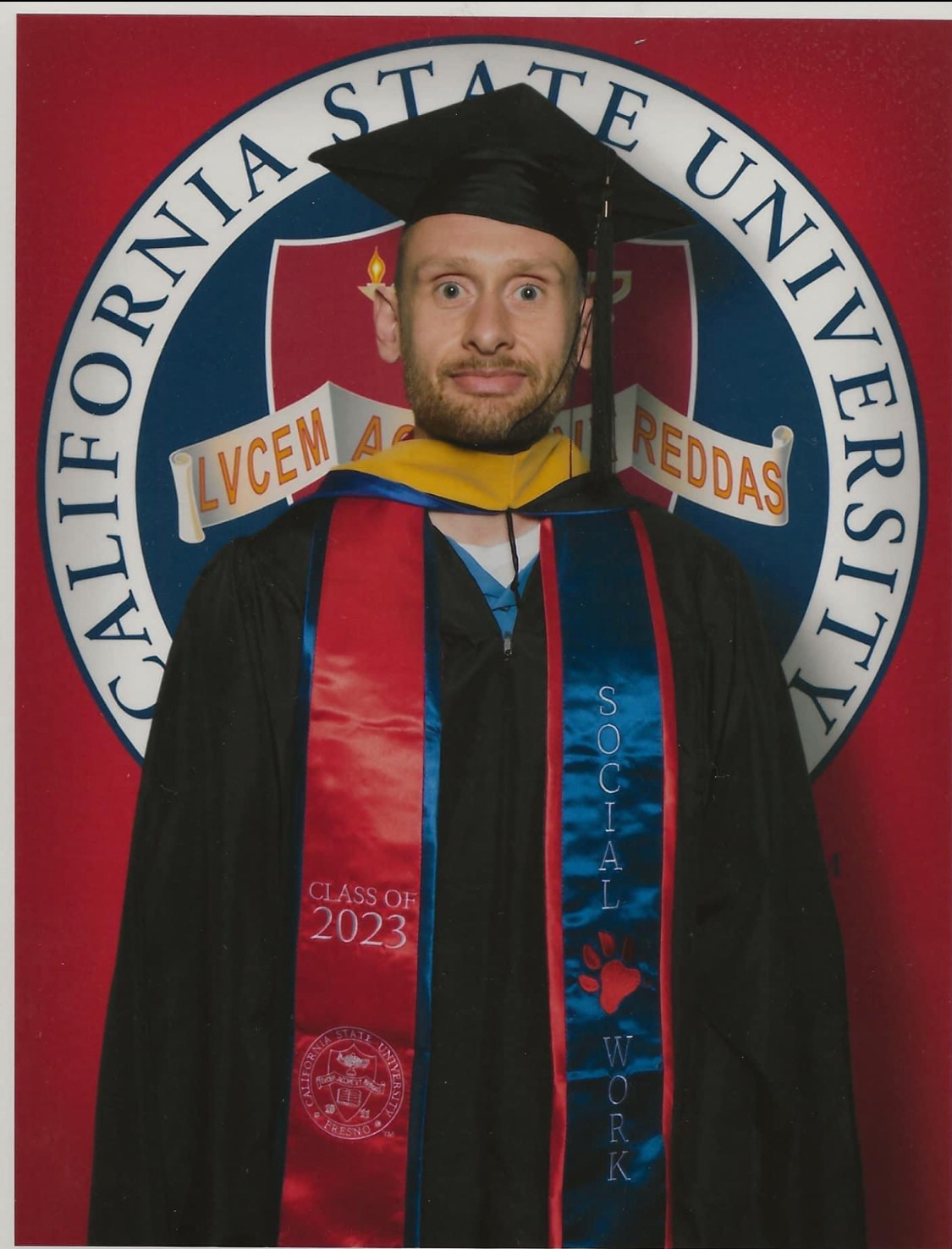
Who am I?
- I have been a Fresno County child welfare social worker for 9 years.
- I have worked in areas such Permanency Planning, Emergency Response, Assessment/Adoptions, Meeting Facilitation, and am currently a social worker for Intensive Services Foster Care (ISFC).
- I am a member of the SOGIE taskforce with Fresno County DSS.
- I have plans of eventually earning my hours to become a Licensed Clinical Social Worker (LCSW).
Vocabulary used in this presentation
- Bisexual: The term bisexual means a man or woman who is emotionally, romantically, and sexually attracted to both men and women.
- Gay: The term gay is used to mean a man or woman who is emotionally, romantically, and sexually attracted to the people of the same gender; some use the term only to identify gay men.
- Gender Identity: Gender identity means one’s inner sense of oneself as male or female.
- Gender Expression: Gender expression is the communication of one’s gender through behavior and appearance that is culturally associated with a particular gender.
- Lesbian: A lesbian is a woman who is emotionally, romantically, and sexually attracted to women.
Vocabulary used in this presentation cont.
- LGBTQ+: This is an acronym used to identify people who fall under the label of Lesbian, Gay, Bisexual, Transgender, or Queer/Questioning.
- Queer: Queer is an umbrella term for individuals who do not identify as heterosexual or cis-gender. Queer includes lesbian, gay, bisexual, transgender, pansexual, omnisexual, and identities that do not fall under dominant notions of sexuality and gender.
- Sexual Orientation: Sexual orientation is defined by whom a person is emotionally, romantically, and sexually attracted to. Sexual orientation is independent of gender identity.
- SOGIE: Acronym for Sexual Orientation, Gender Identity, and Expression.
- Transgender: Transgender is an umbrella term that describes people whose gender identity differs from expectations associated with the sex assigned to them at birth. Transgender people may be heterosexual, bisexual, gay, lesbian, or any other sexual orientation.
Why is this important?
- Knowing the number of LGBTQ+ youth in foster care is difficult because youth may not be forthcoming with the information due to past rejection.
- LGBTQ+ youth are overrepresented in foster care at a rate of 1.5 to two times that of the general population (Wilson & Kastanis, 2015).
- LGBTQ+ foster youth experience unique challenges that non-LGBTQ+ foster youth do not
experience or they experience them at a higher rate.
- Microaggressions, more frequent hospitalizations, double standards, more placement changes, negative academic outcomes, rejection from family members and caregivers.
- New care providers receive 12 hours of pre-service training through the Resource Family
Approval (RFA) process (CDSS, 2016).
- Pre-service trainings cover a multitude of topic, but only a small portion is related to SOGIE.
Why is this important? Local perspective - Fresno
- 2019 - The Human Rights Campaign (HRC) - Fresno ranked 55 out of 100 (4th lowest in
California).
- Fresno lacks protections for gender identity expression
- No human rights commission
- No LGBTQ liaison to city hall or the police department
- Lacks leadership on LGBTQ issues (Sheeler & Sheehan, 2019).
- 2015 - Study in Fresno and Santa Barbara
- Lack of LGBTQ+ community resources in Fresno
- Care provider’s religious beliefs interfered with their willingness to accept LGBTQ+ youth
- Social workers felt that they only had “basic” training on LGBTQ+ issues (Center for the Study of Social Policy, 2015).
Challenges Experienced by LGBTQ+ Foster Youth
- Overrepresented in the child welfare system (Dettlaff, et al., 2018).
- Rejection while in care had negative results (Mountz & Capous-Desyllas, 2020).
- More placement changes
- Lack of connection to LGBTQ+ community
- General feeling that they are unequipped to begin their adult lives
- Double standards while in care (Woronoff & Estrada, 2006).
- Overrepresented in the homeless population and more likely than heterosexual youth to engage in high risk behavior (Ecker, 2016).
Efforts to Decrease Disparities of LGBTQ Youth
Data Collection
- Youth in foster care may be reluctant to provide their SOGIE data for a multitude of reasons (Center for the Study of Social Policy, 2015).
- Child welfare agencies need to be collecting SOGIE data for the youth they serve to know the prevalence and outcomes of LGBTQ+ youth in the system (Dettlaff, et al., 2018).
Efforts to Decrease Disparities of LGBTQ Youth cont.
Affirming Behaviors are needed
- Real need for foster parents who embody affirming behaviors (Mountz & Capous-Desyllas, 2020).
- Open to new things, open to new ideas, and respected the youth’s difference (McCormick,
Schmidt, & Terrazas, 2016).
- Youth can look past shortcomings if care providers can accept their sexual orientation
- Providing education to caregivers on the effects that rejection has on a youth has previously been effective in helping caregivers change their behaviors (Ryan et al., 2009).
Family Acceptance Project (FAP)
- Training model developed to help care providers and families develop accepting behaviors.
- FAP helps families decrease rejecting behaviors and increase accepting behaviors.
- FAP utilizes a strengths-based approach that accessed families’ own cultural and religious values.
- (Ryan, 2019)
Recognize, Intervene, Support, and Empower (RISE)
- Training to combat anti-gay, anti-transgender, and heteronormative biases. (Weeks, et al., 2018).
- Helps address anti-gay and anti-transgender bias at the systems/organizational and individual levels, barriers to permanency, and absence of evidence-based practices targeting heterosexism and anti-transgender bias (Lorthridge, et al., 2017).
- Help public and child welfare agencies become more welcoming and competent while servicing LGBTQ+ youth in care (Weeks, at al., 2018).
- Defines competency as having knowledge of LGBTQ+ issues, using affirmative language, and being able to identify and address biased statement (Weeks, at al., 2016).
Efforts to Decrease Disparities of LGBTQ Youth cont.
- Qualitative interviews with LGBTQ+ youth provides insight (Mountz, Capous-Desyllas,
& Perez, 2019).
- Youth felt more comfortable when placed with LGBTQ+ care providers or providers that had affirming behaviors.
- There is a need for agencies to increase efforts to recruit foster parents who are LGBTQ+ or have affirming behaviors.
- There is a need for more recruitment of LGBTQ+ therapists, as many LGBTQ+ youth only want to speak to a therapist that understands their identity and/or orientation.
- Child welfare agencies should do more extensive screenings of foster parents to see if they exhibit LGBTQ+ affirming behaviors.
Policy Analysis
- Two Policies were analyzed using the McInnis-Dittrich model
- The California Foster Care Non-Discrimination Act (AB 458)
- The LGBT Disparities Reduction Act (AB 959)
- McInnis Dittrich model uses an acronym of “ANALYSIS” to analyze policies (Cabral,
2013)
- Approach
- Need
- Assessment
- Logic
- Your Reaction
- Support
- Innovation
- Social Justice
Approach - The California Foster Care Non-Discrimination Act (AB 458)
- Prohibits discrimination in the California Foster Care System on basis of actual of sex, sexual orientation, gender identity, etc. (National Center for lesbian rights, n.d.).
- The law mandates:
- Specific trainings are provided to care providers.
- All youth who are experiencing foster care have right to be free from discrimination
- All care providers are to receive initial and ongoing training regarding foster youth’s rights to have fair and equal access to services and to be free from discrimination based on perceived sexual orientation or gender identity
Approach – The LGBT Disparities Reduction Act (AB 959)
- Mandates that human services agencies collect SOGIE data during regular data collection
(Chiu, n.d.)
- Highlights disparities in populations.
- Previously has been a lack of data collection regarding LGBTQ+ community in child welfare systems.
- All County Letters (ACL’s) provide instructions to child welfare departments
Need – Why are these policies needed?
 The California Foster Care Non-Discrimination Act |
 The LGBT Disparities Reduction Act |
|---|---|
|
|
Assessment - Strengths
| The California Foster Care Non-Discrimination Act | The LGBT Disparities Reduction Act |
|---|---|
|
Strengths
|
Strengths
|
Assessment - Weaknesses
 The California Foster Care Non-Discrimination Act |
 The LGBT Disparities Reduction Act |
|---|---|
|
Weaknesses
|
Weaknesses
|
Logic – Connection Between Need & Policy
| The California Foster Care Non-Discrimination Act | The LGBT Disparities Reduction Act |
|---|---|
|
|
Your Reaction – Author’s reaction
| The California Foster Care Non-Discrimination Act | The LGBT Disparities Reduction Act |
|---|---|
|
|
Support – Financial Support
- This policy analysis does not go into deep analysis regarding funding.
Innovation – Provisions to implement policy
| The California Foster Care Non-Discrimination Act | The LGBT Disparities Reduction Act |
|---|---|
|
|
Social Justice – Are these policies just?
Social Justice policies focus on “issues of poverty, unemployment, discrimination” and should “promote knowledge about oppression and cultural and ethnic diversity” (NASW, n.d.).
| The California Foster Care Non-Discrimination Act | The LGBT Disparities Reduction Act |
|---|---|
|
|
Thank You!
Thank you CCASSC for this Student Stipend opportunity!
Any Questions?
Brandon Simons, MSW
simonba@fresnocountyca.gov
golfingman12@mail.fresnostate.edu
559-600-6647 (Desk)
559-974-8895 (Cell)
References
- Cabral, J. (2012). Health information portability and accountability act of 1996: An analysis of its implication using an adapted model. Perspectives on Social Work: 2012. https://hdl.handle.net/10657/5209.
- California Department of Social Services. (2016, February 17). All County Letter NO. 16-10. https://cdss.ca.gov/lettersnotices/entres/getinfo/acl/2016/16-10.pdf.
- Center for the Study of Social Policy & the University of Houston Graduate College of Social Work (2015). Final report to the Walter S. Johnson foundation: Get recognize.engage.affirm.love. Retrieved from https://cssp.org/wp-content/uploads/2018/08/Santa-Clara-Fresno-Report-1.pdf.
- Chiu, D. (n.d.). AB 959 – The LGBT disparities reduction act. Equality California. https://www.eqca.org/wp-content/uploads/AB-959-Chiu-EQCA-Fact-Sheet.pdf.
- Dettlaff, A. J., Washburn, M., Carr, L., C., & Vogel, A. N. (2018). Lesbian, gay, and bisexual (LGB) youth within in welfare: Prevalence, risk and outcomes. Child Abuse & Neglect. 80, 183-193. https://doi.org/10.1016/j.chiabu.2018.03.009.
- Ecker. (2016). Queer, young, and homeless: A review of the literature. Child & Youth Services, 37(4), 325–361. https://doi.org/10.1080/0145935X.2016.1151781.
- Lorthridge, E. M., Heaton, L., Stevens, A., & Phillips, L. (2017). Strengthening family connections and support for youth in foster care who identify as LGBTQ: Findings from the PII-RISE evaluation. (Permanency Innovations Initiative and Recognize, Intervene, Support, Empower interventions). Child Welfare, 96(1), 53.
References cont.
- McCormick, A., Schmidt, K., & Terrazas, S. R. (2016). Foster family acceptance: Understanding the role of foster family acceptance in the lives of LGBTQ youth. Children and Youth Services Review, 61, 69-74.
- Mountz, S., Capous-Desyllas, M., & Perez, N. (2019). Speaking back to the system: Recommendations for practice and policy from the perspectives of youth formerly in foster care who are LGBTQ. Child Welfare, 97(5), 117–140.
- Mountz, S., Capous-Desyllas, M., & Sevillano, L. (2020). Educational trajectories of youth formerly in foster care who are LGBTQ: Before, during, and after emancipation. Child Welfare, 97(6), 77–99.
- National Center for Lesbian Rights. (n.d.). AB 458 fact sheet: The California foster care non-discrimination act. https://www.nclrights.org/get-help/resource/ab-458-fact-sheet-the-california-foster-care-non-discrimination-act/.
- Ryan, C. (2019, October 7). 20.1 The family acceptance project’s model for LGBTQ youth. Journal of the American Academy of Child $ Adolescent Psychiatry, 58(10), S28-S29. Retrieved from https://www-sciencedirect-com.hmlproxy.lib.csufresno.edu/science/article/pii/S089085671930588X.
References cont.
- Ryan, C., Huebner, D., Diaz, R.M., & Sanchez, J. (2009). Family rejection as a predictor of negative health outcomes in white and Latino lesbian, gay, and bisexual young adults. Pediatrics, 123(1), 346-352.
- Sheeler, A. & Sheehan, T. (2019, November 19). Fresno’s LGBTQ-friendliness is lacking, new report from human rights campaign says. The Fresno Bee. https://www.fresnobee.com/news/local/article237550149.html.
- Weeks, A., Altman, D., Stevens, A., Lorthridge, J., & Heaton, L. (2018). Strengthening the workforce to support youth in foster care who identify as LGBTQ+ through increasing LGBTQ+ competency: Trainers’ experience with bias. Child Welfare, 96(2), 125–150.
- Wilson, B. D. M., & Kastanis, A. A. (2015). Sexual and gender minority disproportionality and disparities in child welfare: A population-based study. Children and Youth Services Review, 58, 11-17.
- Woronoff, & Estrada, R. (2006). Regional listening forums: An examination of the methodologies used by the Child Welfare League of America and Lambda Legal to highlight the experiences of LGBTQ youth in care. Child Welfare, 85(2), 341–360.
This HTML version was generated with AI assistance and may contain errors or omissions. The original approved PDF remains the official document of record. An alternative accessible format is available upon request from the document creator in accordance with Title II of the ADA.