Longevity for San Joaquin Valley Elders: San Joaquin County
Background and Implications
As for seniors everywhere, socio-economic and demographic characteristics of those in the San Joaquin Valley are linked to longevity. Individual and neighborhood characteristics combine to produce disparities in health that accumulate over a lifetime. On a community level, race/ethnicity often serves as a proxy measure of many social determinants of health, such as access to healthcare, to fresh produce and good air quality. This report examines premature mortality prior to age 65 as well as years of life lost after 65 within San Joaquin County (SJC) compared to the state.
Summary of Findings
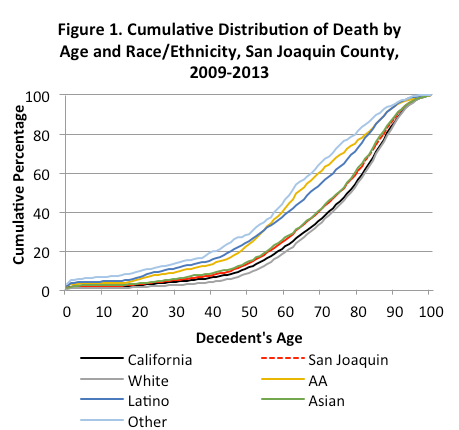
Figure 1 illustrates all deaths (total of 23,833) in SJC between 2009 and 2013. Compared to California, SJC experiences greater premature loss of life. In SJC, 32% of deaths were prior to age 65 as compared to 28% for the state. There are also notable racial/ethnic differences in premature mortality within SJC. While 25% (below state average) of White and 32% of Asian deaths occurred prior to age 65 years, African Americans and Latinos experience higher than average premature mortality at 51%, and 45%, respectively. Fifty-eight percent of Native American, Hawaiian/Pacific Islander, biracial, and self-identified other racial/ethnic groups combined also experience high premature death.
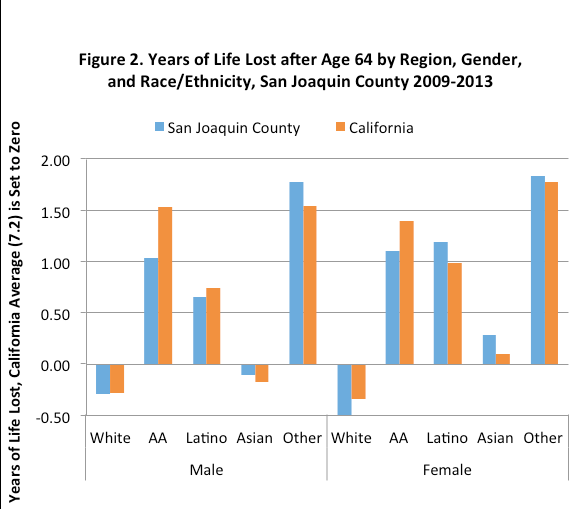
Figure 2 illustrates years of life lost after the age of 64 in the SJC senior population in relation to California’s age- and gender-specific life expectancy. This graph provides insight into which racial/ethnic groups, on average, are not living as long as expected. African-Americans and those in the “other” category are disproportionately affected at the state level and within SJC. In contrast, Whites and Asian males are living longer than expected throughout the state.
San Joaquin County Public Health Services
1601 E. Hazelton Ave., Stockton, CA 95205
(209) 468-3411 • www.sjcphs.org
SAN JOAQUIN VALLEY PUBLIC HEALTH CONSORTIUM
www.sjvphc.org
September 2016
How Does Public Health Help Promote and Protect Elder Health?
San Joaquin County Public Health Services (PHS) staff offer support to families and work with community partners to create and promote policies and systems to improve opportunities for all elderly to be healthier. PHS operates the following programs that aim to prevent disease or mitigate its impact in elders and promote their health and well-being.
Chronic disease prevention
Lifetime of Wellness, funded by the U.S. Centers for Disease Control and Prevention (CDC), is a four-year project that focuses on 15 intersecting strategies to prevent diabetes, heart disease, and stroke. Senior and adult residents who are at elevated risk for these chronic diseases are the target audience for the proven effective interventions.
Physical activity and transportation
PHS partners with senior advocacy and service organizations to educate and encourage county and city public works and planning departments to address senior concerns with the built environment (e.g., to fund infrastructure improvements that will make it safer and easier for seniors to walk in their neighborhoods and/or to use public transit).
Health care
PHS partner health care organizations offer better access to primary medical and mental health care services to senior residents because of the federal Affordable Care Act.
Recommendations to improve opportunities for better elder health
There are many areas on which PHS and partners can collaborate to promote and protect elder health and well-being and improve longevity. These require improving the upstream social environments and policies that impact personal and public health. For example, regarding food security, some health care providers inquire with their patients or their families about access to adequate food and connect them to resources when needed. They, and most service providers, can similarly inquire at client encounters about their housing adequacy and connect them to resources. Efforts by partners to improve education for all, and particularly high-school graduation of everyone, will have significant long-term public health improvements into old-age.
Nutrition
Get Fresh provides senior and adult nutrition education workshops at local community centers, most of which are located in older neighborhoods whose disadvantaged and under-resourced residents suffer from preventable diseases and health disparities. Workshops include food demonstrations, sharing of recipes, and other activities to help seniors learn economical ways to achieve a healthier diet (e.g., more fruits and vegetables, and alternatives to sugary drinks and desserts).
San Joaquin County Public Health Services
1601 E. Hazelton Ave., Stockton, CA 95205
(209) 468-3411 • www.sjcphs.org
SAN JOAQUIN VALLEY PUBLIC HEALTH CONSORTIUM
www.sjvphc.org
September 2016
This HTML version was generated with AI assistance and may contain errors or omissions. The original approved PDF remains the official document of record. An alternative accessible format is available upon request from the document creator in accordance with Title II of the ADA.