Asking Inclusive Demographic Questions: Training Video Discussion Guide
Video Discussion Guide: Asking Inclusive Demographic Questions
Objective:
Supervisors and Facilitators can use APSWI’s APS Training Video: Asking Inclusive Demographic Questions with staff to support fulfilling the mandates of AB959 by gathering sexual orientation and gender identity (SOGI) information for those who APS works with and practice cultural responsiveness. No matter how experienced your staff are, they are likely to have questions or concerns around embedding this practice into their daily work. As their supervisor (or facilitator), you can help them incorporate this material and better understand the subject matter.
How to Use:
This video discussion guide first provides information and suggestions to help you get ready to support your staff asking questions about someone’s sexual orientation and gender identity. It then provides questions to use with staff designed to guide learning associated with the video.
There is also a section on frequently asked questions which can be facilitated through dialogue or as team activity. Use with APS units, training participants, or individuals either during or after the viewing of the APSWI Training Video: Asking Inclusive Demographic Questions.
When facilitating, be mindful that while normalizing the inclusion of SOGI questions in APS practice is the goal, there are a variety of issues that may present barriers to this. Examples include language barriers or cultural reference points that inhibit someone’s understanding of the questions being asked. While we may not be able to address every potential cultural or language difference that might arise, it is important to maintain culturally responsiveness while working to follow mandates.
Content Warning:
We recognize that APS work is both challenging and rewarding and APS professionals are whole human beings who have their own experiences before and during APS work. Content and discussion in these activities may activate feelings based on personal or professional experiences, including vicarious trauma. Staff, Supervisors and Facilitators are encouraged everyone to do what they need to do in order to safely engage in these discussions.
Getting Started:
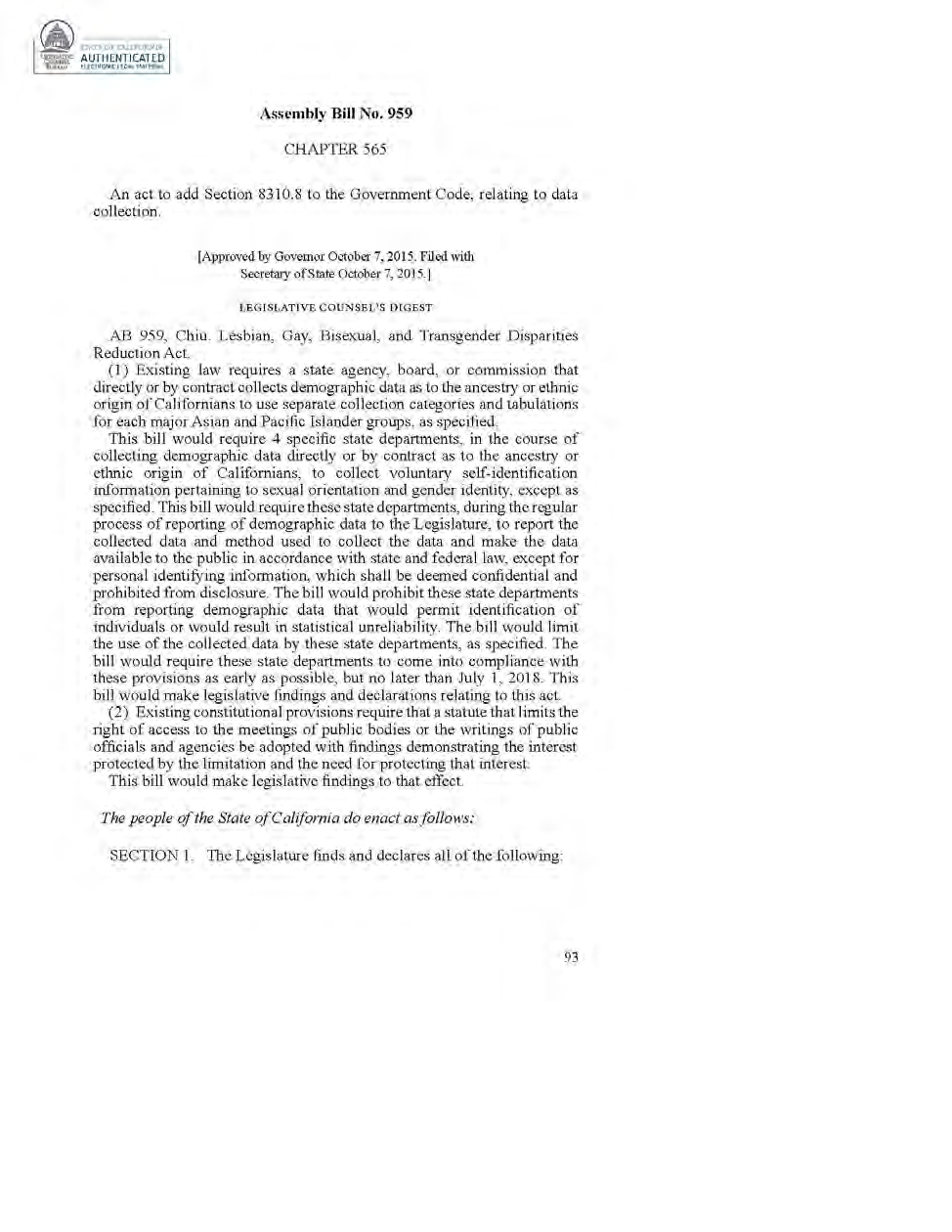
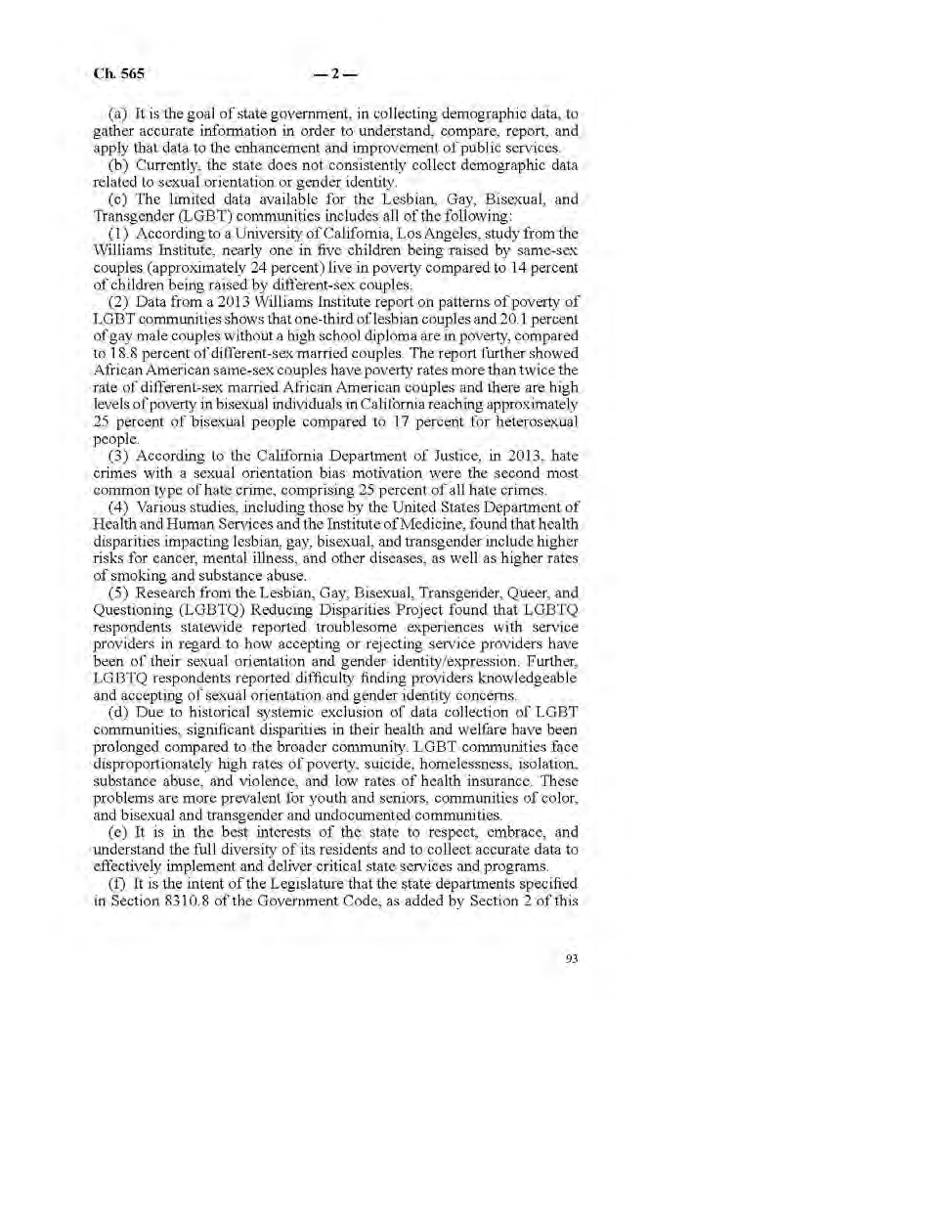
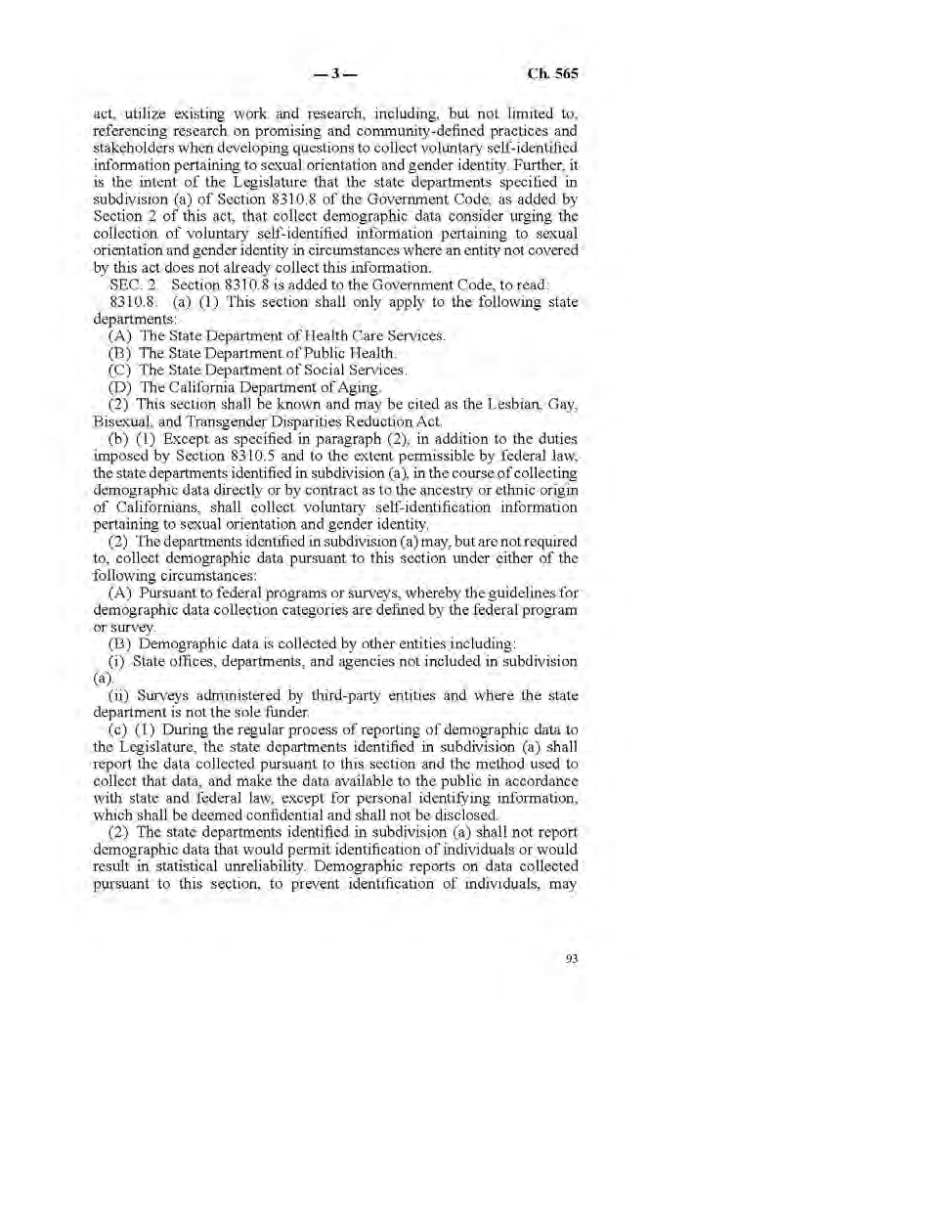
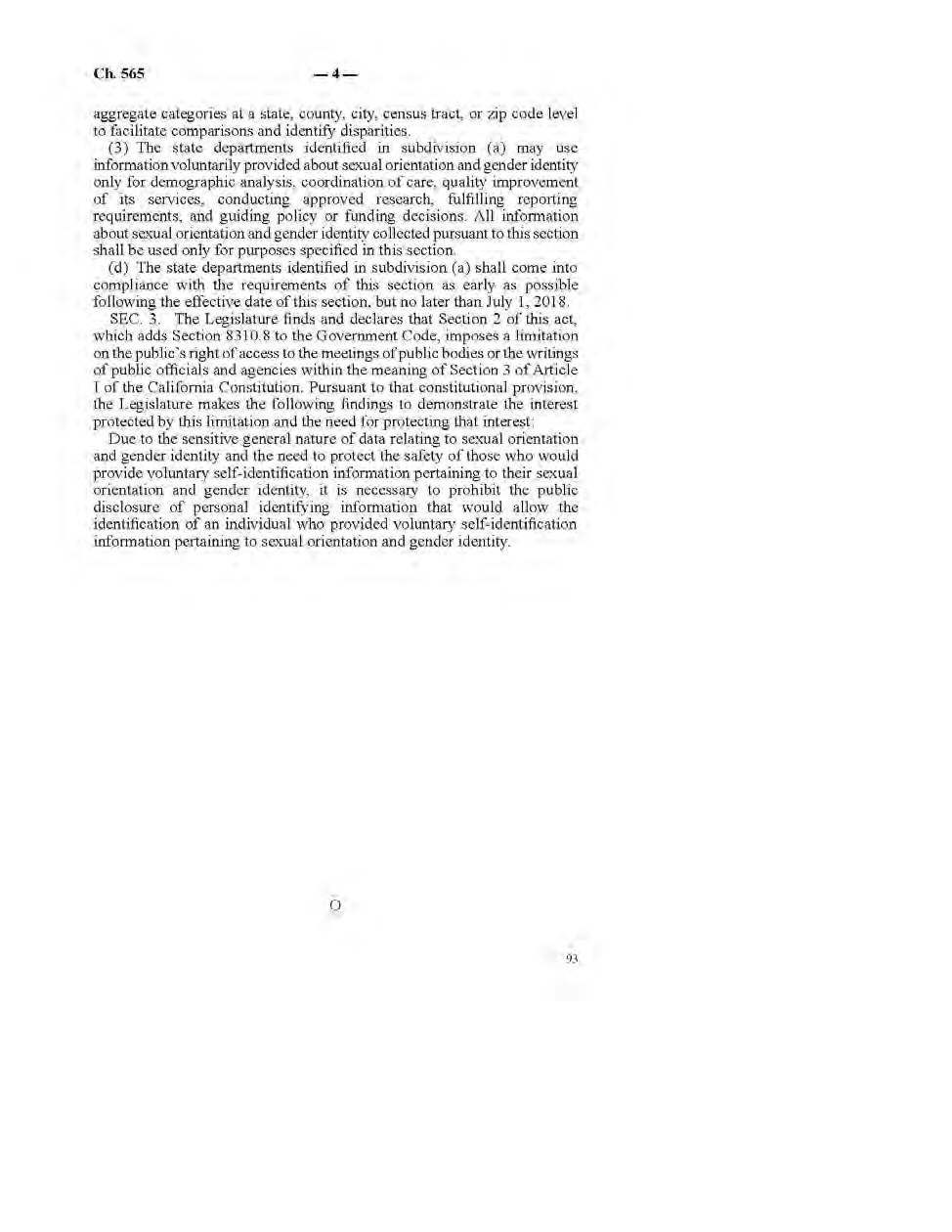
- Familiarize yourself with AB 959 (document attached in Appendix)
- Reflect the importance of capturing accurate demographic information for those served by APS and encourage strong interview skills with your team. This can be demonstrated through your supervisor’s review of APS case documentation. Ensure your agency has a document review policy and procedure in place to verify that accurate SOGI information is collected and entered into your APS case management system. The SOC 242 and You: What you Need to Know eLearning provides additional information on collecting demographic information.
- Know and share what you know about the effects of implicit bias, ageism and ableism
- Implicit bias can be better understood by watching this short video Implicit Bias | Concepts Unwrapped - Bing video. Implicit bias is often unconscious and involves assumptions or prejudice we don’t explicitly realize that we hold. APS professionals who automatically assume that an APS client is heterosexual and cisgender may be operating from a place of implicit bias.
- Ageism is prejudice or discrimination that is based on assumptions about age. Ageism may include unconscious assumptions or beliefs that perpetuate stereotypes about older adults. APS professionals who don’t think that older adults will understand SOGI questions may be acting on ageist beliefs. APS professionals who presume that their client will become uncomfortable, hostile, or angry when SOGI is explored may also be working from a perspective filled with ageism and implicit bias.
- Ableism presents as social prejudice against persons with disabilities or persons who are perceived to have disabilities; and through a tendency to define persons by their disability. When APS professionals neglect to incorporate SOGI information in the social history interviews for clients with disabilities, they may be unconsciously enacting ableist ideals around romantic and sexual lives of individuals with disabilities.
Discussion Questions
Watch this 10:45 minute video portraying an APS professional conducting an initial home visit with an APS client. You may pause the video at the indicated minute markers to consider the questions below. You may also choose to watch the video in its entirely, then discuss the items below.
Choose any or all of the following questions to discuss. Timestamps are provided for quick reference or play back:
- What are your overall reflections on the video? What went well, and what seemed uncomfortable?
- The APS professional confirms that the client’s dog, Teddy, is his companion. Discuss how this portion of the conversation may have gone differently if the APS professional didn’t ask clarifying questions. (2:30)
- The APS professional first presents the client with a general overview of the purpose of visit (concerns with caregiver). She then begins her interview by collecting client demographics. Discuss the potential risks and benefits to starting the interview this way. (2:58)
- The APS professional seemed comfortable with her choice of phrasing to explain the intention behind collecting demographics. However, she acknowledges that it was ‘a lot of information’ which seemed apparent in the client’s confusion. How might you choose to re-phrase the APS professional’s statements to provide a less overwhelming introduction? (4:08)
- The APS professional repeats that the client has the right to not answer any demographic questions a couple of times. How does this mirror messaging you provide to APS clients regarding their right to self-determination? What do you find helpful in conveying this succinctly and clearly, and how will you apply these principles to SOGI questions? (5:00)
- The APS professional starts with date of birth, age, and race/ethnicity before asking about gender identity. It seems they felt this will ‘ease into it’. What are your thoughts about this? (6:10)
- The APS professional shows the client her printed list of race and ethnicity demographic options while also reading them out loud. When do you find using printed aides helpful in APS interviews? Would you feel comfortable structing your interview in this way?
- The client asks the APS professional to define non-binary. Reflect on a time when an APS client asked you questions to clarify your interview questions. Did you have difficulty explaining the purpose or scope of a line of questioning? How did you navigate this, and what did you learn from that experience? What happens when someone’s native language doesn’t have the same terminology used on APS forms? (7:22)
- The client mentions that asking about sexual orientation seems a bit personal. How might you respond if a client seems offended, or responds negatively? (7:39)
- The APS professional explains that asking about Oscar’s sexuality is “more than checking a box” and will help with their case planning. Elaborate on why it matters how Oscar replies to this question. How might his response direct the APS professional’s next steps or follow up questions? (8:23)
- As the APS professional transitions to discussing the reported abuse/neglect on the referral, it appears that the client already feels comfortable with her, and is forthcoming about his caregiver. Discuss how the APS professional’s demographics collection served to build rapport. (9:24)
Supervisor Guide-Frequently Asked Questions
It matters because no matter how hard we try to treat people ‘the same’, there will always be differences in people’s experiences, perceptions, and access to services. Being culturally responsive is the “ability to learn from and relate respectfully with people of our own cultures as well as those from others” (NCCREST, 2008). Inherent personal and confirmation bias, as well as our own lived experiences and group cohort effects, leads us to consider the differences between us and others. By failing to recognize and celebrate these differences, we miss opportunities to celebrate strengths. Even worse, we risk acting out unconscious bias that might negatively affect others.
Here are a few sentence starters that are tried and true by APS professionals doing exactly the work you are doing:
- Next, I’ve got some personal questions that you don’t have to answer, but I do have to ask. It’s okay to say pass.
- I’d like to make sure my records are accurate. Can you tell me a few things about yourself?
- Ok, now it’s the time where I ask some additional but important questions- I hope you don’t mind.
- Some people may find these next questions to be intrusive, but I’m required to ask this of everyone I meet with
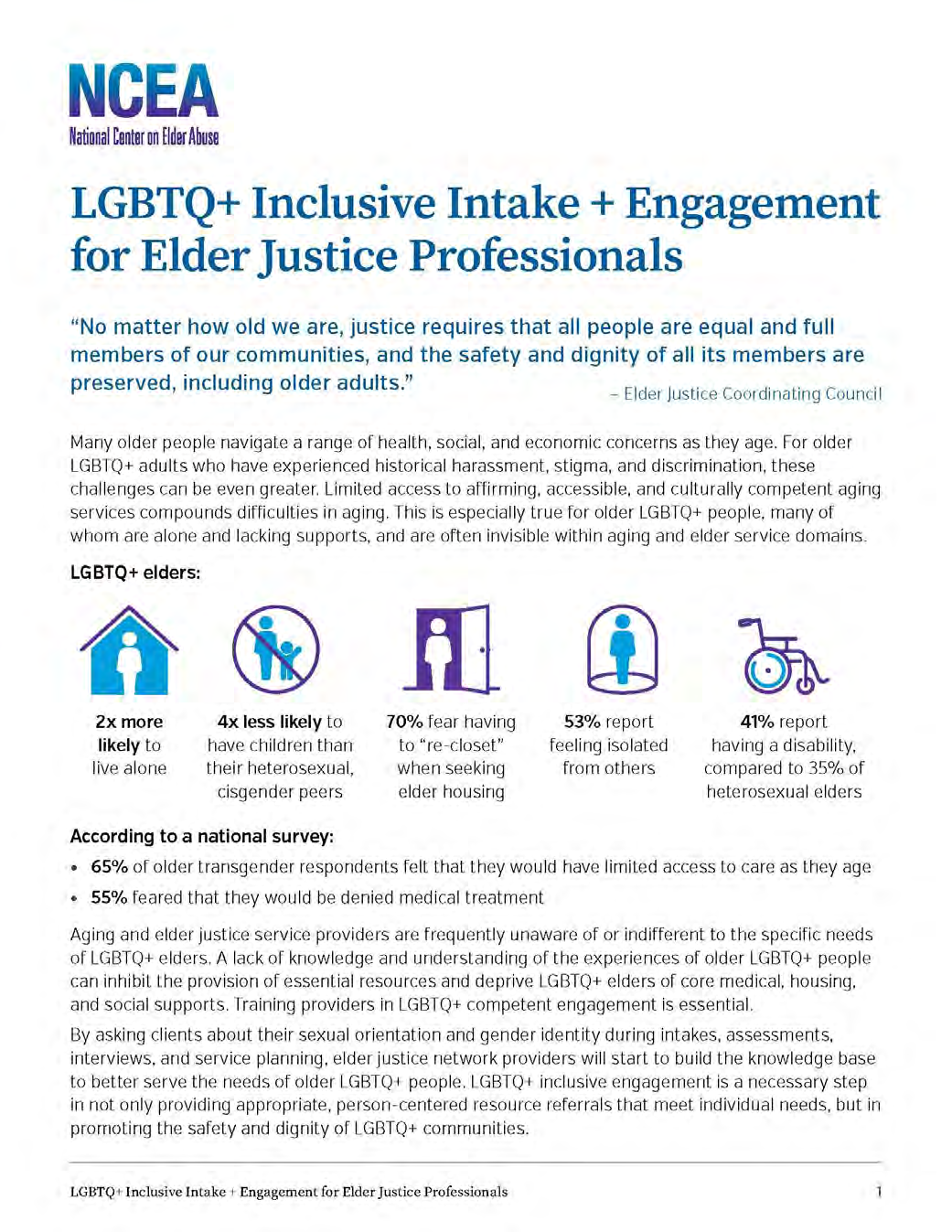
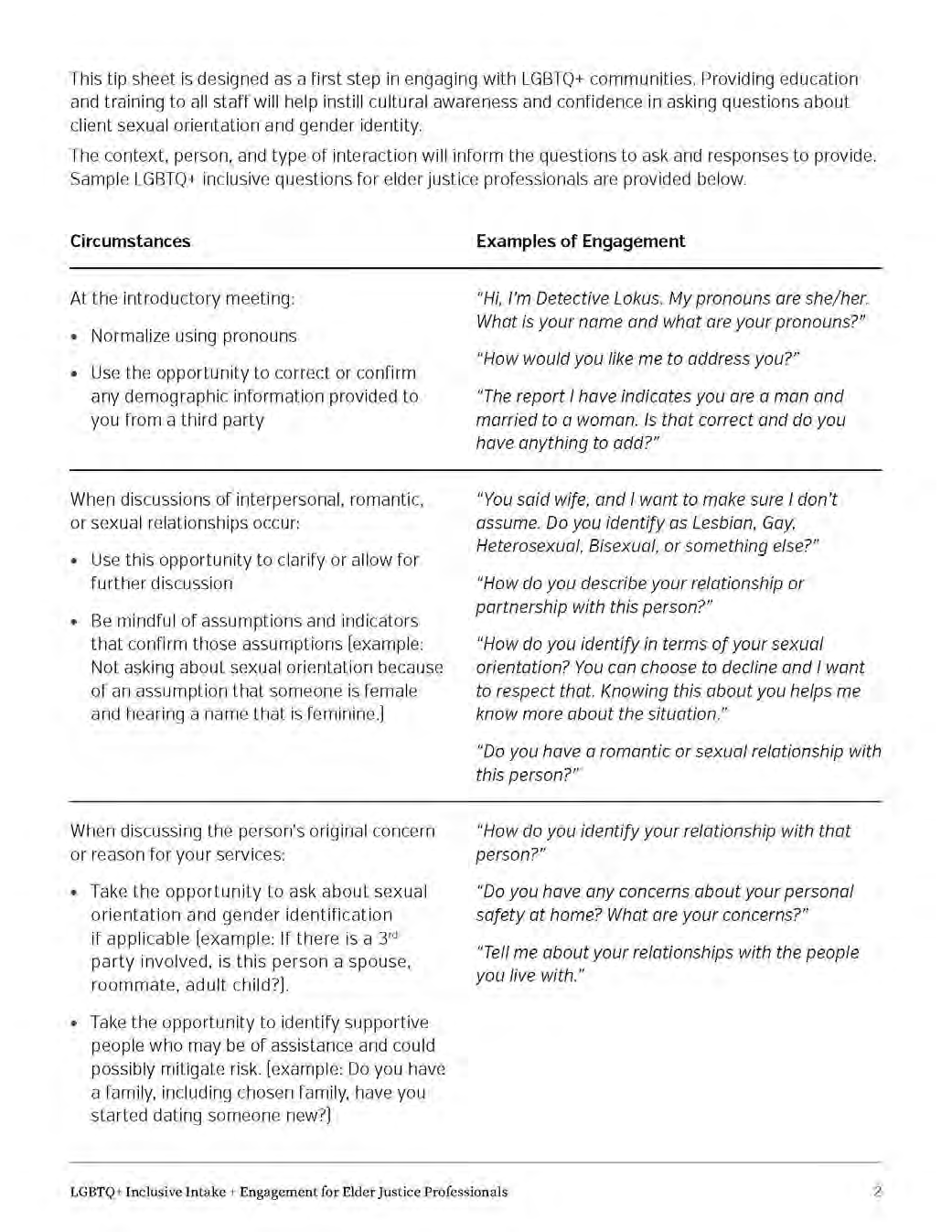
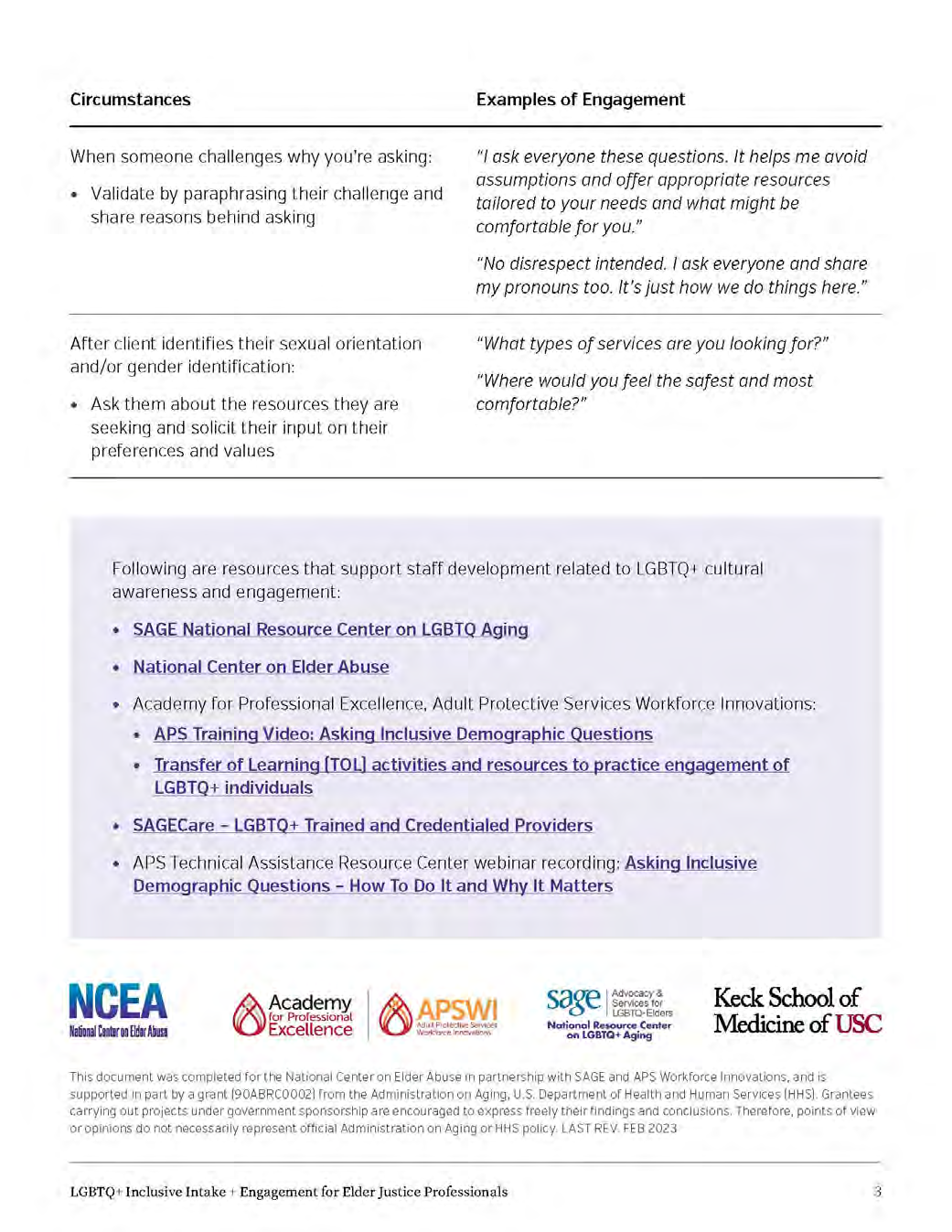
- Review any of the examples from the NCEA LGBTQ+ Inclusive Intake and Engagement for Elder Justice Professionals Tip Sheet for more ideas.
The practical value is similar to the practical value in all of our interview skills: APS professionals strive to engage in rapport building and information gathering in every APS interaction. We try to gather as much evidence as we can, and we build as rich of a picture as possible about the clients we serve, when conducting an APS risk assessment.
There’s further practical value for those APS interacts with who’ve had stigmatizing experiences explicitly related to their gender identity or sexual orientation, and who lacked strong advocates such as an APS professional. Real life examples include Mary Walsh and Bev Nance, a married couple who were denied a shared unit in a senior apartment setting because of their relationship; Lawrence and Alexandre who were separated when Alexandre went into assisted living facility and Lawrence was denied visiting rights; and countless LGBTQ+ individuals who were denied survivor’s benefits because their relationships weren’t validated by federal law. APS professionals advocate for social justice, but we can’t advocate for the invisible.
No, in fact, just the opposite. By getting to know your client better, you are developing a richer assessment and allowing for greater rapport. APS identifies people who are important in client’s lives and this can assist with finding out more about their social support as well as possible caregivers, thus lowering potential risk for abuse, neglect and exploitation.
That would be great! Consider that SOGI questions could open conversation doors that would be otherwise stay closed. Initiating this conversation may uncover something that your APS client has questions about but wasn’t sure how to ask. Suppose an APS client you are working with is the grandparent of LGBTQ+ youth and wants to better understand their grandchild. Suppose an APS client you are working with wants to discuss something they’ve heard in recent media coverage. It’s likely that they haven’t felt they were in a comfortable place to discuss these topics until you open the door. And don’t worry- if you don’t have the answer to a question your client asks, it’s always okay to say so. Just like you would with any APS resource question, work alongside your client to find the answers together. Part of being culturally responsive is that we accept we don’t have all of the answers and instead can learn from and with the people we interact with.
That’s fair. Phrases, acronyms, and symbols for the LGBTQ+ community have evolved over time and continue to do so. It can be confusing and overwhelming, even for those who identify as members of the community. Give yourself a break and remember that positive intentions can be felt. The people you work with may not remember what you said, or even how you said it, but they will always remember how you made them feel.
Here’s a tip- consider what each of the letters in LGBTQ means and say them out loud to yourself: Lesbian, Gay, Bisexual, Transgender, Queer, Questioning. Alphabet soup is more meaningful when we understand and acknowledge each of the ingredients.
Actually, no, it’s not inappropriate. Consider how this frame of mind conveys a sense of ageism. Layered in with our implicit bias is an implicit ageism that is present when we assume older adults won’t be comfortable talking about sexual orientation and gender identity. Working under such an assumption isn’t fair and is often inaccurate. While not everyone’s word choice and acronym-awareness may not be up to speed, APS clients’ lived experiences are worth asking about and play a meaningful part in their sense of self. Historical trauma may add to someone not being comfortable to openly share about their sexual orientation and gender identity. APS can recognize this and use their soft-skills to decrease anxiety around answering these questions.
It is always possible that any efforts made to interview an APS client could be negatively received by the client. Whether we are asking the client about their financial situation, caregiving needs, functional abilities, or their demographic information, an APS client may become upset at the perceived intrusion. As an APS professional, you’ve developed rapport building and interviewing soft-skills that you display throughout your home visits. You may have also been trained in field worker safety. As in other situations where clients may be offended or become angry, be attentive to signs of agitation, aggression, or any indication that the home visit is no longer a safe environment to conduct your interview and end the visit when necessary.
At no point during SOGI information gathering should APS professionals be asking the client to discuss or describe their sexual activity. That would be very inappropriate. Discussing sexual orientation is not the same as discussing sex practices. Sexual orientation refers to whom the person is romantically attracted to. The APS professional is only being asked to determine whether an APS client identifies as straight, gay, bisexual, questioning, or something else.
This may be an option, depending on the client and how the interview is going. For example, sometimes APS clients who are hard of hearing or need more time to process information benefit from handwritten notes to share information or ask questions. However, as a general rule, this is not likely the most effective way to discuss SOGI with your APS clients. Checklists may stifle conversation and discourage the APS client from asking questions if they wish to discuss the subject further.
Like any new practice, it takes time to form a habit. What are some other examples of information you make sure gets asked at every home visit? Examples might be confirming client’s DOB, names and contact for adult children, information for the client’s PCP. If you have gotten into the habit of asking for this information at every home visit, you can also get into the habit of asking SOGI information. Here are some tips:
- Add SOGI questions to your printed interview sheet if you carry one- highlight them before you go to the home visit
- Remember that you can follow up with the client by phone if you forget to ask something at the home visit
- Ask that your supervisor to send risk assessments back to you if they are missing the SOGI information
This will depend on the flow of your interview and rapport built with your client, as well as the specific abuse type being investigated. If you have a comfortable and easy rapport early in the interview, you may prefer to address SOGI questions early on. If this is your first time meeting the client, or rapport is a little slower, it may be best to wait until the end of your visit. Each contact is different, and you will use your social work intuition and soft skills to determine the most comfortable time to introduce these questions.
- The APSWI Including Sexual Orientation and Gender Identity Questions in APS Practice eLearning provides some scenarios around this exact question.
- The NCEA LGBTQ+ Inclusive Intake and Engagement for Elder Justice Professionals Tip Sheet provides opportunities of when to ask as well.
Team Activity- Frequently Asked Questions
This activity uses the Frequently Asked Questions (FAQ) from the Supervisors Guide, but allows learning and discussion to occur amongst colleagues and peers. It is designed for an in-person meeting or training.
Instructions:
- Materials:
- Print and cut out the FAQ questions from the grid below.
- Print and cut out the FAQ answers from the grid below.
- Fold the answers in half, then attach them to the unfolded respective question with a paperclip.
- Set-up:
- Separate staff into smaller groups of two or three.
- Give each small group one question with the folded answer attached.
- Ask the group to designate one Asker, one Answerer, and one Observer (if a group of 3).
- Timing:
- Provide the groups with 5-7 minutes to complete asking and answering their question.
- Let the groups know that the Answerer should respond as they feel appropriate but may use the folded answer attached to their question if they get stuck.
- Bring the group back together and debrief
- Debriefing questions:
- Would anyone like to share their group discussion?
- Was anyone surprised by their question, or their answer?
Activity Questions
| Activity Questions | Activity Questions |
|---|---|
| Q.: I don’t understand why this even matters. Shouldn’t we just treat all people the same? | Q.: How do I even start with these questions? |
| Q.: Does collecting SOGI information even have real life value? I’m tired of having to do things just because it’s the county way when I’ve got real work to do. | Q.: Won’t trying to focus on SOGI take time and attention from the real issues we are there for? |
| Q.: What if these questions lead to other subjects or questions that I’m not ready for? | Q.: This alphabet soup stuff just feels so complicated. I’m always so anxious that I’ll mess something up that I don’t even want to try. |
| Q.: Isn’t it just inappropriate to ask older adults about sexual orientation and gender identity? It’s not like this is stuff something older adults are going to be comfortable talking about. | Q.: What if my client gets offended, or is angry when I ask these questions? |
| Q.: I don’t feel comfortable talking about sexual activity with my clients. My beliefs don’t allow me to talk about intimate subjects outside of my own relationship. | Q.: In the video the APS professional shows the client her paper and asks him to read several options for race and ethnicity. Should I just give my APS client a SOGI checklist to fill out themselves? |
| Q.: I get this is something we have to do, I just can’t seem to remember to complete SOGI every time I’m meeting an APS client. How can I get more consistent? | Q.: Should I ask the SOGI questions first, last, or in the middle of the interview? |
Activity Answers
| Question and Answer |
|---|
|
Q.: I don’t understand why this even matters. Shouldn’t we just treat all people the same? A.: It matters because no matter how hard we try to treat people ‘the same’, there will always be differences in people’s experiences, perceptions, and access to services. Being culturally responsive is the “ability to learn from and relate respectfully with people of our own cultures as well as those from others” (NCCREST, 2008). Inherent personal and confirmation bias, as well as our own lived experiences and group cohort effects, leads us to consider the differences between us and others. By failing to recognize and celebrate these differences, we miss opportunities to celebrate strengths. Even worse, we risk acting out unconscious bias that might negatively affect others. |
|
Q.: How do I even start with these questions? A.: Here are a few sentence starters that are tried and true by APS professionals doing exactly the work you are doing:
|
|
Q.: Won’t trying to focus on SOGI take time and attention from the real issues we are there for? A.: No, in fact, just the opposite. By getting to know your client better, you are developing a richer assessment and allowing for greater rapport. APS identifies people who are important in client’s lives and this can assist with finding out more about their social support as well as possible caregivers, thus lowering potential risk for abuse, neglect and exploitation. |
|
Q.: Does collecting SOGI information even have real life value? I’m tired of having to do things just because it’s the county way when I’ve got real work to do. A.: The practical value is similar to the practical value in all of our interview skills: APS professionals strive to engage in rapport building and information gathering in every APS interaction. We try to gather as much evidence as we can, and we build as rich of a picture as possible about the clients we serve, when conducting an APS risk assessment. There’s further practical value for those APS interacts with who’ve had stigmatizing experiences explicitly related to their gender identity or sexual orientation, and who lacked strong advocates such as an APS professional. Real life examples include Mary Walsh and Bev Nance, a married couple who were denied a shared unit in a senior apartment setting because of their relationship; Lawrence and Alexandre who were separated when Alexandre went into assisted living facility and Lawrence was denied visiting rights; and countless LGBTQ+ individuals who were denied survivor’s benefits because their relationships weren’t validated by federal law. APS professionals advocate for social justice, but we can’t advocate for the invisible. |
|
Q.: What if these questions lead to other subjects or questions that I’m not ready for? A.: That would be great! Consider that SOGI questions could open conversation doors that would be otherwise stay closed. Initiating this conversation may uncover something that your APS client has questions about but wasn’t sure how to ask. Suppose an APS client you are working with is the grandparent of LGBTQ+ youth and wants to better understand their grandchild. Suppose an APS client you are working with wants to discuss something they’ve heard in recent media coverage. It’s likely that they haven’t felt they were in a comfortable place to discuss these topics until you open the door. And don’t worry- if you don’t have the answer to a question your client asks, it’s always okay to say so. Just like you would with any APS resource question, work alongside your client to find the answers together. |
|
Q.: This alphabet soup stuff just feels so complicated. I’m always so anxious that I’ll mess something up that I don’t even want to try. A.: That’s fair. Phrases, acronyms, and symbols for the LGBTQ+ community have evolved over time and continue to do so. It can be confusing and overwhelming, even for those who identify as members of the community. Give yourself a break and remember that positive intentions can be felt. The people you work with may not remember what you said, or even how you said it, but they will always remember how you made them feel. Here’s a tip- consider what each of the letters in LGBTQ means and say them out loud to yourself: Lesbian, Gay, Bisexual, Transgender, Queer, Questioning. Alphabet soup is more meaningful when we understand and acknowledge each of the ingredients. |
|
Q.: Isn’t it just inappropriate to ask older adults about sexual orientation and gender identity? It’s not like this is stuff something older adults are going to be comfortable talking about. A.: Actually, no, it’s not inappropriate. Consider how this frame of mind conveys a sense of ageism. Layered in with our implicit bias is an implicit ageism that is present when we assume older adults won’t be comfortable talking about sexual orientation and gender identity. Working under such an assumption isn’t fair and is often inaccurate. While not everyone’s word choice and acronym-awareness may not be up to speed, APS clients’ lived experiences are worth asking about and play a meaningful part in their sense of self. Historical trauma may add to someone not being comfortable to openly share about their sexual orientation and gender identity. APS can recognize this and use their soft-skills to decrease anxiety around answering these questions. |
|
Q.: What if my client gets offended, or is angry when I ask these questions? A.: It is always possible that any efforts made to interview an APS client could be negatively received by the client. Whether we are asking the client about their financial situation, caregiving needs, functional abilities, or their demographic information, an APS client may become upset at the perceived intrusion. As an APS professional, you’ve developed rapport building and interviewing soft-skills that you display throughout your home visits. You may have also been trained in field worker safety. As in other situations where clients may be offended or become angry, be attentive to signs of agitation, aggression, or any indication that the home visit is no longer a safe environment to conduct your interview and end the visit when necessary. |
|
Q.: I don’t feel comfortable talking about sexual activity with my clients. My beliefs don’t allow me to talk about intimate subjects outside of my own relationship. A.: At no point during SOGI information gathering should APS professionals be asking the client to discuss or describe their sexual activity. That would be very inappropriate. Discussing sexual orientation is not the same as discussing sex practices. Sexual orientation refers to whom the person is romantically attracted to. The APS professional is only being asked to determine whether an APS client identifies as straight, gay, bisexual, questioning, or something else. |
|
Q.: In the video the APS professional shows the client her paper and asks him to read several options for race and ethnicity. Should I just give my APS client a SOGI checklist to fill out themselves? A.: This may be an option, depending on the client and how the interview is going. For example, sometimes APS clients who are hard of hearing or need more time to process information benefit from handwritten notes to share information or ask questions. However, as a general rule, this is not likely the most effective way to discuss SOGI with your APS clients. Checklists may stifle conversation and discourage the APS client from asking questions if they wish to discuss the subject further. |
|
Q.: I get this is something we have to do, I just can’t seem to remember to complete SOGI every time I’m meeting an APS client. How can I get more consistent? A.: Like any new practice, it takes time to form a habit. What are some other examples of information you make sure gets asked at every home visit? Examples might be confirming client’s DOB, names and contact for adult children, information for the client’s PCP. If you have gotten into the habit of asking for this information at every home visit, you can also get into the habit of asking SOGI information. Here are some tips:
|
|
Q.: Should I ask the SOGI questions first, last, or in the middle of the interview? A.: This will depend on the flow of your interview and rapport built with your client, as well as the specific abuse type being investigated. If you have a comfortable and easy rapport early in the interview, you may prefer to address SOGI questions early on. If this is your first time meeting the client, or rapport is a little slower, it may be best to wait until the end of your visit. Each contact is different, and you will use your social work intuition and soft skills to determine the most comfortable time to introduce these questions.
|
References and Additional Resources
The following were used to inform this TOL and/or provide staff with additional resources to explore.
Academy for Professional Excellence (Producer). (2022). Including Sexual Orientation and Gender Identification Questions in APS Practice [eLearning]. Retrieved from https://theacademy.sdsu.edu/programs/apswi/advanced-training/incorporating-sexual-orientation-and-gender-identification-questions-in-aps-practice/.
Ehrenfeld, J., Gamble, R., Huggins, A., Taylor, S.(2019) Trans-specific Geriatric Health Assessment (TGHA): An Inclusive clinical guideline for the geriatric transgender patient in a primary care setting. Elsevier-Maturitas 132, 70-75. Retrieved from https://www.maturitas.org/article/S0378-5122(19)30996-X/pdf.
Lade, D. (2012). Nursing homes can push gay seniors back into the closet. Milwaukee Journal Sentinel. Retrieved from https://archive.jsonline.com/news/health/nursing-homes-can-push-gay-seniors-back-into-the-closet-556fjfe-166774376.html/
Lesbian, Gay, Bisexual, and Transgender Disparities Reduction Act. (2015-2016). California Legislative Information. Retrieved from https://leginfo.legislature.ca.gov/faces/billCompareClient.xhtml?bill_id=201520160AB959&showamends=false.
National Center for Culturally Responsive Educational Systems (2008). Module 5: Culturally responsive literacy. Facilitator’s manual. Arizona, Arizona State University.
National Center on Elder Abuse, Academy for Professional Excellence, SAGE National Resource Center (2023). LGBTQ+ Inclusive Intake + Engagement for Elder Justice Professionals. Retrieved from https://lgbtagingcenter.org/resources/resource.cfm?r=2148.
National Center for Lesbian Rights (2020). Walsh v. Friendship Village of South County, Case & Advocacy. Retrieved from https://www.nclrights.org/our-work/cases/walsh-v-friendship-village-of-south-county/
National Resource Center on LGBTQ+ Aging (2011). Lawrence Discusses Caregiving [video clip]. Gen Silent. Retrieved from https://www.lgbtagingcenter.org/resources/resource.cfm?r=14
Appendix
Assembly Bill No. 959
The following pages reproduce the attached Assembly Bill No. 959, Chapter 565.
Assembly Bill No. 959, continued
LGBTQ+ Inclusive Intake + Engagement for Elder Justice Professionals
Our Why: Revolutionize the way people work to ensure the world is a healthier place
theacademy.sdsu.edu
6505 Alvarado Road, Suite 107; San Diego, CA 92120 (619) 594-3546
Developed by Whitney Barnes, MSW
With input from the CA APS Curriculum Advisory Committee, April 2023. Contact apstraining@sdsu.edu for any questions for feedback
© 2023. San Diego State University School of Social Work, Academy for Professional Excellence. Please acknowledge this copyright in all non-commercial uses and attribute credit to the developer and those organizations that sponsored the development of these materials. No commercial reproduction allowed.
The Academy for Professional Excellence is a project of the San Diego State University School of Social Work
This HTML version was generated with AI assistance and may contain errors or omissions. The original approved PDF remains the official document of record. An alternative accessible format is available upon request from the document creator in accordance with Title II of the ADA.