Does the implementation of a sexual health tool during a well-woman exam increase the diagnosis of sexual dysfunction?
Christine Kelly
Title: DNPc, MSN, BSN
California State University, Fresno
Doctor of Nursing Practice Program
Acknowledgements
- Dr. Lynn Jakobs, project chair
- Dr. Asawari Khadye OBGYN, mentor/committee member
- Dr. Nisha Nair committee member
- Marineh Ventresca, FNP
- My husband and kids
- My family and friends
- My DNP cohort
Purpose of the project
-
Use of a standard screening tool for sexual health during well-woman exams
- Will it increase the diagnosis of sexual dysfunction
- Low impact on the current workflow for clinicians
Introduction
- What is sexual health?
- What organizations are there?
- When should it be evaluated?
Background
- Studies show that 18 to 44.8% of women report some sexual dysfunction during their lifetime (Briken et al., 2020; Faubion & Rullo, 2015).
- These rates are thought to be low as sexual dysfunction is under-reported.
- Patients fail to bring up sexual issues unless asked by their provider or the concern is severe
Problem
- Sexual dysfunction can lead to decreased overall health.
- Even after advised by experts, clinicians often do not complete a comprehensive sexual health history.
- There is no standardization to sexual health screening
Theoretical Framework

-
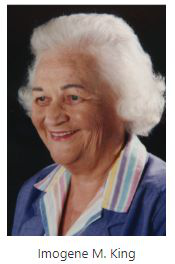
Theory of goal attainment
- founded by Imogene King
- Focusing on the development of the nurse-patient relationship to meet healthcare goals
-
The theory has 3 interacting systems
- Personal
- Interpersonal
- Social
Review of the literature

Identification:
- Tounkel et. al (2022) compare different screening tools
- Rosen et al (2000) developed and tested an assessment tool (FSFI) that is widely accepted to identify women at risk for sexual dysfunction
- Development of FSFI6 from Isidori et. al (2010)
- Newer studies focus on using the abbreviated FSFI-6 tool (Briken et. al 2020)
Barriers & Recommendations:
- A comprehensive sexual health history is advised (ACOG, ISSWISH, WHO)
-
Barriers:
- Time constraints
- Lack of knowledge
Treatment options for dysfunction:
- Oral/vaginal medication
- Physical therapy
- Behavioral therapy
Methods

- Type: Quantitative Quality Improvement (QI) project
- Research design: Correlational research
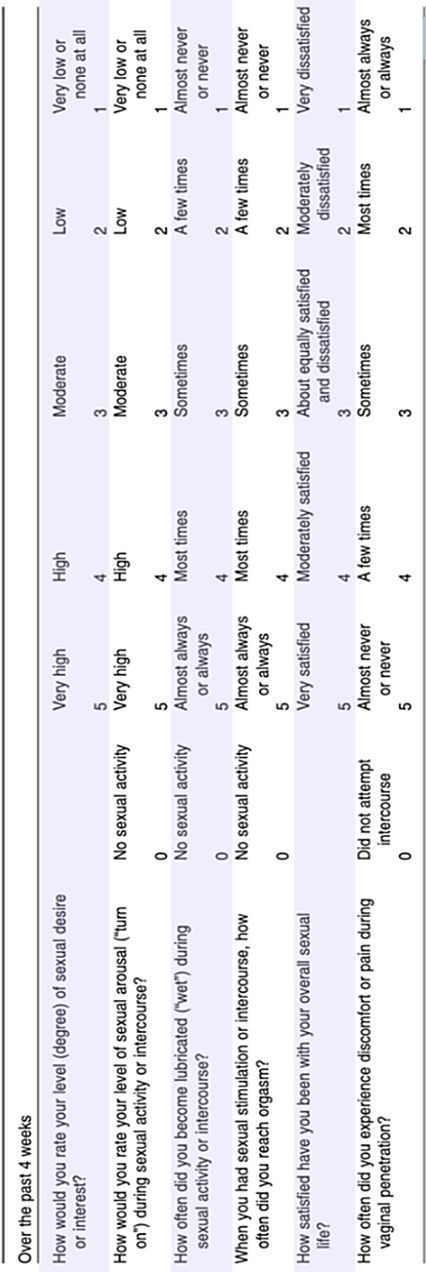
Female Sexual Function Index -6 (FSFI6)
| Over the past 4 weeks | ||||||
|---|---|---|---|---|---|---|
| How would you rate your level (degree) of sexual desire or interest? | Very high 5 |
High 4 |
Moderate 3 |
Low 2 |
Very low or none at all 1 |
|
| How would you rate your level of sexual arousal (“turn on”) during sexual activity or intercourse? | No sexual activity 0 |
Very high 5 |
High 4 |
Moderate 3 |
Low 2 |
Very low or none at all 1 |
| How often did you become lubricated (“wet”) during sexual activity or intercourse? | No sexual activity 0 |
Almost always or always 5 |
Most times 4 |
Sometimes 3 |
A few times 2 |
Almost never or never 1 |
| When you had sexual stimulation or intercourse, how often did you reach orgasm? | No sexual activity 0 |
Almost always or always 5 |
Most times 4 |
Sometimes 3 |
A few times 2 |
Almost never or never 1 |
| How satisfied have you been with your overall sexual life? | Very satisfied 5 |
Moderately satisfied 4 |
About equally satisfied and dissatisfied 3 |
Moderately dissatisfied 2 |
Very dissatisfied 1 |
|
| How often did you experience discomfort or pain during vaginal penetration? | Did not attempt intercourse 0 |
Almost never or never 5 |
A few times 4 |
Sometimes 3 |
Most times 2 |
Almost always or always 1 |
Data Analysis: FSFI6 results
| Measure | Age | FSFI6 score |
|---|---|---|
| N | 39 | 39 |
| Missing | 0 | 0 |
| Mean | 42.8 | 20.0 |
| Median | 41 | 22 |
| Standard deviation | 11.9 | 6.04 |
| Minimum | 23 | 5 |
| Maximum | 73 | 30 |
Data Analysis: Sexual Dysfunction Diagnosis
| Group | Diagnosis | Total | |
|---|---|---|---|
| Sexual dysfunction diagnosis | No sexual dysfunction | ||
| Control group | 1 | 82 | 83 |
| Group using FSFI6 | 9 | 66 | 75 |
| Total | 10 | 148 | 158 |
| Test | Value | df | p |
|---|---|---|---|
| χ2 | 7.74 | 1 | 0.005 |
| N | 158 | ||
| Measure | Value |
|---|---|
| Phi-coefficient | 0.221 |
| Cramer's V | 0.221 |
Outcomes & Discussion of Results
- P=0.005
- Clinician reports
Outcomes &Discussion of Results
| Measure | Age | FSFI6 Score |
|---|---|---|
| N | 14 | 14 |
| Missing | 0 | 0 |
| Mean | 48.4 | 13.4 |
| Median | 49.5 | 14.0 |
| Standard deviation | 13.2 | 4.65 |
| Minimum | 29 | 5 |
| Maximum | 73 | 19 |
Limitations
- Small sample size
- Patient demographics unknown
- Short time frame
What is next?
- Clinician education
- Clinician barriers
References
Acog committee opinion no. 755: Well-woman visit. (2018, reaffirmed 2020). Obstetrics & Gynecology, 132(4), e181–e186. https://doi.org/10.1097/aog.0000000000002897
Briken, P., Matthiesen, S., Pietras, L., Wiessner, C., Klein, V., Reed, G. M., & Dekker, A. (2020). Estimating the prevalence of sexual dysfunction using the new icd-11 guidelines. Deutsches Ärzteblatt international. https://doi.org/10.3238/arztebl.2020.0653
Defining sexual health. (2024). World Health Organization. Retrieved from https://www.who.int/teams/sexual-and-reproductive-health-and-research/key-areas-of-work/sexual-health/defining-sexual-health
Faubion, S. S., MD, & Rullo, J. E., PhD. (2015, August 15). Sexual Dysfunction in women: a Practical approach. American Family Physician, 92(4), 281–288.
Isidori, A. M., Pozza, C., Esposito, K., Giugliano, D., Morano, S., Vignozzi, L., Corona, G., Lenzi, A., & Jannini, E. A. (2010). Original research—outcomes assessment: Development and validation of a 6-item version of the female sexual function index (fsfi) as a diagnostic tool for female sexual dysfunction. The Journal of Sexual Medicine, 7(3), 1139–1146. https://doi.org/10.1111/j.1743-6109.2009.01635.x
Parish SJ, Hahn SR, Goldstein SW, Giraldi A, Kingsberg SA, Larkin L, Minkin MJ, Brown V, Christiansen K, Hartzell-Cushanick R, Kelly-Jones A, Rulle J, Sadovsky R, Faubion SS. (2019). Identification of sexual concerns and problems in women. Mayo Clinic Proceeding. 94 (5). 842-856. https://doi.org/10.1016/j.mayocp.2019.01.009
Tounkel, I., Nalubola, S., Schulz, A., Lakhi, N., (April 2022) Sexual Health Screening for Gynecologic and Breast Cancer Survivors: A Review and Critical Analysis of Validated Screening Tools. Sexual Medicine, 10 (2), 100498. https://doi.org/10.1016/j.esxm.2022.100498
World Health Organization. (2024, April 5). WHO calls for action to uphold right to health amidst inaction, injustice and crises [Press release]. https://www.who.int/news/item/05-04-2024-who-calls-for-action-to-uphold-right-to-health-amidst-inaction--injustice-and-crises
Thank you.
Questions?