Will Workshops on a Diabetes Toolkit Improve Diabetes Care in the Hmong Community?
DNP Project
Maybo Heu
April 30, 2025
Introduction
Diabetes was one of the leading causes of death in the United States in 2021. Asian American adults made up 9.1% of those who are diagnosed with diabetes.
Diabetes prevalence among the Chinese, Japanese, Korean, and Vietnamese was between 6.1% and 7.1%, compared to 8.9% within other Asian American groups (American Diabetes Association, n.d.).
The Hmong have a higher prevalence of diabetes when compared to other Asian American groups and non-Hispanic Whites. The Hmong have a 3.3 times higher chance of getting diabetes when compared to non-Hispanic Whites (Lao et al., 2021).
Project Question
Project Question:
Will workshops on a diabetes toolkit improve diabetes care in the Hmong community?
Toolkit:
Wisconsin Department of Health Services (WDHS) 12-page Diabetes Self-Care Guide
Participant Recruitment
- Lack of data on the Hmong subgroup of Asians. Data disaggregation is essential to learning more about the health disparities within each Asian subgroup.
- Target Population: The vulnerable population of interest in this project is the Hmong living in Fresno County.
- The nurse practitioner at the clinic recruited participants for the project.
Project Subquestions
- Did Hemoglobin A1c lab values in project participants improve after attending two diabetes toolkit workshops?
- Did weekly physical activity adherence in project participants improve after attending two diabetes toolkit workshops?
- Did weekly strength physical activity adherence in project participants improve after attending two diabetes toolkit workshops?
- Did weekly diabetes medication adherence in project participants improve after attending two diabetes toolkit workshops?
Literature Review
- An extensive literature review was performed using the key search terms “diabetes” and “Hmong” using OneSearch on the Fresno State Library website
- Twelve peer-reviewed journal articles on “diabetes” and “Hmong” were published from 2013 to 2023.
- Six of these 12 articles were published from 2020 to the present.
Peer-Reviewed Journal Articles
- Barriers to Diabetes Management Among Hmong: Patients’ and Physicians’ Perspectives (Lao et al., 2021)
- Association between Herbal use Behavior and Hemoglobin A1c among Ethnic Minorities in Thai Border Communities (Choowanthanapakorn et al., 2023)
- Epidemiology of prediabetes mellitus among hill tribe adults in Thailand (Apidechkul et al., 2022)
- A Digital Diabetes Storytelling Intervention for the Hmong Community: A Pilot Study (Brown et al., 2023)
- Barriers to Type 2 Diabetes Mellitus Management for Older Hmong Patients with Minimal English Language Skills: Accounts from Caregivers, Case Managers, and Clinicians (Park et al., 2023)
- Comparing Disease Burden of Diabetes Mellitus Type 2 between Hmong and other Ethnic Groups (Lao et al., 2020)
Methods
- The Wisconsin Department of Health Services’ 12-page Diabetes Self-Care Guide was used as the workshop presentation format. Workshops were interactive with question-and-answer opportunities.
- The second workshop was scheduled 6 to 8 weeks after the first workshop.
- Each project participant was given a progress form to track changes in the patients’ physical activity, diet adherence, and medication adherence.
- Each project participant was provided a Diabetes Self-Care Guide in Hmong and English.
- A Hmong medical interpreter was present at the workshops to interpret the workshop information for project participants.
Project Participant Criteria
- Hmong
- 40 to 75 years of age
- All Genders
- Can speak and understand the Hmong language
- Hemoglobin A1c of 6.5% or more within 3 months of the project
- Resident of Fresno County
- Exclusion: Individuals who have diabetes mellitus type 1, newly diagnosed diabetes type 2 within the past 3 months
Results
- Population Size
- n = 10 (first workshop)
- n = 3 (second workshop)
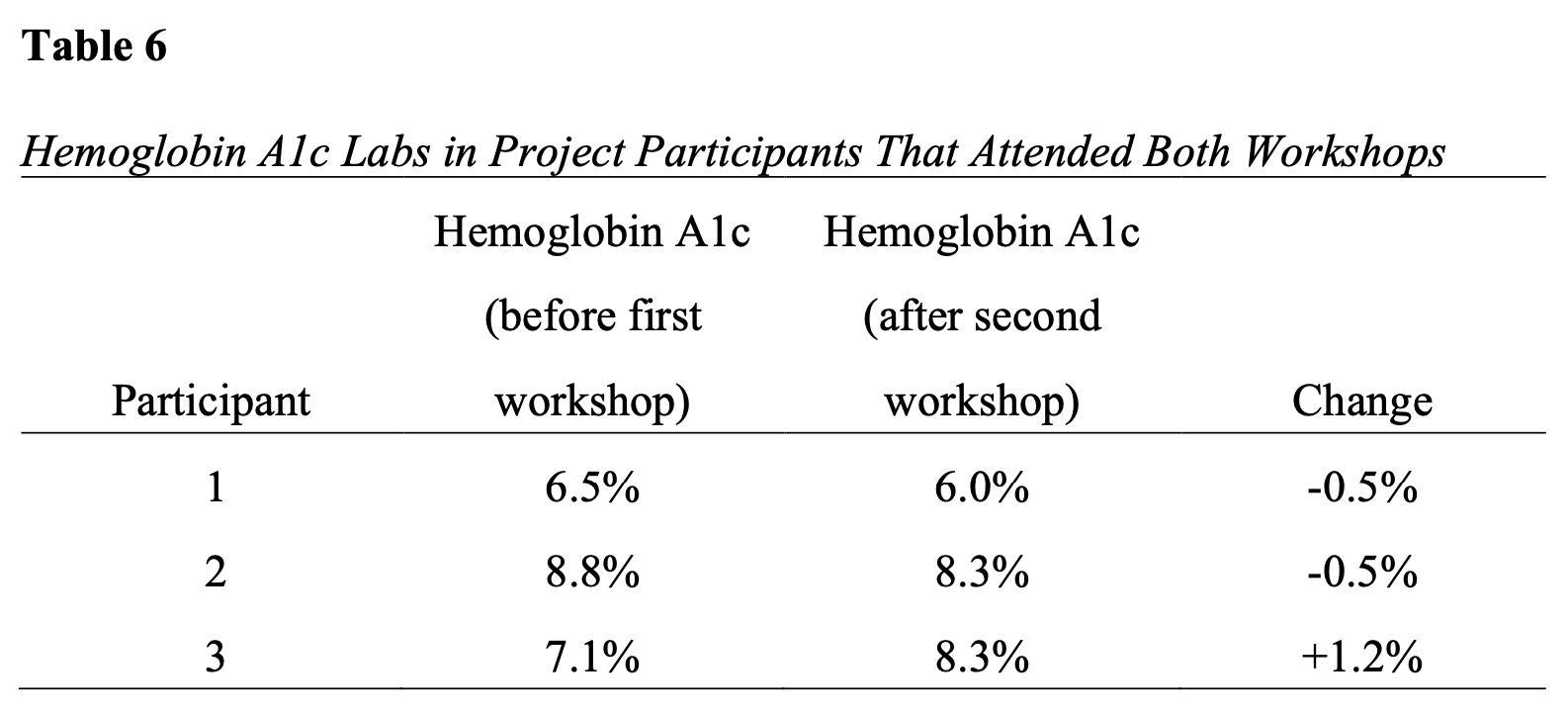
- Project Subquestion 1: Did Hemoglobin A1c lab values in project participants improve after attending two diabetes toolkit workshops?
- All other Project Subquestions Unfit for Analysis
Table 6. Hemoglobin A1c Labs in Project Participants That Attended Both Workshops
| Participant | Hemoglobin A1c (before first workshop) | Hemoglobin A1c (after second workshop) | Change |
|---|---|---|---|
| 1 | 6.5% | 6.0% | -0.5% |
| 2 | 8.8% | 8.3% | -0.5% |
| 3 | 7.1% | 8.3% | +1.2% |
Data Analysis
The Wilcoxon non-parametric test was used to analyze the Hemoglobin A1c (HbA1c) data collected. It was found that there was no statistical significance between the HbA1c lab values before the workshop and after attending two diabetes toolkit workshops.
Data analysis was based on data from three participants (n = 3).
A low number of final study participants was unexpected. Retention of participants was an issue in this project.
Discussion
- Due to the low enrollment, the project author requested an addendum to the original IRB proposal and added one extra workshop date to the first and second workshops.
- In total, there were three dates for the first workshop and the second workshop that participants could choose from. Even though the number of workshops was increased, participation and retention did not improve.
- In future projects with the same design, barriers must be addressed to obtain a larger sample size and improve participant retention, including babysitting, transportation, convenience, and having cultural humility of patriarchal practice in this population.
References
Ali, A. H., Kang, M. S., Kaur, K., Al Adhami, S., & Yuvienco, C. R. (2020). Review of Hmong-related health problems: A quick guide for healthcare providers. Cureus, 12(8), e9808. https://doi.org/10.7759/cureus.9808
American Diabetes Association. (n.d.). About diabetes: Statistics about diabetes. https://diabetes.org/about-diabetes/statistics/about-diabetes
Apidechkul, T., Chomchiei, C., Upala, P., & Tamornpark, R. (2022). Epidemiology of prediabetes mellitus among hill tribe adults in Thailand. PloS One, 17(7), e0271900-. https://doi.org/10.1371/journal.pone.0271900
Brown, K. M., Silveira, C., Xiong, S., Lumpkin, N., Carlin, C., Pang, C. J., & Schafer, K. M. (2023). A digital diabetes storytelling intervention for the Hmong community: A pilot study. Health Promotion Practice, 15248399231208990–15248399231208990. https://doi.org/10.1177/15248399231208990
Choowanthanapakorn, M., Seangpraw, K., Ong-Artborirak, P., Auttama, N., Boonyathee, S., Tonchoy, P., & Kantow, S. (2023). Association between herbal use behavior and hemoglobin A1c among ethnic minorities in Thai border communities. The Open Public Health Journal, 16(1). https://doi.org/10.2174/18749445-v16-230809-2023-59
Lao, L., Chen, M. S., & Stewart, S. L. (2020). Comparing disease burden of diabetes mellitus type 2 between Hmong and other ethnic groups. Hmong Studies Journal, 22, 1–13.
Lao, L., Chen, M. S., Stewart, S. L., & Fang, D. M. (2021). Barriers to diabetes management among Hmong: Patients’ and physicians’ perspectives. Hmong Studies Journal, 23(1), 1–23.
Lor, M., & Bowers, B. (2014). Evaluating teaching techniques in the Hmong breast and cervical cancer health awareness project. Journal of Cancer Education: The official journal of the American Association for Cancer Education, 29(2), 358–365. https://doi.org/10.1007/s13187-014-0615-0.
Park, L., Vang, A., Yang, B., & Quanbeck, A. (2023). Barriers to type 2 diabetes mellitus management for older Hmong patients with minimal English language skills: Accounts from caregivers, case managers, and clinicians. Journal of Racial and Ethnic Health Disparities, 10(6), 3062–3069. https://doi.org/10.1007/s40615-022-01480-7
Pew Research Center. (2021). Hmong in the U.S. Fact Sheet. https://www.pew.org/social-trends/fact-sheet/asian-americans-hmong-in-the-u-s/
Plotnikoff, G. A., Numrich, C., Wu, C., Yang, D., & Xiong, P. (2002). Hmong shamanism. Animist spiritual healing in Minnesota. Minnesota Medicine, 85(6), 29–34.
Stanford Medicine Ethnogeriatrics. (n.d.). Demographics. https://geriatrics.stanford.edu/ethnomed/hmong/introduction/demographics.html
United States Department of Health and Human Services. (2019, January 19). 2018 requirements (2018 common rule): Code of Federal Regulations title 45 part 46. https://www.hhs.gov/ohrp/regulations-and-policy/regulations/45-cfr-46/revised-common-rule-regulatory-text/index.html#46.102
Wisconsin Department of Health Services. (2020). Diabetes self-care guide. https://www.dhs.wisconsin.gov/library/collection/p-43081
This HTML version was generated with AI assistance and may contain errors or omissions. The original approved PDF remains the official document of record. An alternative accessible format is available upon request from the document creator in accordance with Title II of the ADA.