Engaging and Assessing Nursing Students’ Clinical Judgment using Evidenced-Based Tools in the Clinical Practicum
Tara Reed
DNPc
California State University, Fresno
Doctor of Nursing Practice Program
Acknowledgements
- Dr. Kathleen Rindahl, Dr. Eileen Jimenez, Dr. Janine Spencer, and Dr. Marie Gilbert
- Dennis, Shaley and a special to acknowledgement to my son Dillon
- Friends, Colleagues and Students
Introduction
Nurses have a legal accountability to practice safely.
- Nursing Practice Act
- defines nursing practice as the ability to observe and determine abnormality and the obligation to act
- NCSBN Licensing (NCLEX) Exam
- determines a nurse is safe to practice
- Agencies
- Accrediting agencies recognize educational institutions or programs that meet or exceed standards and criteria for educational quality
The NCSBN defines clinical judgment
“as the observed outcome of critical thinking and decision-making. It is an iterative process that uses nursing knowledge to observe and assess presenting situations, identify a prioritized client concern, and generate the best possible evidence-based solutions to deliver safe client care”.
(Betts et al., 2019, p. 23; NCSBN, 2019a, p. 1)
Problem
 Declining New Graduate Clinical Judgment & Safety
 New Graduate Attrition Rates < 3 years
 Stakeholders advocating for improved practice readiness new graduates
 NCSBN updated licensing exam
 Opportunity to improve Clinical Judgment in local nursing program
Methods
ATI Comprehensive Predictor Exam
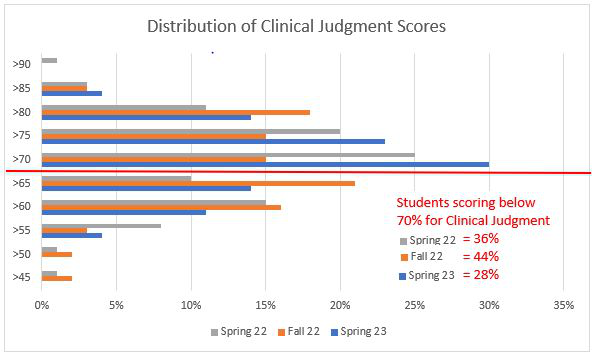
(ATI, 2023)
Purpose of the project
- Identify if clinical instructors perceive using an evidenced-based tool improves their ability to ENGAGE students in clinical judgment.
- Identify if clinical instructors perceive using an evidence-based tool aids to ASSESS student’s clinical judgment competencies and provide specific feedback.
- Identify innovative, intentional and a standardized approach to increase opportunities to develop students’ clinical judgment competencies.
Theoretical Framework
Tanner’s Clinical Judgment Model
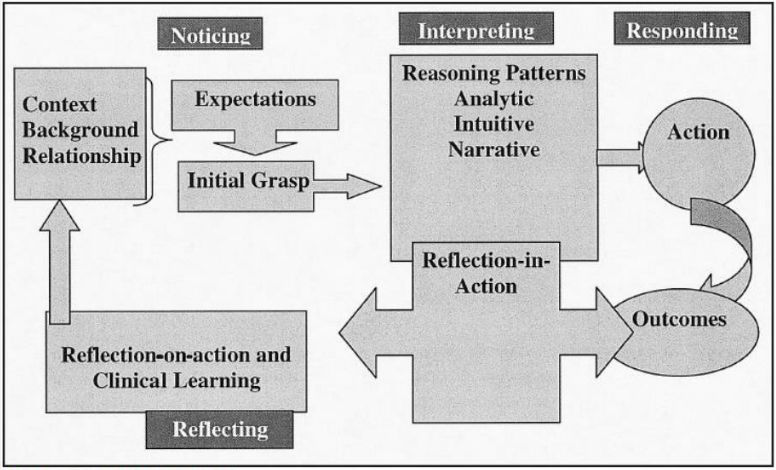
Permission obtained to use (Tanner, 2006).
Review of the literature
- Academia called to act
- Faculty Considerations
- NCSBN Clinical Judgment Measurement Model (NCJMM)
- Lasater’s Clinical Judgment Rubric (LCJR)
Methods
- Boyer’s Scholarship of Application
- Mixed method of Quantitative and Qualitative Survey
- Convenience sampling:
- Clinical instructors teaching medical-surgical and complex acute care clinical courses
- Nine of the 15 (60%) clinical instructors consented to participate
- Data Collection
- Setting
- Data Analysis
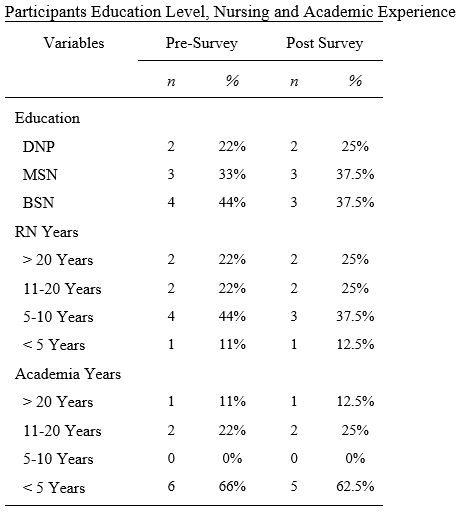
| Variables | Pre-Survey n | Pre-Survey % | Post Survey n | Post Survey % |
|---|---|---|---|---|
| Education: DNP | 2 | 22% | 2 | 25% |
| Education: MSN | 3 | 33% | 3 | 37.5% |
| Education: BSN | 4 | 44% | 3 | 37.5% |
| RN Years: > 20 Years | 2 | 22% | 2 | 25% |
| RN Years: 11-20 Years | 2 | 22% | 2 | 25% |
| RN Years: 5-10 Years | 4 | 44% | 3 | 37.5% |
| RN Years: < 5 Years | 1 | 11% | 1 | 12.5% |
| Academia Years: > 20 Years | 1 | 11% | 1 | 12.5% |
| Academia Years: 11-20 Years | 2 | 22% | 2 | 25% |
| Academia Years: 5-10 Years | 0 | 0% | 0 | 0% |
| Academia Years: < 5 Years | 6 | 66% | 5 | 62.5% |
NCJMM Quantitative Data Analysis
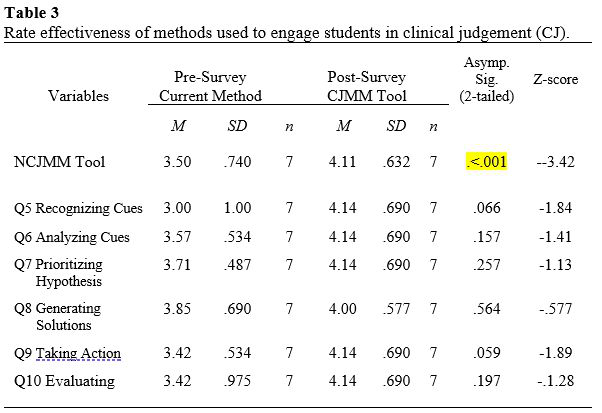
| Variables | Pre-Survey Current Method M | Pre-Survey Current Method SD | Pre-Survey n | Post-Survey CJMM Tool M | Post-Survey CJMM Tool SD | Post-Survey n | Asymp. Sig. (2-tailed) | Z-score |
|---|---|---|---|---|---|---|---|---|
| NCJMM Tool | 3.50 | .740 | 7 | 4.11 | .632 | 7 | <.001 | −3.42 |
| Q5 Recognizing Cues | 3.00 | 1.00 | 7 | 4.14 | .690 | 7 | .066 | −1.84 |
| Q6 Analyzing Cues | 3.57 | .534 | 7 | 4.14 | .690 | 7 | .157 | −1.41 |
| Q7 Prioritizing Hypothesis | 3.71 | .487 | 7 | 4.14 | .690 | 7 | .257 | 1.13 |
| Q8 Generating Solutions | 3.85 | .690 | 7 | 4.00 | .577 | 7 | .564 | −.577 |
| Q9 Taking Action | 3.42 | .534 | 7 | 4.14 | .690 | 7 | .059 | −1.89 |
| Q10 Evaluating | 3.42 | .975 | 7 | 4.14 | .690 | 7 | .197 | −1.28 |
Note: Two participants were excluded from the effectiveness of methods quantitative analysis.
LCJR Quantitative Data Analysis
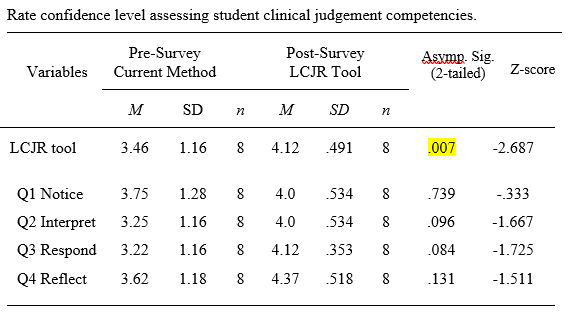
| Variables | Pre-Survey Current Method M | Pre-Survey Current Method SD | Pre-Survey n | Post-Survey LCJR Tool M | Post-Survey LCJR Tool SD | Post-Survey n | Asymp. Sig. (2-tailed) | Z-score |
|---|---|---|---|---|---|---|---|---|
| LCJR tool | 3.46 | 1.16 | 8 | 4.12 | .491 | 8 | .007 | −2.687 |
| Q1 Notice | 3.75 | 1.28 | 8 | 4.0 | .534 | 8 | .739 | −.333 |
| Q2 Interpret | 3.25 | 1.16 | 8 | 4.0 | .534 | 8 | .096 | −1.667 |
| Q3 Respond | 3.22 | 1.16 | 8 | 4.12 | .353 | 8 | .084 | −1.725 |
| Q4 Reflect | 3.62 | 1.18 | 8 | 4.37 | .518 | 8 | .131 | −1.511 |
Note: One participant excluded from the confidence level quantitative analysis did not complete the post-survey.
Qualitative Post Survey Comments
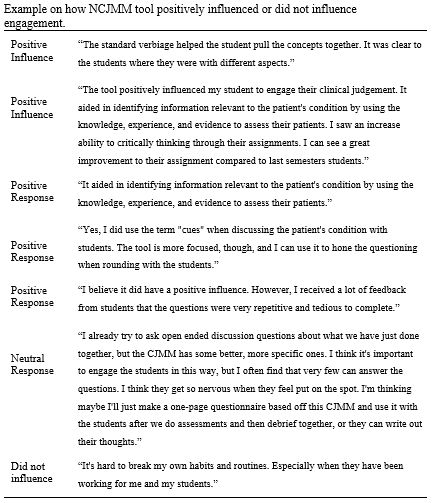
NCJMM = 72% positive
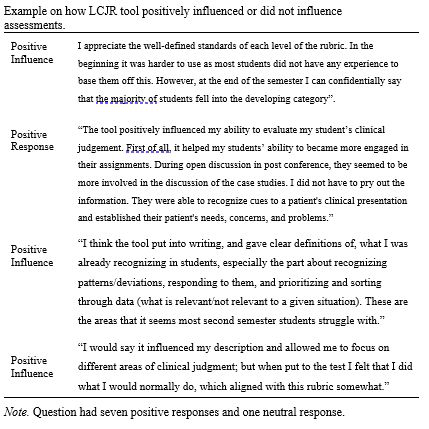
LCJR = 88% positive

Examples of comments visible in the survey images:
- “The standard verbiage helped the student pull the concepts together. It was clear to the students where they were with different aspects.”
- “The tool positively influenced my student to engage their clinical judgement. It aided in identifying information relevant to the patient’s condition by using the knowledge, experience, and evidence to assess their patients. I saw an increase ability to critically thinking through their assignments. I can see a great improvement to their assignment compared to last semesters student.”
- “It aided in identifying information relevant to the patient’s condition by using the knowledge, experience, and evidence to assess their patients.”
- “Yes, I did use the term ‘cues’ when discussing the patient’s condition with students. The tool is more focused, though, and I can use it to hone the questioning when rounding with the students.”
- “I believe it did have a positive influence. However, I received a lot of feedback from students that the questions were very repetitive and tedious to complete.”
- “I already try to ask open ended discussion questions about what we have just done together, but the CJMM has some better, more specific ones. I think it’s important to engage the students in this way, but I often find that very few can answer the questions. I think they get so nervous when they feel put on the spot. I’m thinking maybe I’ll just make a one-page questionnaire based off this CJMM and use it with the students after we do assessments and then debrief together, or they can write out their thoughts.”
- “It’s hard to break my own habits and routines. Especially when they have been working for me and my students.”
- “I appreciate the well-defined standards of each level of the rubric. In the beginning it was harder to use as most students did not have any experience to base them off this. However, at the end of the semester I can confidently say that the majority of students fell into the developing category”.
- “The tool positively influenced my ability to evaluate my student’s clinical judgement. First of all, it helped my students’ ability to become more engaged in their assignments. During open discussion in post conference, they seemed to be more involved in the discussion of the case studies. I did not have to pry out the information. They were able to recognize cues to a patient’s clinical presentation and established their patient’s needs, concerns, and problems.”
- “I think the tool put into writing, and gave clear definitions of, what I was already recognizing in students, especially the part about recognizing patterns/deviations, responding to them, and prioritizing and sorting through data (what is relevant/not relevant to a given situation). These are the areas that it seems most second semester students struggle with.”
- “I would say it influenced my description and allowed me to focus on different areas of clinical judgment; but when put to the test I felt that I did what I would normally do, which aligned with this rubric somewhat.”
Note. Question had five positive responses, one neutral, one no influence response and one response excluded because participant evaluated the virtual simulation and not the NCJMM tool.
Note. Question had seven positive responses and one neutral response.
Discussion
- Pilot study demonstrated positive results.
- Intentional use of NCJMM and LCJR tools assisted clinical instructors to engage and assess students’ clinical judgment competencies.
Limitations
- Small number of participants.
- Existing practicum evaluation documentation did not align with tools.
Recommendations
- Use ALL ATI Proctored Clinical Judgment Scores to identify <70 % students.
- Adopt Clinical Judgment tools to standardize engagement and assessment across all semesters.
- Develop performance improvement plan for student’s clinical judgment exams < 70% and communicate plan to next semester.
- Ensure formal orientation for onboarding clinical faculty and ongoing CE.
- Continue to seek innovative opportunities to increase clinical judgment.
The Vision
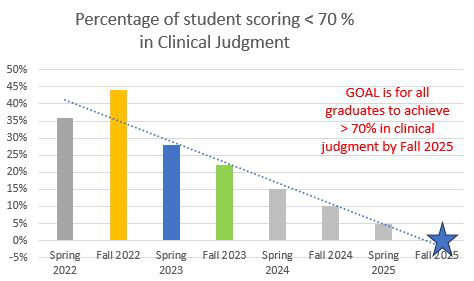
Percentage of student scoring < 70 % in Clinical Judgment
GOAL is for all graduates to achieve > 70% in clinical judgment by Fall 2025
Comparing pre study data to Spring 24 Cohort that participated in project study.
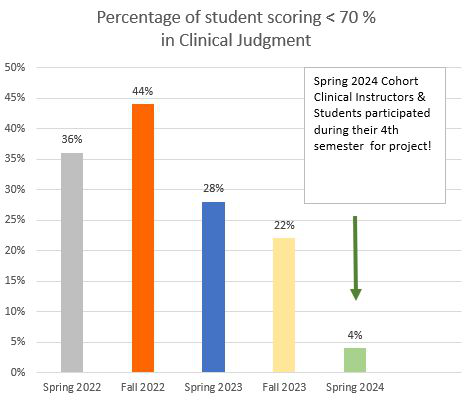
Spring 2024 Cohort Clinical Instructors & Students participated during their 4th semester for project!
Meaningful data to continue to improve student competencies.
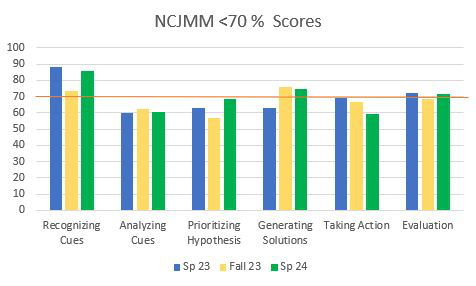
Clinical Judgment Data
Questions?
References
References
- Accreditation Commission for Education in Nursing. (2023, April 17). 2023 Accreditation Manuel. www.acen. Retrieved August 18, 2023, from https://resources.acenursing.org
- American Association of Colleges of Nursing. (2021). Re-envisioned essentials: A roadmap for the transformation of nursing education [PDF]. Retrieved September 2, 2023, from https://www.aacnnursing.org/Portals/0/PDFs/Essentials/Roadmap-to-New-Essentials.pdf
- American Association of Colleges of Nursing. (2022). Nurse shortage fact sheet [PDF]. Retrieved July 15, 2023, from https://www.aacnnursing.org/Portals/0/PDFs/Fact-Sheets/Nursing-Shortage-Factsheet.pdf
- American Association of Colleges of Nursing. (2023). The essentials: Competencies for professional nursing education [PDF]. American Association of Colleges of Nursing’s. Retrieved September 2, 2023, from https://www.aacnnursing.org/Portals/0/PDFs/Publications/Essentials-2021.pdf
- Assessment Technologies Institute. (2022). 2022-next-generation-nclex-guidebook [PDF]. Retrieved June 20, 2023, from https://www.atitesting.com/docs/default-source/next-gen-nclex/2022-next-generation-nclex-guidebook9f6037dd80cb405a808bba44f60d9c52.pdf
- Assessment Technologies Institute. (2023b). ATI analytics. https://faculty.atitesting.com/faculty/results
- Baxter, P., & Norman, G. (2011). Self-assessment or self deception? a lack of association between nursing students’ self-assessment and performance. Journal of Advanced Nursing, 67(11), 2406–2413. Retrieved August 23, 2023, from https://doi.org/10.1111/j.1365-2648.2011.05658.x
- Betts, J. (2022). Transcript_2022NCLEX_jbetts_ncjmm.pdf [pdf]. National Council of State Boards for Nurses. Retrieved 2022, from https://www.ncsbn.org/search.page?q=nursing+process
- Betts, J., Muntean, W., Kim, D., Jorion, N., & Dickison, P. (2019). Building a method for writing clinical judgment items for entry-level nursing exams. Journal of Applied Testing Technology, 20(2), 21–36. Retrieved March 5, 2023, from
- Calcagni, L., Lindell, D., Weaver, A., & Jackson, M. (2023). Clinical judgment development and assessment in clinical nursing education. Nurse Educator, 48(4), 175–181. Retrieved September 2, 2023, from https://doi.org/10.1097/nne.0000000000001357
- Harvey, G. (2015). Connecting theory to practice: Using guided questions to standardize clinical postconference. Journal of Nursing Education, 54(11), 655–658. Retrieved August 1, 2023, from https://doi.org/10.3928/01484834-20151016-08
References
- Hensel, D., & Billings, D. M. (2019). Strategies to teach the national council of state boards of nursing clinical judgment model. Nurse Educator, 45(3), 128–132. https://doi.org/10.1097/nne.0000000000000773
- Hoffman, D. M. (2019). Transitional experiences: From clinical nurse to nurse faculty. Journal of Nursing Education, 58(5), 260–265. Retrieved June 20, 2023, from https://doi.org/10.3928/01484834-20190422-03
- Ignatavicius, D. D., & Silvestri, L. A. (2022). Preparing for the next-generation NCLEX (NGN) A "how-to" step-by-step faculty resource manual. https://evolve.elsevier.com/education/expertise/next-generation-nclex/ngn-faculty-resource-manual/. Retrieved October 13, 2022, from https://evolve.elsevier.com/education/expertise/next-generation-nclex/ngn-faculty-resource-manual/
- Ignatavicius, D. D., & Silvestri, L. A. (2024). From nursing process to clinical judgment.
Elsevier Education. https://evolve.elsevier.com/education/expertise/apply-clinical-judgment/ngn-transitioning-from-the-nursing-process-to-clinical-judg
ment/ - Jessee, M. (2021). An update on clinical judgment in nursing and implications for education, practice, and regulation. Journal of Nursing Regulation, 12(3), 50–60. Retrieved March 5, 2023, from https://doi.org/10.1016/s2155-8256(21)00116-2
- Kavanagh, J. M., & Szweda, C. (2017). A crisis in competency: The strategic and ethical imperative to assessing new graduate nurses’ clinical reasoning. Nursing Education Perspectives, 38(2), 57–62. Retrieved February 27, 2023, from https://doi.org/10.1097/01.nep.0000000000000112
- Kavanagh, J., & Sharpnack, P. (2021). Crisis in competency: A defining moment in nursing education. OJIN: The Online Journal of Issues in Nursing, 26(1). Retrieved September 4, 2023, from https://doi.org/10.3912/ojin.vol26no01man02
- Knapp, H. (2016). Practical statistics for nursing using spss (1st ed.). SAGE Publications, Inc.
- Lasater, K. (2007). Clinical judgment development: Using simulation to create an assessment rubric. Journal of Nursing Education, 46(11), 496–503. Retrieved October 25, 2022, from https://doi.org/10.3928/01484834-20071101-04
- Lasater, K., Nielsen, A. E., Stock, M., & Ostrogorsky, T. L. (2015). Evaluating the clinical judgment of newly hired staff nurses. The Journal of Continuing Education in Nursing, 46(12), 563–571. Retrieved April 10, 2023, from https://doi.org/10.3928/00220124-20151112-09
- Leighton, K., Kardong-Edgren, S., McNelis, A. M., Foisy-Doll, C., & Sullo, E. (2021). Traditional clinical outcomes in prelicensure nursing education: An empty systematic review. Journal of Nursing Education, 60(3), 136–142. Retrieved August 16, 2023, from https://doi.org/10.3928/01484834-20210222-03
References
- Makary, M. A., & Daniel, M. (2016). Medical error—the third leading cause of death in the us. BMJ, i2139. Retrieved August 16, 2023, from https://doi.org/10.1136/bmj.i2139
- Manetti, W. (2018). Evaluating the clinical judgment of prelicensure nursing students in the clinical setting. Nurse Educator, 43(5), 272–276. Retrieved April 10, 2023, from https://doi.org/10.1097/nne.0000000000000489
- Marino, M., Andrews, K., & Ward, J. (2020). Clinical decision making at the bedside. Nursing Clinics of North America, 55(1), 29–37. Retrieved July 20, 2023, from https://doi.org/10.1016/j.cnur.2019.10.003
- McClure, E., & Black, L. (2013). The role of the clinical preceptor: An integrative literature review. Journal of Nursing Education, 52(6), 335–341. Retrieved March 16, 2023, from https://doi.org/10.3928/01484834-20130430-02
- Monagle, J. L., Lasater, K., Stoyles, S., & Dieckmann, N. (2018). New graduate nurse experiences in clinical judgment: What academic and practice educators need to know. Nursing Education Perspectives, 39(4), 201–207. Retrieved March 6, 2023, from https://doi.org/10.1097/01.nep.0000000000000336
- Morris, G. (2023, January 23). Nurse residencies with the most opportunities for new grads. NurseJournal. Retrieved August 10, 2023, from https://nursejournal.org/resources/the-best-residency-programs-for-nurses/#:~:text=The%20most%20common%20goals%20for completing%20a%20nurse,skills%2C%20and%20fostering%20continued%20professional%20growth%20and%20development.
- National Council of State Board of Nursing. (2018b). Report of findings from the 2017 rn nursing knowledge survey [Research Brief]. NCSBN. Retrieved July 15, 2023, from https://www.ncsbn.org/exams-research/report-of-findings-from-the-2017-rn-nursing-knowledge-survey
- National Council of State Board of Nursing. (2019a). Ngn_winter19 [PDF]. https://www.ncsbn.org/public-files/NGN_Winter19.pdf
- National Council of State Board of Nursing. (2022). Why is NCSBN changing the NCLEX? National Council of State Boards of Nursing,. Retrieved October 13, 2022, from https://www.ncsbn.org/exams/next-generation-nclex/NGN+FAQS/ngn-faqs-for-educators.page
- National Council of State Board of Nursing. (2023e). Nclex pass rates. NCSBN. Retrieved September 3, 2023, from https://www.ncsbn.org/exams/exam-statistics-and-publications/nclex-pass-rates.page
References
- Nibbelink, C. W., & Brewer, B. B. (2018). Decision-making in nursing practice: An integrative literature review. Journal of Clinical Nursing, 27(5-6), 917–928. https://doi.org/10.1111/jocn.14151
- Nielsen, A., Gonzalez, L., Jessee, M., Monagle, J., Dickison, P., & Lasater, K. (2022). Current practices for teaching clinical judgment. Nurse Educator, 48(1), 7–12. Retrieved March 28, 2023, from https://doi.org/10.1097/nne.0000000000001268
- Nielsen, A., Lasater, K., & Stock, M. (2016). A framework to support preceptors’ evaluation and development of new nurses’ clinical judgment. Nurse Education in Practice, 19, 84–90. Retrieved March 16, 2023, from https://doi.org/10.1016/j.nepr.2016.03.012
- Poston, K. M., Brunette, G., & Ciccone, J. (2023). Collaborative strategies to improve clinical judgement and address bedside care challenges. Teaching and Learning in Nursing, 18(3), e94–e97. Retrieved August 20, 2023, from https://doi.org/10.1016/j.teln.2023.02.001
- Reljić, N., Lorber, M., Vrbnjak, D., Sharvin, B., & Strauss, M. (2017). Assessment of clinical nursing competencies: Literature review. In Teaching and learning in nursing. InTech. https://doi.org/10.5772/67362
- Sherrill, K. J. (2020). Clinical judgement and next generation NCLEX: a positive direction for nursing education! Teaching and Learning in Nursing, 15(1), 82–85. Retrieved March 5, 2023, from
- Sutor, A., & Painter, J. (2020). Nurse residency programs: providing organizational value. Delaware Journal of Public Health, 6(1), 58–61. Retrieved February 13, 2023, from https://doi.org/10.32481%2Fdjph.2020.04.013
- Tanner, C. A. (2006). Thinking like a nurse: A research-based model of clinical judgment in nursing. Journal of Nursing Education, 45(6), 204–211. Retrieved September 20, 2022, from
- Victor-Chmil, J. (2013). Critical thinking versus clinical reasoning versus clinical judgment. Nurse Educator, 38(1), 34–36. Retrieved July 15, 2023, from https://doi.org/10.1097/nne.0b013e318276dfbe
This HTML version was generated with AI assistance and may contain errors or omissions. The original approved PDF remains the official document of record. An alternative accessible format is available upon request from the document creator in accordance with Title II of the ADA.