Doctor of Nursing Practice Student Handbook 2026-2027
California State University, Fresno
Doctor of Nursing Practice
STUDENT HANDBOOK
2026-2027
Cohort 7 Class of 2028

DESCRIPTION OF THE PROGRAM
Welcome to the California State University, Fresno: School of Nursing, Doctor of Nursing Practice (DNP) Program.
The Doctor of Nursing Practice (DNP) prepares experts in specialized advanced nursing practice for leadership and clinical roles and to engage in evidence-based inquiry. Graduates may also serve as faculty in postsecondary nursing education programs. The program is designed for working professionals with the majority of coursework provided via distance modalities.
The cohort-based DNP program is designed to be completed in five semesters (fall, spring, summer, fall, spring) of full-time study consisting of 39 doctoral units and a culminating doctoral project.
Program Mission
The mission of the DNP program is to prepare promising nursing leaders, advanced practice clinicians, and nursing faculty with high leadership potential to critically examine current healthcare practices and policies from a broad theoretical and practical perspective and formulate clinical, administrative, and instructional effective leadership approaches that can improve the quality of healthcare for all populations.
Program Vision
Our vision is to be an exceptional advanced nursing degree program that prepares nurses at a doctoral level to lead healthcare change. DNP graduates serve as nursing faculty, as advanced healthcare stewards, and work collaboratively with other disciplines to improve healthcare systems.
School of Nursing Philosophy
California State University, Fresno School of Nursing offers comprehensive programs that lead to Bachelor of Science and Master of Science degrees in Nursing. A strong general education component in the undergraduate programs fosters lifelong learning. The master’s program is designed to provide specialized study in selected advanced practice fields. The University’s commitment to the San Joaquin Valley is to prepare students for industries and professions serving the community. To achieve the mission, California State University, Fresno supports applied research and public service programs as a means to enhance faculty development and instruction, while contributing to the intellectual, social, cultural, and economic vitality of the San Joaquin Valley and California.
Fresno State School of Nursing philosophy underlies the foundation for the DNP curriculum. For a complete reference to the philosophy please access the School of Nursing website. https://chhs.fresnostate.edu/nursing/
PROGRAM FOR MASTER’S PREPARED NURSES WITH ADVANCED PRACTICE SPECIALTIES
Profound and unprecedented change in healthcare created a need for knowledgeable, innovative clinicians and nurse leaders. Career opportunities for nurses with leadership skills have never been greater. The DNP program is designed to prepare students to assume leadership and clinician roles within the emerging healthcare delivery system.
The program of study includes didactic and practicum courses that link the expansion of scientific knowledge with a focus on practice that is innovative and evidence-based across a variety of settings relevant to the specialty. Clinical experiences are developed to assure that experiences are consistent with each individual’s career path and specialty competencies.
PROGRAM FOR MASTER’S PREPARED NURSE GENERALISTS
The master’s degree prepared nurse generalist DNP graduate leads practice at the highest level in an increasingly complex healthcare system. This individual works collaboratively to promote evidence-based healthcare that is safe, effective, and patient-centered with a focus on quality and high-level patient-care outcomes. Systems transformation is the center of this nurse’s advanced practice.
DNP Program Contact Information
Kara Zografos
Dean, College of Health and Human Services, CSU Fresno
559-278-4004
kzografos@mail.fresnostate.edu
Kathleen Rindahl. DNP, FNP-C
Chair, School of Nursing
559-278-3491
krindahl@mail.fresnostate.edu
Nisha Nair, DNP, WHNP-BC, CNS, CNE, IBCLC
Program Director, Doctor of Nursing Practice
559-278-8854
nishanair@mail.fresnostate.edu
Pierre-Andrew Marquez
Administrative Support Coordinator, Graduate Programs
559-278-4045
pierreandrewmarquez@mail.fresnostate.edu
Please Note: All Fresno State department and university email communication is via your Fresno State official email address ending in @mail.fresnostate.edu.
FRESNO STATE - SON Organizational Chart
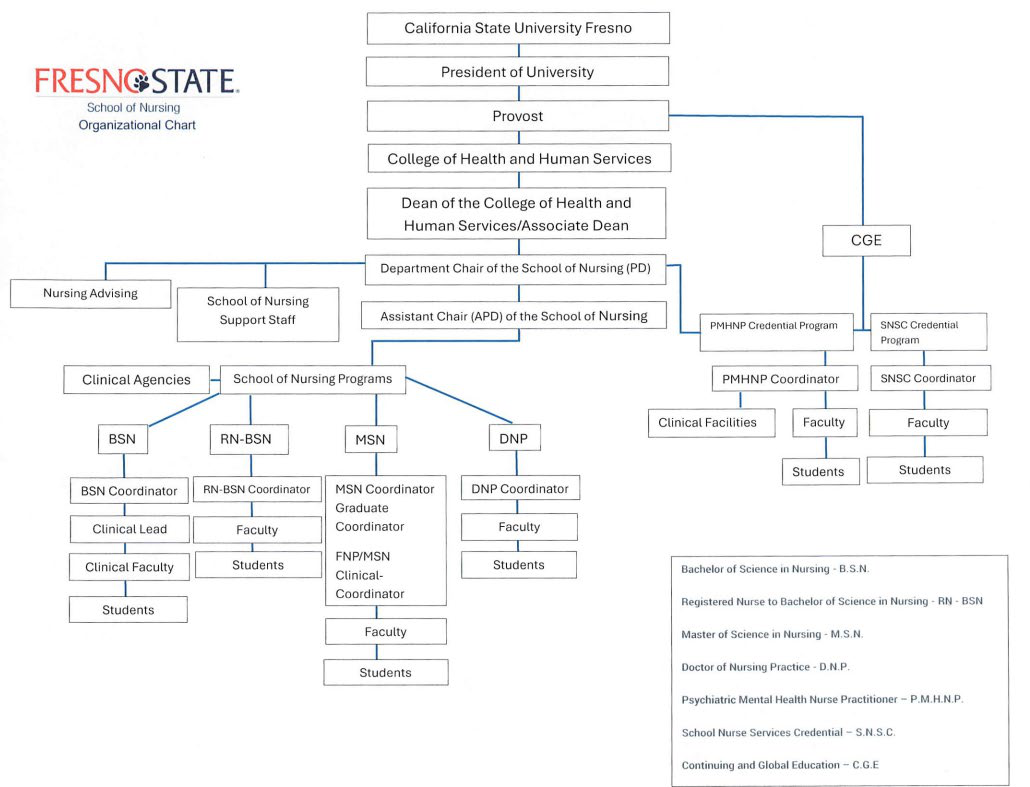
The chart connects California State University Fresno to the President of University, then to the Provost. From the Provost, the chart branches to the College of Health and Human Services and to CGE.
- College of Health and Human Services
- Connects to the Dean of the College of Health and Human Services/Associate Dean, then to the Department Chair of the School of Nursing (PD).
- Department Chair of the School of Nursing (PD)
- Connects to Nursing Advising, School of Nursing Support Staff, Assistant Chair (APD) of the School of Nursing, and PMHNP Credential Program.
- Assistant Chair (APD) of the School of Nursing
- Connects to School of Nursing Programs.
- School of Nursing Programs
- Connects to Clinical Agencies and to four program branches: BSN, RN-BSN, MSN, and DNP.
- BSN branch
- BSN connects to BSN Coordinator, then Clinical Lead, then Clinical Faculty, then Students.
- RN-BSN branch
- RN-BSN connects to RN-BSN Coordinator, then Faculty, then Students.
- MSN branch
- MSN connects to a box containing MSN Coordinator, Graduate Coordinator, and FNP/MSN Clinical-Coordinator. That box connects to Faculty, then Students.
- DNP branch
- DNP connects to DNP Coordinator, then Faculty, then Students.
- CGE
- Connects to PMHNP Credential Program and SNSC Credential Program.
- PMHNP Credential Program
- Connects to PMHNP Coordinator. The coordinator connects to Clinical Facilities and to Faculty; Faculty connects to Students.
- SNSC Credential Program
- Connects to SNSC Coordinator, then Faculty, then Students.
- B.S.N.
- Bachelor of Science in Nursing
- RN - BSN
- Registered Nurse to Bachelor of Science in Nursing
- M.S.N.
- Master of Science in Nursing
- D.N.P.
- Doctor of Nursing Practice
- P.M.H.N.P.
- Psychiatric Mental Health Nurse Practitioner
- S.N.S.C.
- School Nurse Services Credential
- C.G.E.
- Continuing and Global Education
ADMISSION REQUIREMENTS
To enroll in the DNP program, the individual applies to California State University, Fresno and the program. To be considered for admission to the program, at a minimum, the applicant must have:
- Master’s Degree
- If the applicant has a master’s degree in nursing, the degree must be from an accredited institution. If the applicant has a master’s degree in a health-related field (e.g. Public Health or Health Administration), additional post-baccalaureate courses in nursing theories, research methods, transcultural nursing and informatics will be required. Transcripts will be evaluated and an individual plan created at the time of applicant review
- The applicant must hold at least one degree in nursing, either a bachelor's or master's
- National Certification: The applicant must have national certification in nursing or obtain certification prior to the fifth semester of the DNP program
- U.S. citizen or U.S. permanent resident
- Meet admission requirements to California State University, Fresno. Provide official
transcripts from all institutions of higher learning attended. Have an overall GPA
of 3.0 or greater. Demonstrate sufficient preparation and practiced experience as
an APN, nurse manager / administrator / executive / educator / experienced nurse
Have a current, unrestricted California RN licensure and advanced practice national certification if applicable - Complete an application for admission to California State University, Fresno
The admission process includes:
- A complete application to the California State University, Fresno, DNP program
- Three recommendations from professional persons knowledgeable about applicant’s advanced nursing practice experience, as well as the potential for scholarship and leadership. One of the three recommendations must be from the applicant’s current supervisor
- A written statement of purpose reflecting what the applicant expects to accomplish in the DNP program and how the DNP program will advance the applicant’s nursing career and practice
- Completion of required interview
Types of Admission
- Conditionally Classified
- The applicant granted conditionally classified graduate standing has been admitted to the DNP program, and conditionally to the university, but has not yet satisfied all university/program admission requirements.
- Classified
- The applicant granted classified graduate standing has been admitted to the university and fulfilled all program admission requirements. Thus, classified graduate students are those who have been fully admitted to the program
PROGRAM OUTCOMES
The goal of the Doctor of Nursing Practice program is to prepare advanced practice nurses to be clinical scholars, and health policy leaders. Program outcomes have been identified as preparing the graduate to:
- Integrate scientific theories to advance scholarship and integrate evidence-based practice, research, and leadership to improve health outcomes for diverse populations.
- Provide safe, effective, and efficient person-centered care within the scope of advanced nursing practice.
- Influence health care policy, educate others about health disparities, and advocate for social justice to improve the health of populations.
- Translate and apply research findings to improve health, achieve equity, and transform healthcare.
- Design, implement, and evaluate quality improvement measures at the individual and system levels to ensure the safety of patients and populations
- Collaborate with other professionals, patients, families, communities, and policymakers to influence and enhance the care of patients and populations.
- Lead change in healthcare delivery through collaboration within complex systems to address the needs of diverse populations in a cost-effective manner
- Evaluate existing and emerging informatics and patient care technology and enhance organizational and system performance for safe and efficient implementation of quality healthcare.
- Develops a professional identity that reflects the values of the nursing profession, including cultural humility, ethical comportment, accountability, and lifelong learning
- Develop ongoing personal habits of self-reflection, resilience, and lifelong learning to assume leadership roles that advance the nursing profession.
ADVISING & MENTORING
The advising and mentoring component of the DNP program is designed to provide an array of professional development opportunities. Students are advised at the start of the program and throughout the Program by the Program Director, who assists in selecting a project chair, along with two other committee members. The student selects a practicum mentor with the program advisor’s approval. Advisors and mentors assist in identifying professional development experiences and professional associations / networks to enhance their success in the program.
The role of the program advisor, project chair and practicum mentor are to:
- Promote a well-planned and efficient DNP course of study that can be completed within five semesters by a working professional;
- Provide guidance and information that foster academic and professional development; Assist a student as the individual applies knowledge gained through coursework toward improving nursing practice and client outcomes;
- Advocate on behalf of the student and their academic needs;
- Create a doctoral culture typified by:
- Scholarly discussion and dialogue that foster critical inquiry and clinical reasoning.
- Expert supervision of a DNP candidate in the conduct of a doctoral project.
- Fostering informal assessment and feedback designed to enhance student reflection on their doctoral role in advanced nursing practice.
EXECUTIVE LEADERSHIP TEAM / ADVISOR / MENTOR / STUDENT RELATIONSHIP
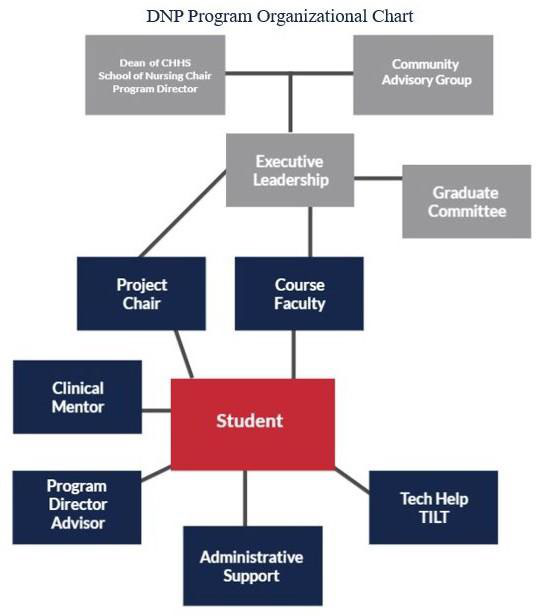
- The Dean of CHHS, School of Nursing Chair, and Program Director share a box connected to the Community Advisory Group. Their connecting line branches to Executive Leadership.
- Executive Leadership connects to the Graduate Committee, Project Chair, and Course Faculty.
- The Student connects directly to the Project Chair, Course Faculty, Clinical Mentor, Program Director Advisor, Administrative Support, and Tech Help TILT.
TRANSFER OF CREDITS EARNED AT OTHER INSTITUTIONS
Students are encouraged to complete the entire program with their cohort. Under unusual circumstances, a student may transfer up to 8 units into the program, only if the institution offering the work is accredited. The DNP executive leadership considers the transfer of units on an individual basis. Documentation of coursework and course syllabus must be provided. The courses must have been taken within the last five years and the student must have earned a grade of B or better in the courses. Coursework from outside the United States is not permitted for use towards the DNP degree.
PROGRAM TIMELINE
The DNP program is designed to be completed in 5 semesters of full-time study. Students are admitted once a year in the fall and complete coursework as a cohort. There is no part-time option. All requirements for the degree are to be completed within five years of achieving classified standing in the doctoral program. The appropriate campus authority, consistent with campus policy, may extend up to two years the time allowed for completion of the requirements under the following circumstances:
- The student is in good standing.
- The extension is warranted by compelling individual circumstances, and
- The student demonstrates current knowledge of research and practice in nursing as required by the campus.
| Semester | Courses |
|---|---|
| Fall Year 1 | NURS 574 The Role of Diversity & Social Issues in Health Care (2 units) NURS 575 Application of Theories in Advanced Nursing Practice (2 units) NURS 576 Application of Biostatistics to Populations (3 units) |
| Spring Year 1 | NURS 583 Leadership & Professional Responsibility in Complex Healthcare Systems (2
units) NURS 584 Technology, Informatics, and Data Management in the Transformation of Healthcare (3 units) NURS 585 Foundations of Evidence-based Practice (2 units) NURS 590 DNP Practicum (6 units) Contingent on hour requirement |
| Summer Year 1 | NURS 586 Transformation of Healthcare Systems: Health Policy & Economics (2 units) NURS 587 Principles of Epidemiology (3 units) NURS 595 Translating Evidence into Reflective Practice I (2 units) NURS 590 DNP Practicum (6 units) Contingent on hour requirement |
| Fall Year 2 | NURS 591 Curriculum Development (3 units) NURS 593 Financial Aspects of Projects & Practice (2 units) NURS 596 Translating Evidence into Reflective Practice II (2 units) NURS 590 DNP Practicum (6 units) Contingent on hour requirement |
| Spring Year 2 | NURS 592 Evaluation in Nursing Education (3 units) NURS 594 Application of Evidence-Based Teaching in Nursing, elective/ optional (3 units) NURS 597 Doctoral Project (2units) NURS 590 DNP Practicum (6 units) Contingent on hour requirement |
Program Timeline (for brief description of courses please see website: curriculum plan) https://chhs.fresnostate.edu/nursing/degrees-programs/fsdnp/index.html
REQUIREMENTS FOR SATISFACTORY PROGRESS IN THE PROGRAM
In order to progress in the DNP program, the student must maintain at least a 3.0 grade point average for the program. A student who falls below a 3.0 grade point average, or receives less than a C grade in a course in any one term will be placed on academic probation and notified in writing. If a student fails to make satisfactory progress, the individual may be officially disqualified from the program after a thorough case review. Disqualification is based on the recommendation of the DNP program faculty. The student must be notified in writing of the disqualification and given the opportunity to appeal. Once disqualified, the student is not allowed to continue in the program without formal re-application and re-admission. The student must advance to candidacy and complete all courses and examinations satisfactorily in the time period specified. The student must pass all required examinations within two attempts.
EVALUATION PROCESS FOR THE DNP PROGRAM
Comprehensive Fresno State DNP Program Evaluation Process
- Curriculum and Program Review
-
- Syllabi
- SON
- College
- University
- WASC
- CCNE
- State Requirements
-
- Degree production
- Employment Data
- Effects of program graduates
- Student Progress
-
- Class Work
- GPA
- Practicum hours (Typhon)
- Qualifying Assessment
- Achievement of SLOs (E-Portfolio)
- Doctoral Project
- Satisfaction
-
- Student with classes, experiences and Faculty Mentor in practicum
- Faculty
- End of Program Assessments
-
- Graduates
- Employers
- Faculty
EVALUATION OF DNP STUDENTS
The student learning outcomes evaluation aligns with the objectives for each course and AACN’s ten domains. Each course has specific grading criteria and evaluation rubrics.
| Domain and Competencies Addressed | Advanced Level Courses |
|---|---|
| 1,1 Demonstrate an understanding of the discipline of nursing’s distinctive perspective and where shared perspectives exist with other disciplines | NURS 574: Diversity NURS 575: Theories NURS 576: Biostatistics NURS 585: EBP NURS 587: Epidemiology NURS 591: Curriculum NURS 593: Finance NURS 595: Reflective Practice 1 |
| 1.2 Apply theory and research-based knowledge from nursing, the arts, humanities, and other sciences. | NURS 574: Diversity NURS 575: Theories NURS 576: Biostatistics NURS 585: EBP NURS 587: Epidemiology NURS 590: DNP Practicum NURS 591: Curriculum NURS 592: Evaluation NURS 593: Finance NURS 594: Teaching Practicum NURS 595: Reflective Practice 1 NURS 597: Doctoral Project |
| 1.3 Demonstrate clinical judgement founded on a broad knowledge base. | NURS 574: Diversity NURS 575: Theories NURS 576: Biostatistics NURS 585: EBP NURS 587: Epidemiology NURS 591: Curriculum NURS 593: Finance NURS 595: Reflective Practice 1 |
| Domain and Competencies Addressed | Advanced Level Courses |
|---|---|
| 2.1 Engage with the individual in establishing a caring relationship | NURS 574: Diversity NURS 590: DNP Practicum NURS 595: Reflective Practice 1 |
| 2.2 Communicate effectively with individuals | NURS 574: Diversity NURS 575: Theories NURS 583: Leadership NURS 590: DNP Practicum NURS 591: Curriculum NURS 593: Finance |
| 2.3 Integrate assessment skills in practice | NURS 587: Epidemiology NURS 590: DNP Practicum |
| 2.4 Diagnose actual or potential health problems and needs | NURS 587: Epidemiology NURS 590: DNP Practicum |
| 2.5 Develop a plan of care | NURS 574: Diversity NURS 575: Theories NURS 583: Leadership NURS 595: Reflective Practice 1 |
| 2.6 Demonstrate accountability for care delivery | NURS 574: Diversity NURS 575: Theories NURS 591: Curriculum NURS 592: Evaluation |
| 2.7 Evaluate outcomes of care | NURS 587: Epidemiology NURS 593: Finance NURS 595: Reflective Practice 1 |
| 2.8 Promote self-care management | NURS 593: Finance NURS 595: Reflective Practice 1 |
| 2.9 Provide care coordination | NURS 575: Theories NURS 583: Leadership NURS 587: Epidemiology NURS 590: DNP Practicum NURS 593: Finance |
| Domain and Competencies Addressed | Advanced Level Courses |
|---|---|
| 3.1 Manage population health | NURS 574: Diversity NURS 575: Theories NURS 583: Leadership NURS 585: EBP NURS 587: Epidemiology NURS 593: Finance |
| 3.2 Engage in effective partnerships | NURS 574: Diversity NURS 575: Theories NURS 576: Biostatistics NURS 583: Leadership NURS 584: Informatics NURS 585: EBP NURS 586: Health Policy NURS 587: Epidemiology NURS 590: DNP Practicum NURS 593: Finance |
| 3.3 Consider the socioeconomic impact of the delivery of health care | NURS 574: Diversity NURS 575: Theories NURS 576: Biostatistics NURS 583: Leadership NURS 584: Informatics NURS 586: Health Policy NURS 587: Epidemiology NURS 590: DNP Practicum NURS 593: Finance |
| 3.4 Advance equitable population health policy | NURS 574: Diversity NURS 575: Theories NURS 583: Leadership NURS 585: EBP NURS 586: Health Policy NURS 587: Epidemiology NURS 590: DNP Practicum |
| 3.5 Demonstrate advocacy strategies | NURS 574: Diversity NURS 586: Health Policy NURS 587: Epidemiology NURS 590: DNP Practicum |
| 3.6 Advance preparedness to protect population health during disasters and public health emergencies. | NURS 586: Health Policy NURS 587: Epidemiology NURS 590: DNP Practicum |
| Domain and Competencies Addressed | Advanced Level Courses |
|---|---|
| 4.1 Advance the scholarship of nursing | NURS 574: Diversity NURS 575: Theories NURS 576: Biostatistics NURS 583: Leadership NURS 584: Informatics NURS 585: EBP NURS 586: Health Policy NURS 587: Epidemiology NURS 591: Curriculum NURS 592: Evaluation NURS 593: Finance NURS 595: Reflective Practice 1 NURS 595: Reflective Practice 1I NURS 597: Doctoral Project |
| 4.2 Integrate best evidence into nursing practice | NURS 574: Diversity NURS 575: Theories NURS 576: Biostatistics NURS 583: Leadership NURS 584: Informatics NURS 585: EBP NURS 586: Health Policy NURS 587: Epidemiology NURS 590: DNP Practicum NURS 592: Evaluation NURS 593: Finance NURS 594: Teaching Practicum NURS 595: Reflective Practice 1 NURS 595: Reflective Practice 1I NURS 597: Doctoral Project |
| 4.3 Promote the ethical conduct of scholarly activities | NURS 574: Diversity NURS 585: EBP NURS 586: Health Policy NURS 592: Evaluation NURS 595: Reflective Practice 1 NURS 596: Reflective Practice 1I |
| Domain and Competencies Addressed | Advanced Level Courses |
|---|---|
| 5.1 Apply quality improvement principles in care delivery | NURS 574: Diversity NURS 585: EBP NURS 586: Health Policy NURS 591: Curriculum NURS 592: Evaluation NURS 593: Finance NURS 595: Reflective Practice 1 NURS 597: Doctoral Project |
| 5.2 Contribute to a culture of patient safety | NURS 585: EBP NURS 586: Health Policy NURS 590: DNP Practicum NURS 594: Teaching Practicum |
| 5.3 Contribute to a culture of provider and work environment safety | NURS 585: EBP NURS 586: Health Policy NURS 592: Evaluation |
| Domain and Competencies Addressed | Advanced Level Courses |
|---|---|
| 6. 1 Communicate in a manner that facilitates a partnership approach to quality care delivery | NURS 574: Diversity NURS 583: Leadership NURS 584: Informatics NURS 586: Health Policy NURS 590: DNP Practicum NURS 593: Finance |
| 6.2 Perform effectively in different team roles, using principles and values of team dynamics. | NURS 583: Leadership NURS 586: Health Policy NURS 590: DNP Practicum |
| 6.3 Use knowledge of nursing and other professions to address healthcare needs | NURS 583: Leadership NURS 586: Health Policy NURS 593: Finance |
| 6. 4 Work with other professions to maintain a climate of mutual learning, respect, and shared values. | NURS 574: Diversity NURS 584: Informatics NURS 586: Health Policy NURS 590: DNP Practicum NURS 593: Finance |
| Domain and Competencies Addressed | Advanced Level Courses |
|---|---|
| 7.1 Apply knowledge of systems to work effectively across the continuum of care | NURS 574: Diversity NURS 576: Biostatistics NURS 585: EBP NURS 586: Health Policy NURS 590: DNP Practicum NURS 593: Finance NURS 595: Reflective Practice 1 NURS 596: Reflective Practice 1I |
| 7.2 Incorporate consideration of the cost-effectiveness of care | NURS 574: Diversity NURS 583: Leadership NURS 585: EBP NURS 586: Health Policy NURS 587: Epidemiology NURS 590: DNP Practicum NURS 593: Finance NURS 595: Reflective Practice 1 NURS 596: Reflective Practice 1I |
| 7.3 Optimize system effectiveness through application of innovation and evidence-based practice | NURS 574: Diversity NURS 585: EBP NURS 586: Health Policy NURS 592: Evaluation NURS 593: Finance NURS 597: Doctoral Project |
| Domain and Competencies Addressed | Advanced Level Courses |
|---|---|
| 8.1 Describe the various information and communication technology tools used in the care of patients, communities, and populations | NURS 574: Diversity NURS 584: Informatics |
| 8.2 Use information and communication technology to gather data, create information, and generate knowledge. | NURS 574: Diversity NURS 584: Informatics |
| 8.3 Use information and communication technologies and informatics processes to deliver safe nursing care to diverse populations in a variety of settings. | NURS 574: Diversity NURS 584: Informatics |
| 8.4 Use information and communication technology to support documentation of care and communication among providers, patients, and all system levels. | NURS 583: Leadership NURS 584: Informatics |
| 8.5 Use information and communication technologies in accordance with ethical, legal, professional, and regulatory standards, and workplace policies in the delivery of care | NURS 583: Leadership NURS 584: Informatics NURS 590: DNP Practicum NURS 595: Reflective Practice 1 NURS 597: Doctoral Project |
| Domain and Competencies Addressed | Advanced Level Courses |
|---|---|
| 9.1 Demonstrate an ethical comportment in one’s practice reflective of the nursing mission to society | NURS 574: Diversity NURS 583: Leadership NURS 586: Health Policy NURS 595: Reflective Practice 1 NURS 597: Doctoral Project |
| 9.2 Employ a participatory approach to nursing care | NURS 574: Diversity NURS 586: Health Policy |
| 9.3 Demonstrate accountability to the individual, society and profession | NURS 574: Diversity NURS 583: Leadership NURS 586: Health Policy NURS 593: Finance |
| 9.4 Comply with relevant laws, policies, and regulations | NURS 586: Health Policy NURS 587: Epidemiology NURS 593: Finance |
| 9.5 Demonstrate the professional identity of nursing | NURS 574: Diversity NURS 587: Epidemiology NURS 597: Doctoral Project |
| 9.6 Integrate diversity, equity, and inclusion as core to one’s professional identity | NURS 574: Diversity NURS 583: Leadership NURS 593: Finance |
| Domain and Competencies Addressed | Advanced Level Courses |
|---|---|
| 10.1 Demonstrate a commitment to personal health and well-being | NURS 574: Diversity NURS 575: Theories NURS 583: Leadership NURS 587: Epidemiology NURS 590: DNP Practicum |
| 10.2 Demonstrate a spirit of inquiry that fosters flexibility and professional maturity | NURS 574: Diversity NURS 583: Leadership NURS 590: DNP Practicum |
| 10. 3 Develop capacity for leadership | NURS 574: Diversity NURS 583: Leadership NURS 586: Health Policy NURS 590: DNP Practicum NURS 593: Finance |
PROGRESS OF REQUIRED DOCUMENTS FOR DEGREE COMPLETION
| FORM | FORM TITLE | DUE DATE |
|---|---|---|
| 1 | Doctoral Project Committee for the Degree of Doctor of Nursing Practice | Semester 2 First Friday of February |
| 2 | Qualifying Assessment Checklist | Semester 2 End of Spring Reviewed at Summer Intensives |
| 3 | Report of the Qualifying Assessment & Defense of Project Proposal for Admission to Candidacy for the Degree of Doctor of Nursing Practice | Semester 3 Last week of Semester |
| 4 | Application for Candidacy for the Degree of Doctor of Nursing Practice | Semester 4 Completed at Fall |
| 5 | Application for the Granting of the Degree of Doctor of Nursing Practice | Semester 5 Online Beginning of Spring Semester |
| 6 | Scheduling of the Doctoral Project Oral Defense | Semester 5 First Friday of March |
| 7 | Project Oral Defense Required Changes | Semester 5 At Oral Defense |
| 8 | Filing of the Doctoral Project for the Degree of Doctor of Nursing Practice | Semester 5 End of Spring semester |
| 9 | Graduation Checklist | Semester 5 First week of May |
QUALIFYING ASSESSMENT
A qualifying assessment is required of each doctoral student at the conclusion of the second semester. All incomplete grades are to be cleared prior to the qualifying assessment. At the conclusion of the first year, the student must make appropriate progress towards achieving the DNP requirements as reflected in the following activities:
- Demonstrated course work progression and maintained at least a 3.0 GPA for the program.
- Typhon Log documentation reflected progression toward 1000 hours of practice post-baccalaureate if appropriate.
- Consistent entries of exemplary work in Typhon.
- Demonstrated progress towards national certification, if applicable.
- The Doctoral Project Committee for the Degree of Doctor of Nursing Practice, Form 1, has been completed by the student and submitted to the program director. The form is filed in the student’s file in the School of Nursing.
- The Qualifying Assessment Checklist, Form 2, is completed by the program director. The advisor and the student sign the form.
- Students shall be required to pass a qualifying assessment within two attempts in order to continue in the program and prior to advancing to candidacy.
ADVANCEMENT TO CANDIDACY
When the student has completed the qualifying assessment and successful defense of the project proposal, the student submits a completed Application for Candidacy for the degree of Doctor of Nursing Practice, Form 4, to their program director. The program director submits the completed form to the Division of Graduate Studies office.
DOCTORAL PROJECT
All students must complete a doctoral project prior to the conferral of the doctoral degree. The doctoral project shall be the written product of systematic, rigorous research related to advanced practice and focused on a potential or existing health problem or issue affecting a group or community, rather than an individual. The project will conform to the following criteria: The doctoral project shall identify the research problem and question(s), state the major theoretical perspectives, explain the significance of the undertaking, relate it to relevant, scholarly and professional literature, set forth the appropriate sources for and methods of gathering and analyzing the data, and offer a conclusion or recommendation.
The student will submit a DNP project proposal to the Quality Review Committee in their first semester to get their approval to maintain the rigor of the DNP project. The project proposal will include the proposed site, project topic, evidence in the literature supporting the project, and the methodology. The project will be conducted according to ethical principles and will be presented to the project committee in a public forum. One or more manuscripts of the project will be submitted to an appropriate peer-reviewed journal.
The American Association of Colleges of Nursing requires that DNP projects should:
- Focus on a change that impacts healthcare outcomes either through direct or indirect care.
- Have systems (micro-, meso-, or macro- level) or population/aggregate focus.
- Demonstrate implementation in the appropriate arena or area of practice
- Include a plan for sustainability (e.g. financial, systems or political realities, not only theoretical abstractions).
- Include an evaluation of processes and/or outcomes (formative or summative). DNP Projects should be designed so that processes and/or outcomes will be evaluated to guide practice and policy. Clinical significance is as important in guiding practice as statistical significance is in evaluating research.
- Provide a foundation for future practice scholarship.
Retrieved from American Association of Colleges of Nursing
https://www.aacnnursing.org/DNP/Tool-Kit
The following forms relate to the doctoral project:
Report of the Qualifying Assessment & Defense of Project Proposal for Admission to Candidacy for the Degree of Doctor of Nursing Practice, Form 3, is completed by the student’s program advisor in the third semester before the student is allowed to apply for advancement to candidacy.
Scheduling of the Doctoral Project Oral Defense, Form 6, is completed and signed by the student and the project committee at the start of the fifth semester.
If there is a need for a second oral defense of the doctoral project, Scheduling of Second Doctoral Project Oral Defense, section 2 of Form 6, is completed and signed by the project chairperson.
Project Oral Defense Required Changes, Form 7, is completed and signed by the student, project chair, and program advisor in the fifth semester.
Filling of the Doctoral Project for the Degree of Doctor of Nursing Practice, Form 8, is completed and signed by the committee and program director and filed with the Division of Research and Graduate Studies by the first Monday in May.
DOCTORAL PROJECT COMMITTEE
The team shall be made up of a team leader who is tenured or tenure-track nursing faculty, shall include at least one additional doctorally prepared nursing faculty member, and may include one member who holds an appropriate professional position. The campus program director may approve an exception to membership criteria, including the addition of a doctorally prepared nursing faculty from another CSU campus as a team member or leader.
- Doctoral Project Chair
- The doctoral project Chair shall provide primary supervision for doctoral projects. The team leader shall be a tenured or tenure-track CSU nursing faculty member approved by the appropriate campus authority.
- Appointment of Doctoral Project Committee
- The team members shall be appointed by the appropriate doctoral program authority (e.g., program director). The DNP program director may allow the replacement of a team member, based on the evaluation of a rationale provided by the student or team member making the request.
The student submits a completed Doctoral Project Committee for the Degree of Doctor of Nursing Practice, Form 1, to the program director. The student’s Doctoral Project Committee counsels the student on all aspects of the doctoral research to foster the student’s progress, and to monitor the quality of the doctoral project. The doctoral student should begin to consider faculty who might make appropriate committee members during the first semester of the program. A change of doctoral project chair should only occur on very rare occasions. Reasons for the change should be documented in writing and should reflect very extenuating circumstances.
The change must be signed off by the current chair, the newly proposed chair and approved by the student’s program advisor. Doctoral Project Committee meetings may be called at any time by the chairperson.
QUALIFYING ASSESSMENT & DOCTORAL PROJECT PROGRESSION
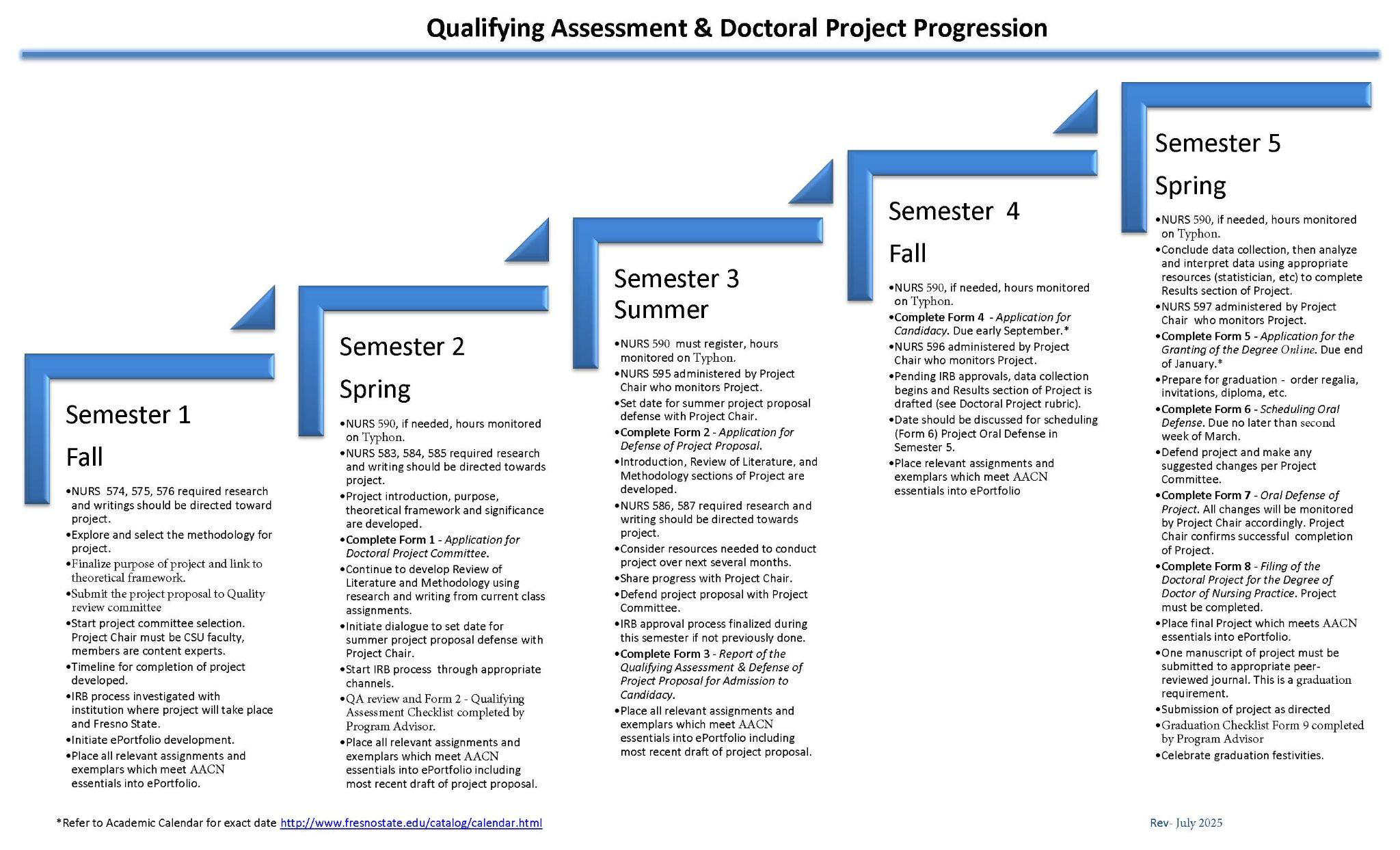
Semester 1 — Fall
- NURS 574, 575, 576 required research and writings should be directed toward project.
- Explore and select the methodology for project.
- Finalize purpose of project and link to theoretical framework.
- Submit the project proposal to Quality review committee
- Start project committee selection. Project Chair must be CSU faculty, members are content experts.
- Timeline for completion of project developed.
- IRB process investigated with institution where project will take place and Fresno State.
- Initiate ePortfolio development.
- Place all relevant assignments and exemplars which meet AACN essentials into ePortfolio.
Semester 2 — Spring
- NURS 590, if needed, hours monitored on Typhon.
- NURS 583, 584, 585 required research and writing should be directed towards project.
- Project introduction, purpose, theoretical framework and significance are developed.
- Complete Form 1 - Application for Doctoral Project Committee.
- Continue to develop Review of Literature and Methodology using research and writing from current class assignments.
- Initiate dialogue to set date for summer project proposal defense with Project Chair.
- Start IRB process through appropriate channels.
- QA review and Form 2 - Qualifying Assessment Checklist completed by Program Advisor.
- Place all relevant assignments and exemplars which meet AACN essentials into ePortfolio including most recent draft of project proposal.
Semester 3 — Summer
- NURS 590 must register, hours monitored on Typhon.
- NURS 595 administered by Project Chair who monitors Project.
- Set date for summer project proposal defense with Project Chair.
- Complete Form 2 - Application for Defense of Project Proposal.
- Introduction, Review of Literature, and Methodology sections of Project are developed.
- NURS 586, 587 required research and writing should be directed towards project.
- Consider resources needed to conduct project over next several months.
- Share progress with Project Chair.
- Defend project proposal with Project Committee.
- IRB approval process finalized during this semester if not previously done.
- Complete Form 3 - Report of the Qualifying Assessment & Defense of Project Proposal for Admission to Candidacy.
- Place all relevant assignments and exemplars which meet AACN essentials into ePortfolio including most recent draft of project proposal.
Semester 4 — Fall
- NURS 590, if needed, hours monitored on Typhon.
- Complete Form 4 - Application for Candidacy. Due early September.*
- NURS 596 administered by Project Chair who monitors Project.
- Pending IRB approvals, data collection begins and Results section of Project is drafted (see Doctoral Project rubric).
- Date should be discussed for scheduling (Form 6) Project Oral Defense in Semester 5.
- Place relevant assignments and exemplars which meet AACN essentials into ePortfolio
Semester 5 — Spring
- NURS 590, if needed, hours monitored on Typhon.
- Conclude data collection, then analyze and interpret data using appropriate resources (statistician, etc) to complete Results section of Project.
- NURS 597 administered by Project Chair who monitors Project.
- Complete Form 5 - Application for the Granting of the Degree Online. Due end of January.*
- Prepare for graduation - order regalia, invitations, diploma, etc.
- Complete Form 6 - Scheduling Oral Defense. Due no later than second week of March.
- Defend project and make any suggested changes per Project Committee.
- Complete Form 7 - Oral Defense of Project. All changes will be monitored by Project Chair accordingly. Project Chair confirms successful completion of Project.
- Complete Form 8 - Filing of the Doctoral Project for the Degree of Doctor of Nursing Practice. Project must be completed.
- Place final Project which meets AACN essentials into ePortfolio.
- One manuscript of project must be submitted to appropriate peer-reviewed journal. This is a graduation requirement.
- Submission of project as directed
- Graduation Checklist Form 9 completed by Program Advisor
- Celebrate graduation festivities.
*Refer to Academic Calendar for exact date http://www.fresnostate.edu/catalog/calendar.html
Rev- July 2025
INSTITUTIONAL REVIEW BOARD REQUIREMENTS
All students are required to review the policies and procedures for research involving human subjects at Fresno State. http://www/fresnostate.edu/academics/humansubjects/index.html
Additionally, Human Subjects (IRB) approval at the facility where the project is to be conducted is required. All projects are to be submitted to the California State University, Fresno School of Nursing Sub-Committee on The Protection of Human Subjects (CPHS) for review.
The human subjects review process is very important and is taken seriously. Any violations of campus or federal human subject’s protection policies can have catastrophic results. The University can lose all federal funding and be banned from receiving future funding. Please read all requirements. The latest version of the Fresno State Policy and Procedures for Research with Human Subjects may be obtained from http://www.fresnostate.edu/academics/humansubjects/policy-procedures/index.html Failure to read and understand the requirements or complete the forms correctly will result in major delays in the project.
No project may be started until written approval to do so has been received.
PRACTICA EMBEDDED IN THE PROGRAM
Practice experiences to assist graduates achieve the essential competencies are embedded in NURS 590, Practicum. According to AACN, in order to achieve the DNP competencies, programs should provide a minimum of 1,000 hours of practice post-baccalaureate as part of a supervised academic program (AACN, 2006, p.19). The students provide official documentation of nursing practicum hours obtained during their master’s degree program or post-master’s certificate program.
PRACTICUM REQUIREMENTS AND GUIDELINES
Practice Experiences in the Curriculum
DNP programs provide rich and varied opportunities for practice experiences aimed at helping graduates achieve the essential and specialty competencies upon completion of the program. In order to achieve the AACN competencies, programs provide a minimum of 1,000 hours of practice post-baccalaureate as part of a supervised academic program. Practice experiences are designed to help students achieve specific learning outcomes related to the AACN Essentials and specialty competencies. These experiences are designed to provide systematic opportunities for feedback and reflection. Experiences include in-depth work with experts from nursing as well as other disciplines and provide opportunities for meaningful student engagement within practice environments. Given the intense practice focus of DNP programs, practice experiences are designed to help students build and assimilate knowledge for advanced specialty practice at a high level of complexity. Therefore, end-of-program practice immersion experiences should be required to provide an opportunity for further synthesis and expansion of the learning developed to that point. These experiences also provide the context within which the final DNP product is completed. Practice immersion experiences afford the opportunity to integrate and synthesize the essentials and specialty requirements necessary to demonstrate competency in an area of specialized nursing practice.
Practicum Hours
According to the American Association of Colleges of Nursing (AACN, 2006), practice experiences in a DNP program build on “advanced specialty practice at a high level of complexity.” The DNP program includes a practice immersion which forms the context for the doctoral project. The post-master’s program, designed to accommodate the majority of DNP students who are practicing Advanced Practice RNs (APRN’s), must plan meaningful clinical experiences that allow integration of DNP level skills as outlined in the Essentials document. Practicum hours for DNP students will occur at health care organization sites.
Rationale for Practicum Hours:
- Integration of AACN competencies
- To provide evidence of achievement with end of end-of-program competencies
- To synthesize what is learned in didactic courses
- To engage in EBP
- To support the Doctoral Project
- Complex systems experience
- To provide advanced direct care with integrated systems experiences
- Leadership skills
- To demonstrate leadership and collaboration skills
- To provide policy-making experiences
The American Academy of Colleges of Nursing (AACN) has mandated that all DNP graduates have completed at least 1000 hours of clinical experiences as part of a supervised academic program in their specialty area post-baccalaureate. Most master level programs require approximately 500 supervised practicum hours. Therefore, on average, DNP students will need to complete approximately 400-500 additional practicum hours focused on the acquisition of abilities in the AACN Essentials document. Even if as a master level nurse the individual completed over 1000 hours, the student still needs to log hours in the DNP program as a demonstration of achieving stated outcomes of the DNP Essentials. The student and the program director create an individualized practicum plan for the person to meet the goals and outcomes of the practicum.
Applicants must provide documentation of supervised practicum hours completed while enrolled in their master’s program as validated by an official letter from the master’s program director. All students will be required to submit appropriate documentation so their program director can assess required practicum-learning hours and determine the number of units the student will need to enroll in. At the first intensive, the individual will meet with their program director to review the Practicum Hours Calculation Worksheet.
The individual may enroll in the practicum course, NURS 590, after completing the first semester of the program. The student will take NURS 590 each semester as needed to complete the 1000 practicum hours required by the American Academy of Colleges of Nursing. The student will sign up for 6 units of NURS 590, which equals 270 hours of practicum. Depending on individual need, calculated at the first intensive, the student will continue to sign up for NURS 590 each subsequent semester. There is the possibility that a student completing no practicum hours in their master’s program will take 4 semesters of NURS 590, semester 2, 3, 4, and 5 for a total of 1080 hours.
Logging of Practicum Hours
All DNP students will take NURS 590 once (6 units=270 hours) during the program. This is required to reflect practicum outcomes as they relate to the AACN Essentials.
The DNP program uses an electronic logging system, Typhon, to document the hours accrued during NURS 590. The student will be provided a user name and password during the first practicum course. The student can only log hours while enrolled in the course. However, there is a significant amount of flexibility regarding what hours the student can count as practicum hours. For instance, all hours (while enrolled in NURS 590) that are spent researching, investigating, and creating the final doctoral project count towards practicum hours. The hours are to be logged accordingly in Typhon. The hours are separated by AACN Essentials, allowing the student to show evidence of achieving mastery of the culminating outcomes expected of a DNP graduate.
When applicable, the DNP student is allowed to count hours accrued while working in their chosen specialty. The line between current employment and clinical application hours must be clear. The individual is not permitted to simply state, “I accrued 8 hours today toward a given essential.” The individual must be purposeful with their objectives towards a given Essential and demonstrate thoughtful reflection.
Practicum Mentor
Each DNP student selects, with the input of their program advisor, a mentor for their practicum experience. The mentor must be an expert in the area in which the DNP student wishes to develop expertise. The practicum mentor will not necessarily be a DNP–prepared advanced practice nurse. The mentor, in conjunction with the program advisor, serves as overseer, advocate, and coordinator of activities in the healthcare setting. Students may have more than one mentor. Mentors will submit a resume or curriculum vitae for review of appropriate qualifications.
Examples of individuals who might fill the practicum mentor role include:
- an advanced practice nurse or other professional with a doctoral degree
- an advanced practice nurse with considerable experience and recognition as an expert in a particular clinical field
- a MD with specialized training and experience
- a nurse with a high level administrative position as the Director, Vice President, President, or CEO within a health care organization
- a nurse educator with a master’s or doctoral degree
- a nurse with an advanced business or other degree, etc.
The practicum mentor must hold a position in the organization where the individual can facilitate the DNP student’s access to clinical services, organizational information, decision makers, and other personnel in order to meet the DNP student’s practicum outcomes and implement the doctoral project (if applicable) during the practicum within the organization. Goals and outcomes of the practice experience are negotiated with the student’s practicum mentor.
Worksite
The practicum will facilitate student’s professional goals as well as meet student learning outcomes of the DNP program. The site for the practicum is determined in accordance with the student’s interest, skill level, and geographic needs, as well as the availability of clinical sites and mentors. A student may be exposed to a variety of clinical settings and have opportunities to interact with professionals from a variety of disciplines. A student may complete practicum hours in their workplace setting as described below. The final doctoral project may be implemented at the student’s practice site. Conditions for approving the worksite for clinical hour completion include:
- Program Goals
- If the placement permits accomplishment of learning outcomes
- If the student is in an APN role and is doing an evidence-based project appropriate for doctoral study
- Change in Current Practice
- If the student can identify how their practice has changed while incorporating the DNP competencies
- If the project represents a change in the system or leadership activity to improve care
- Clear boundaries
- If the student is in a department other than his/her current work environment
- If boundaries are made clear and agreeable to the faculty, manager, mentor and student.
Students may consider their practicum hours and practice at their worksite an advantage; allowing them to “give back” to their agency by improving practice.
Health Requirements
All DNP students will follow each facility’s health care requirement where practicum hours are completed.
Affiliation Agreements (Contracts) for Clinical Sites
Students are welcome to develop their own practicum sites from the California area. However, it may take 2-3 months to establish new contractual arrangements, so students should begin to work early with faculty to make those arrangements. No student may participate in a practicum in an agency in which there is no current affiliation agreement. The DNP student will be provided a list of current affiliations.
CERTIFICATION
Students entering the Doctor of Nursing Practice program should have advanced education in a specialty. Candidates who are eligible for clinical certification as Advanced Practice nurses should have valid state licensure and state certification. Additionally, they must be able to maintain their certification as an ongoing process with regard to clinical hours, continuing education units, etc. Graduates from other advanced specialty areas (such as public health or health administration) need not have APN certification. However, these individuals must be prepared to sit for a national certification if an advanced practice or master’s level certification is not co-existent with their original master’s degree. All DNP students must have a valid national certification at the time of graduation in order to have their degree conferred.
POLICIES ON PROFESSIONAL ETHICS & ACADEMIC INTEGRITY
Students enrolled at Fresno State and Faculty of Fresno State will respect and honor the codes and standards set by Fresno State in all matters.
CODE OF ACADEMIC INTEGRITY HONOR CODE
Fresno State is committed to maintaining a culture of academic integrity where all members are expected to adhere to fundamental values in both academic and non-academic endeavors. For purposes of this code, academic integrity is defined as “a commitment, even in the face of adversity, to five fundamental values: honesty, trust, fairness, respect, and responsibility. From these values flow principles of behavior that enable academic communities to translate ideals to action” (Center for Academic Integrity, Fundamental Values of Academic Integrity – January 2005)
All Academic Policies including Academic Governance, Personnel/Faculty, and Student
Affairs may be found at the following website:
http://www.fresnostate.edu/academics/facultyaffairs/policies/apm/index.html/html
The Code
Members of the Fresno State academic community adhere to principles of academic integrity and mutual respect while engaged in university work and related activities.
Principles of Implementation
- All members of the university community are responsible for adhering to high standards of academic integrity, for actively ensuring that others uphold the Code, and for responding assertively to violations. (APM 336 *)
- Faculty members are responsible for informing students of academic behaviors that are permissible and not permissible, and for reporting violations of the code to the proper campus authorities. (APM 235, 241, 336)
- Students shall not give or receive unauthorized aid on examinations or other course work that is to be used by the instructor as the basis of grading.
DNP Faculty Responsibilities
DNP academic faculty will:
- Exhibit high standards of professional ethics. (APM 336)
- Treat all students fairly and consistently to avoid any appearance of special favors for special groups. (APM 336)
- Explain what constitutes cheating, plagiarism, inappropriate collaboration or other issues related to academic integrity through the class syllabus, and in relation to assignments, tests and other class activities for which grades are to be assigned. Provide links to university web sites that explain and elaborate these policies. (e.g., APM 235, 241, 336)
- Give examples of cheating and plagiarism for the particular class and provide examples of past consequences to students for such behavior. (APM 241)
- Regularly update tests, assignments and notes.
- Uphold university policy to report all instances of cheating, plagiarism and inappropriate academic behavior to the Office of the Vice-President for Student Affairs /Dean of Students. (APM 235)
- Establish a ‘culture of academic integrity’ in individual classes and in each department.
- Monitor students during tests and develop procedures for assessing whether assigned work has been completed in accordance with expectations.
- Develop expectations for student self-monitoring and collective monitoring during examinations and on assignments by having students include and sign the following statement on all work to be used as the basis for a grade: “I have done my own work and have neither given nor received unauthorized assistance on this work.”
DNP Student Responsibilities
- Understand or seek clarification about expectations for academic integrity (including no cheating, plagiarism, and inappropriate collaboration) as noted by faculty and on class syllabi, university catalogue, university web sites and other referenced sources. (APM 235, 241)
- Take responsibility to monitor academic dishonesty in any form and to report it to the instructor or other appropriate official for action.
POLICIES & PROCEDURES
Student Grievances
A student-related dispute could arise out of a decision or action, in the course of official duty by a member of the faculty, staff, or administration of California State University, Fresno. The decision or action could be alleged as discriminatory, contrary to accepted academic relationships and procedures, or restrictive of the rights of any student of the university to fair treatment. The dispute resolution process provides a mechanism for students to have a third party review the situation. The student must first make a good faith effort to resolve the matter informally by talking directly with the individual concerned, the individual’s direct supervisor or department chair, and the director of the unit or college/school dean. If resolution is not effective through the informal procedures, for assistance, the student should contact the Office of the Vice President for Student Affairs and Dean of Students.
http://www.fresnostate.edu/academics/aps/documents/apm/415.pdf
Recommended by the Academic Senate April 2005 Approved by the President May 5, 2005 – APM 236.2
Student Dispute Resolution Process
General student disputes may be addressed during DNP Executive Leadership Team (ELT) meetings. If a resolution is not reached, the matter may be escalated to the Student Affairs Committee. The process for resolving student disputes follows established university and program policies and procedures. Students have three options for resolving concerns, which are expected to follow this sequence:
- Informal Resolution – The student should first attempt to resolve the issue directly with the involved faculty member.
- Program-Level Appeal – If the issue is not resolved, the student may bring the concern to the DNP Advisor or submit it for review by the DNP ELT Committee.
- Formal Appeal to Student Affairs Committee – If a satisfactory resolution is not achieved, the student may appeal to the Student Affairs Committee.
If the dispute progresses to Step 3, the recommendation of the Student Affairs Committee will be communicated at the time of the hearing. Written copies of the recommendation will be sent to the student, the faculty member involved, and the Chair of the School of Nursing (SON). A copy will also be placed in the student’s SON academic file.
For disputes not related to grades, a Student Advising Form will be initiated to document the concern and resolution process. This form will also be placed in the student’s academic file.
Referenced Policies from the University’s Academic Policy Manual:
- APM 235--Policy on Cheating and Plagiarism
http://www.fresnostate.edu/academics/aps/documents/apm/235.pdf - APM 241--Policy on Course Syllabi and Grading
https://academics.fresnostate.edu/facultyaffairs/documents/apm/241.pdf - APM 336--University Statement on Faculty Rights and Responsibilities
https://academics.fresnostate.edu/facultyaffairs/documents/apm/336.pdf
CHEATING & PLAGIARISM
http://www.fresnostate.edu/academics/aps/documents/apm/235.pdf
PHILOSOPHY
Honesty and integrity are two of the most important values of the university in its pursuit and dissemination of truth and knowledge. Faculty and students share the responsibility for maintaining the probity of the educational experience and preserving high standards of excellence.
Academic dishonesty -- Cheating and Plagiarism -- is unacceptable behavior morally, ethically and legally; and it cannot be justified or tolerated. To do otherwise undermines the ideals and purposes of higher education and severs the bonds of respect and trust between teacher, student and society. Cheating and plagiarism compromise the process of fair and equitable evaluation of all students' academic performance and erode the quality and value of degrees conferred by the University. Students engaging in such practices are denying themselves the benefit of an instructors’ accurate assessment and feedback, thereby hindering their academic and personal development. Moreover, intellectual dishonesty reinforces the false idea that success in life, personally and professionally, can come to those who deviate from community norms and who lack the requisite expertise in their chosen careers.
RESPONSIBILITY
Although faculty set the standards for moral and academic excellence in teaching and learning, such standards cannot be attained without full cooperation and support of students. Therefore, each student is expected to accept her/his responsibility to maintain honesty and integrity in all endeavors inside and outside of the classroom, studio, or laboratory. Faculty must encourage this by: establishing an atmosphere of mutual respect in their classrooms; stating her/his own standards and expectations for academic performance; structuring learning situations that encourage honesty and deter cheating and plagiarism; presenting the University's policy on cheating and plagiarism and the penalties for violations thereof; and holding accountable those who infringe on this policy. The policies herein on cheating and plagiarism and the accompanying due process procedures are designed to accomplish the above stated objectives, while protecting the rights of the accused. This policy, along with the related procedures, should be followed scrupulously.
INTRODUCTION
Adjudicating cases of cheating and plagiarism involves at least two aspects of the student's status within the university. The first directly affects the student's academic status in the university. The second may involve disciplinary action, which also may jeopardize the student's ability to remain enrolled in the university. When an instructor believes a student is cheating and/or plagiarizing, he/she must still preserve the student's right to due process and confidentiality in handling the situation according to this policy on cheating and plagiarism and Executive Order 628, Student Disciplinary Procedures for the California State University.
STUDENT'S ACADEMIC STATUS/STANDING
Academic Work and Grading
The faculty expects students to maintain honesty and integrity in their academic performance. On the other hand, students expect faculty to maintain integrity and fair play in the performance of their teaching and grading responsibilities. Students are expected to be familiar with university policies on cheating and plagiarism which can be found in the university's General Catalog and Schedule of Courses. Instructors shall include a statement in their syllabus on intellectual honesty and integrity as it relates to the University's policies on cheating and plagiarism.
Since proving cheating and/or plagiarism can result in severe penalties and consequences, students are expected to clarify with their instructors whether or not certain actions would or would not be acceptable behavior in taking examinations, writing papers, doing homework, and performing other activities pertaining to any given class and/or laboratory. If a student observes one or more students cheating and/or plagiarizing, it would be proper for the student to confront those students directly and/or to notify the instructor so that the instructor could take appropriate action.
Definitions
For examples of cheating please see Academic Policy 235 Appendix A and B:
http://www.fresnostate.edu/academics/aps/documents/apm/235.pdf
Cheating
Cheating is the actual or attempted practice of fraudulent or deceptive acts for the purpose of improving one's grade or obtaining course credit; such acts also include assisting another student to do so. Inappropriate behavior reasonably interpreted as evidence of the intent to cheat is also interpreted as cheating for the purpose of this policy. Typically, such acts occur in relation to examinations. However, it is the intent of this definition that the term "cheating" not be limited to examination situations only, but that it includes any and all actions by a student that are intended to gain an unearned academic advantage by fraudulent or deceptive means.
Plagiarism
Plagiarism is a specific form of cheating which consists of the misuse of the published and/or unpublished works of others by misrepresenting the material (i.e., their intellectual property) so used as one's own work.
Procedures
When a faculty member responsible for a course has reason to believe that an action of a student falls within one or both of the above definitions, the faculty member is obliged to initiate a faculty-student conference [Section 1. paragraphs a) through c)] or refer it directly to a departmental hearing [Section 2, paragraphs a) through e)]. If the alleged cheating and/or plagiarism occurred at the end of the semester, the faculty member shall submit a grade of "I", rather than an "F" or other letter grade, which will stand until the allegation has been resolved. Given the sensitive nature of the events referenced by this policy, all parties involved should act and respond in a timely fashion.
Faculty-Student Conference
The instructor may choose to handle the alleged instance of cheating and/or plagiarism in conference with the student. During the conference, the instructor shall present the student with the charge and the evidence. Sooner is better, but normally the conference should occur no later than one month from the alleged incident or discovery of it. If the conference finds that cheating and/or plagiarism occurred, the Instructor's Report of Cheating and/or Plagiarism must be filed.
The procedures for the faculty-student conference are detailed in paragraphs a) through c) below:
Academic Sanctions
If the student admits to the wrongdoing, the instructor shall impose an academic sanction. The instructor has the prerogative of lowering a grade, assigning a grade of “0” or “F” for the test/paper, assigning an “F” for the entire course, or recommending another penalty that seems appropriate. No sanction can be imposed without filing the Instructor's Report of Cheating and/or Plagiarism with the Vice President for Student Affairs and Dean of Students.
- Disciplinary Sanctions
- In addition to academic sanctions, faculty may also recommend students who admit to cheating and/or plagiarism be subject to additional disciplinary sanctions by the Vice President for Student Affairs and Dean of Students pursuant to Section 41301 of Title 5; Executive Order No.628. Following procedures consonant with due process, disciplinary action taken by the Vice President for Student Affairs and Dean of Students may include, but is not limited to, the following: blocking the possibility of substituting a grade earned later in the same course, a written reprimand, probation, suspension, or expulsion.
- Recommendations for these disciplinary sanctions will be considered upon receipt of the Instructor's Report of Cheating and/or Plagiarism filed by the instructor as called for under Section I Subpart C within one month following the faculty-student conference.
- Instructor’s Report of Cheating and Plagiarism
- If the faculty member is convinced that cheating and/or plagiarism did not occur, the conference is considered concluded and no report of the incident is made. If the faculty member and the student agree that cheating and/or plagiarism did occur and the student accepts the recommended sanction(s), the conference is considered completed to the satisfaction of both parties. At the successful conclusion of the faculty-student conference, the faculty member must file the Instructor's Report of Cheating and/or Plagiarism with the Vice President for Student Affairs and Dean of Students within one month of the faculty-student conference. The report will be placed in a confidential file in accordance with the federal Family Educational Rights and Privacy Act of 1974 and California's Education Code, Section 67100 et. seq. Seven years after the cheating/plagiarism incident is resolved, the report shall be removed from the file and destroyed.
Departmental Hearing
At the initiation of the faculty member or in the event that no mutually agreeable settlement is reached as a result of the faculty-student conference, the faculty member immediately concerned will consult with the department chair(s) or designees as soon as possible but normally no later than one week after the faculty-student conference or the alleged incident occurred and/or was discovered. At that time, the faculty member will describe the nature of the incident and present supporting evidence. In addition to the evidence presented by the instructor, the chair may conduct an investigation. The procedures for the departmental hearing are detailed in paragraphs a) through e) below.
- Notification of Hearing
- The department chair will forward a written statement of the allegation to the student as soon as possible, together with a brief description of the supporting evidence, a statement of the student's right to a meeting and to present evidence in his or her own behalf, in addition to a copy of the Policy and Procedures on Cheating & Plagiarism (APM 235). The student must be informed of where and when the full supporting evidence of academic dishonesty is available for review and be notified of his/her right to bring an advisor to the hearing. The student must be given time to prepare a defense.
- Official Hearing
- The department chair will schedule a hearing as soon as possible -- normally, this should be no later than two weeks after the alleged incident occurred and/or was discovered. Every effort should be made to schedule the hearing at a time convenient to all parties involved. Those present at the hearing will include the department chair or designees, the faculty member, and the student charged. Also, a faculty/staff member or student of the student's choice may attend to act as an advisor. Legal counsel may not attend departmental hearings. In a case where two or more students are involved, the chair will schedule a group hearing unless one or more students request separate hearings or the chair believes separate hearings would be necessary or appropriate. The department chair will conduct the hearing and has the authority to negotiate a settlement between or among the principals, if agreeable to all parties. (For example, a different test might be constructed and administered, an essay might be rewritten, or a disinterested third party might be asked to grade the test/paper.) It should be remembered that the burden of responsibility is upon the instructor to provide evidence during the hearing that the student did cheat or plagiarize. If the departmental hearing finds that cheating and/or plagiarism did occur.
- If the instructor alleging cheating/plagiarism is also the department chair or another administrator, the college/school dean will schedule and conduct this meeting.
- Actions on sanctions recommended after the departmental hearing cannot be taken without filing the department chair's Report of Cheating and/or Plagiarism. The department chair will notify the student and the instructor in writing of the decision resulting from the departmental hearing. In the event the faculty member or the student involved does not attend the departmental hearing, the hearing shall proceed. The department chair shall render a decision and notify in writing all parties involved of the decision resulting from the departmental hearing including a copy of the department chair's report of cheating/plagiarism. The faculty member shall forward a copy of the Instructor's Report of Cheating and Plagiarism if appropriate. If the instructor alleging cheating/plagiarism is also the department chair or another administrator, the college/school dean or designee will schedule and conduct this meeting.
- Academic Sanctions
- If the departmental hearing finds that cheating and/or plagiarism did occur, the faculty member shall impose an academic sanction. The student will be informed in writing of the academic sanctions imposed. The instructor has the prerogative of lowering a grade, assigning a grade of "0" or "F" for the test/paper, assigning an "F" for the entire course, or assigning another penalty that seems appropriate. If the student does not acknowledge guilt or acknowledges guilt but is not willing to accept the recommended sanction(s), the student has the right to appeal the decision to the Student Academic Petitions Committee in accordance with the Policy & Procedures for Reviewing and Appealing an Assigned Grade (APM 242). If a failing grade for the entire course is assigned, the instructor must inform the student that he/she should remain in the course --completing all assignments, and taking all tests to accommodate the student's option to appeal the instructor's grade and to allow for the time required by the appeal process to render a final decision. On the other hand, if the evidence does not support the charge, the Chair will notify the student in writing and will request the instructor to record the appropriate grade. If the faculty member disagrees with the Chair's decision, the faculty member may appeal the decision to the Student Academic Petitions Committee. The faculty member must appeal the decision by formal memorandum within two weeks of the decision. If the alleged cheating and/or plagiarism occurred at the end of the semester, the faculty member shall submit a grade of "I", rather than an "F" or other letter grade, which will stand until the allegation has been resolved by due process as described above and in accordance with the Policy & Procedures for Reviewing and Appealing an Assigned Grade (APM 242).
- Disciplinary Sanctions
- In addition to academic sanctions, faculty may also recommend students who are found guilty of cheating and/or plagiarism be subject to additional disciplinary sanctions by the Vice President for Student Affairs and Dean of Students pursuant to Section 41301 of Title 5; Executive Order No.628. Following procedures consonant with due process, disciplinary action taken by the Vice President for Student Affairs and Dean of Students may include, but is not limited to, the following: blocking the possibility of substituting a grade earned later in the same course, a written reprimand, probation, suspension, or expulsion.
- Recommendations for these disciplinary sanctions will be considered upon receipt of the Instructor's Report of Cheating and/or Plagiarism filed by the instructor normally within one month of the hearing conducted by the department chair.
- Instructor's Report of Cheating and/or Plagiarism
- At the conclusion of the departmental hearing where cheating and/or plagiarism is found to have occurred, the faculty member shall file the Instructor's Report of Cheating and/or Plagiarism with the Dean of Students normally within one month of the hearing. If the student accepts the recommended sanctions(s), the departmental hearing is considered completed to the satisfaction of both parties. The report will be placed in a confidential file in accordance with the federal Family Educational Rights and Privacy Act of 1974 and California's Education Code, Section 67100 et.seq. Seven years after the cheating/plagiarism incident is resolved, the report shall be removed from the file and destroyed.
Student Rights
Nothing in this policy statement is intended to deny students who come within its scope full access to due process, including the right to be informed of the charges against him or her, to be informed of the nature of the evidence supporting such charges, to have a meeting at which time statements and evidence in his or her own behalf may be submitted, and to appeal any decision resulting from such meeting through appropriate university channels. If the student does not acknowledge guilt, or acknowledges guilt but is not willing to accept the recommended sanction(s), the student has the right to appeal the decision to the Student Academic Petitions Committee in accordance with the Policy and Procedures for Reviewing and Appealing an Assigned Grade (APM 242). If a failing grade for the entire course is assigned, the instructor must inform the student that he/she should remain in the course -completing all assignments and taking all tests to accommodate the student's option to appeal the instructor's grade and to allow for the time required by the appeal process to render a final decision. On the other hand, if the evidence does not support the charge, the chair will notify the student in writing and will request the instructor to record the appropriate grade. The student has the right to appeal the faculty member's grade or other action and department chair's decision to uphold the grade or other action to the Student Academic Petitions Committee within two weeks of the written notification of the decision.
A copy of the Policy & Procedures for Reviewing and Appealing An Assigned Grade may be obtained from the Office of Advising Services. In addition, the Policy is located in the Academic Policy Manual in each academic department office and in the Library.
References: Family Educational Rights and Privacy Act of 1974 California's Education Code, Section 67100 et. seq. Title 5 Section 41301; CSU Executive Order No.628 Policy & Procedures for Reviewing and Appealing an Assigned Grade (APM 242)
Recommended by the Academic Senate August 1979 Approved by the Vice President-in-Charge September 1979 Amended 4/84; 5/96; 3/30/01
STUDENT FEES
The authorizing legislation designated the fee structure for the CSU DNP programs and the CSU Board of Trustees subsequently approved fees that conform to the legislative provisions. The fees are divided equally over 5 semesters and are not based on units per semester. This fee does not include miscellaneous university fees, such as Health Center Fees. Fees are subject to change at any time as per the Chancellor’s Office directives. Out-of-State, non-California resident students are charged Non-Resident Tuition Fees in addition to tuition and other fees.
https://adminfinance.fresnostate.edu/accountingservices/students/tuitionfees.html
LEAVE OF ABSENCE OR WITHDRAWING FROM THE UNIVERSITY
Planned Educational Leave of Absence
A planned educational leave of absence is defined as a planned interruption or pause in a student's regular education during which the student temporarily ceases formal studies in the CSU Fresno DNP program while pursuing other activities that may assist in clarifying the student's educational goals. The intent of the policy is to make it possible for a student to suspend his or her academic work and later resume studies with a minimum of procedural difficulty. A student who is approved for a planned leave will be considered a continuing CSU Fresno DNP student. A planned educational leave for graduate students must be recommended by the Dean, Division of Graduate Studies, California State University, Fresno.
Planned educational leaves may be granted for a variety of reasons or projects, but certain characteristics must be contained in any request for a leave:
- The student must have a definite objective, which in the judgment of the appropriate university official, contributes to his or her educational goals and objectives.
- A student must have a verified serious medical condition that warrants absence from the university. Medical documentation must be submitted with the request.
- The request must be for a specific period of time which shall not exceed four consecutive semesters.
- The student must plan to return to CSU Fresno DNP program at the conclusion of his or her leave.
- The following regulations apply to the planned educational leave:
- A student currently enrolled in a fully matriculated session may be considered for a planned educational leave.
- A student may be granted only one leave. Planned educational leaves are granted for up to four consecutive semesters.
- Petitions for planned educational leaves must be filed (with the appropriate recommendation) at the Registrar's Office before the first day of classes for the semester during which the leave is to begin.
- Leaves are not approved for students in disqualified status or on contract to remove academic deficiencies.
- A student is expected to devote the leave primarily to non-classroom activities. A leave is not approved if the student plans to attend another institution, unless the coursework the student seeks is not available at the CSU Fresno DNP program. Any academic credit earned while on a planned educational leave is accredited by CSU Fresno DNP only if permission is granted for that credit in advance.
- Students who do not return to the university at the conclusion of their planned educational leave and those who enroll elsewhere will be considered to have withdrawn from the university at the end of their last semester of regular enrollment in the CSU Fresno DNP program and will have to reapply for admission upon their return.
Students wishing to apply for a planned educational leave should obtain a request form from the Admissions, Records, and Evaluations Office, North Lobby, Joyal Administration Building. A student who has been granted a leave will be allowed to join a later cohort, which, when the individual returns, is taking classes that were missed. Students unable to withdraw from a course within the allotted time period for withdrawals, due to extenuating circumstances or university error, may file a Request for Retroactive Withdrawal form.
UNIVERSITY POLICIES
Students with Disabilities:
Upon identifying themselves to the instructor and the university, students with disabilities will receive reasonable accommodation for learning and evaluation. For more information, contact Services to Students with Disabilities in the University Library, Room 1202 (278- 2811).
Financial Aid Satisfactory Academic Progress Standards and Appeals Process:
https://studentaffairs.fresnostate.edu/financialaid/policies/sap/index.html
The following University policies can be found on the web at:
- Adding and Dropping Classes
- Cheating and Plagiarism
- Computers
- Copyright Policy
- Disruptive Classroom Behavior
- Honor Code
- Title IX
Fresno State is committed to fostering a safe, productive learning environment for all students. Title IX and CSU policy prohibit discrimination on the basis of sex, which includes sexual harassment, domestic and dating violence, sexual assault, sexual exploitation, and stalking. We understand that sexual violence can impact a students’ ability to be successful in the learning environment. We encourage students who have experienced sexual misconduct to seek information on where to report from any member of our faculty or staff in order to ensure that the university can provide students with the necessary resources and supportive measures.
As an instructor, I have a mandatory reporting responsibility as a part of my role. It is my goal that you feel comfortable sharing information related to your life experiences in classroom discussions, in your written work, and in our one-on-one meetings. I will seek to keep the information you share private to the extent possible. However, I am required to report any information I receive regarding sexual misconduct or information about a crime that may have occurred during your time at Fresno State.
Students can report incidents of alleged sexual misconduct to either or both of the following resources:
- Office of Compliance and Civil Rights | occr.fresnostate.edu | 559.278.5003
- Fresno State Police Department | fresnostate.edu/police | 559.278.8400
Students can also report other incidents of discrimination or harassment to:
Office of Compliance and Civil Rights | occr.fresnostate.edu | 559.278.5003
Students can access confidential support from two separate resources on campus:
- Counseling Services | studentaffairs.fresnostate.edu/health/counseling | 559.278.2734
- Survivor Advocacy Services | fresnostate.edu/survivoradvocate | 559.278.6796
Pregnancy or Related Conditions:
Pregnant Students or those with related conditions should contact the Title IX Coordinator in the Office of Compliance and Civil Rights for assistance. The Title IX Coordinator can coordinate specific actions to prevent sex discrimination and ensure the students equal access to educational programs or activities.
Office of Compliance and Civil Rights | occr.fresnostate.edu | 559.278.5003
Parent scholars provides information on priority registration and other support for parenting students.
Services for Students with Disabilities can also provide assistance with accommodations.
If you have concerns and you are unsure who to contact, please visit the Concern & Action Guide.
Emergency Information
In the event of an emergency, everyone in the campus community becomes a partner in the response. To ensure you are prepared and remain calm you must make yourself familiar with campus protocols. To contact the Fresno State Police Department call 559.278.8400 from your cell phone or 911 from a campus phone. Prior to an emergency, assess your environment for options depending on the emergency. Identify all possible exit routes, in an emergency always use the closest most safe exit. Once you exit the building go to the predetermined evacuation assembly point, if that is unavailable then go to an open safe space away from the emergency. Identify where and how you can secure yourself inside if you need to shelter in place or hide from a threat. Be prepared to help guide those around you and assist individuals who may be in need. Additional information can be found at www.fresnostate.edu/emergency.
UNIVERSITY SERVICES
The following University services can be found on the web at:
- Associated Students, Inc.
- Students with Disabilities
- Dream Success Center
- Library
- Learning Center Information
- Student Health and Counseling Center
- Academic Success Coaching
- Survivor Advocacy
- Writing Center
SIGNATURE PAGE
I have read and understand the California State University, Fresno, Doctor of Nursing Practice STUDENT HANDBOOK 2026-2027
STUDENT NAME (PRINT)
STUDENT SIGNATURE
DATE