Deaf Education Graduate Program Student Outcomes Assessment Plan
California State University, Fresno
College of Health and Human Services
Communicative Sciences and Deaf Studies, MA
Deaf Education Graduate Program
Department/Program Assessment Coordinator (i): Brooke Findley, Ed.D. CCC-SLP, BCBA
I. Mission Statement
The Mission of the Department of Communicative Sciences and Deaf Studies at California State University, Fresno is to disseminate knowledge and to train professionals who will provide quality service to the public. The department will accomplish this mission by providing a stimulating learning environment for enhancing personal and educational development, promoting an understanding of people of various cultures, and offering opportunities for research and scholarship in Communicative Sciences and Deaf Studies.
I. Institutional Learning Outcomes, Program Learning Outcomes/Goals, and SLOs [a,b,c]
A. Institutional Learning Outcomes
Fresno State ILOs are posted on the following webpage: http://fresnostate.edu/academics/oie/assessment/fresno-state-assessment.html. They include:
- Developing a foundational, broad, and integrative knowledge
- Acquiring specialized knowledge
- Improving intellectual knowledge
- Applying knowledge
- Exemplifying equity, ethics, and engagement
B. Program Learning Outcomes and SLOs
- PLO: Read, understand, and apply research literature to strengthen educational services
for Deaf and/or hard of hearing students.
- SLO: Students will understand the scientific method, describe major research designs, and apply basic measurement techniques in formal projects, or in education applications.
- SLO: Students will appreciate and critically evaluate Deaf Education research as well as the role of and need for research in the field and practice of Deaf Education.
- PLO: Demonstrate professional communication skills.
- SLO: Students will write using appropriate spelling and grammar and produce well-organized papers using current American Psychological Association (APA) guidelines (American Psychological Association, 2019).
- SLO: Students will use effective communication skills to establish and maintain good relationships with students, parents, other professionals, administrators, and school personnel.
- PLO: Understand and apply foundational information in anatomical, physiological, neurological,
psychological, and sociological aspects of human communication.
- SLO: Students will demonstrate knowledge of the behavioral, linguistic, academic, social, and psychological implications associated with being Deaf or hard of hearing.
- PLO: Assess an individual’s ability or performance and appropriately interpret and
apply this information.
- SLO: Students will appropriately select, administer, and interpret the results of formal and informal assessments of the educational needs of Deaf and/or hard of hearing students.
- PLO: Plan, implement, evaluate, and modify educational interventions across a wide
range of students.
- SLO: Students will understand the philosophies underlying current intervention and education methods.
- SLO: Students will competently plan, apply, and modify educational intervention strategies based on assessment results and/or analysis of ongoing progress monitoring.
- PLO: Appreciate, understand, and productively apply multicultural information.
- SLO: Students will understand multicultural, multilingual, and social considerations concerning the practice of Deaf Education.
- SLO: Students will select and implement appropriate assessment and intervention procedures and materials for individuals from a variety of culturally, linguistically, or socially diverse populations.
II. Curriculum Map [d]: Courses in which SLOs are addressed and evaluated
| Course | SLO 1.1 | SLO 1.2 | SLO 2.1 | SLO 2.2 | SLO 3.1 | SLO 4.1 | SLO 5.1 | SLO 5.2 | SLO 6.1 | SLO 6.2 |
|---|---|---|---|---|---|---|---|---|---|---|
| CSDS 201 | I | I | I | |||||||
| CSDS 203 | I, D, M | I, D, M | I, D, M | |||||||
| CSDS 206 | D | I | I | |||||||
| CSDS 255 | I, D | D | D | D | D | |||||
| CSDS 262 | D | D | D | D | ||||||
| CSDS 263 | D | D | D | D | ||||||
| CSDS 264 | D | D | D | D | ||||||
| CSDS 271 | I | D | I, D | I, D | ||||||
| CSDS 272 | D | D | D | D | D | |||||
| CSDS 273 | D | D | D | D | D | |||||
| CSDS 258 | M | M | M | M | M | M | M | |||
| CSDS 260 | D | D | D | D | D | D | D | |||
| CSDS 268 | M | M | M | M | M | M | M | |||
| CSDS 299 | Only applicable if students have selected this culminating experience. In such cases, the SLOs addressed depend on the topic of the student’s research. | |||||||||
Key: I = Introduced D = Developed M = Mastered
III. SLOs Mapped Assessment Measures and Methods [e]
| Assessment Measure | Evaluation Method | SLO 1.1 | SLO 1.2 | SLO 2.1 | SLO 2.2 | SLO 3.1 | SLO 4.1 | SLO 5.1 | SLO 5.2 | SLO 6.1 | SLO 6.2 |
|---|---|---|---|---|---|---|---|---|---|---|---|
| Graduate Writing Requirement | Score | X | X | X | |||||||
| Student Teaching Evaluation | Score | X | X | X | X | X | X | X | |||
| Comprehensive Examination Results | Score | X | X | X | X | X | X | ||||
| Exit Survey | Score | X | X | X | X | X | X | ||||
| Employer Survey | Score | X | X | X | X | X | X | X | |||
| Advisory Committee | Focus Group | X | X | X | X | X | X | X |
IV. Assessment Measures: Description of Assignment and Method (rubric, criteria, etc.) used to evaluate the assignment [f]
A. Direct Measures (Department/Program must use a minimum of three different direct measures)
- Graduate Writing Requirement Results. Students meet the graduate writing requirement through passing a spontaneous essay and successful completion of a written research proposal. Major reasons for fails will be noted for program review. At least 80% of students will pass the graduate-level writing requirement on their first attempt.
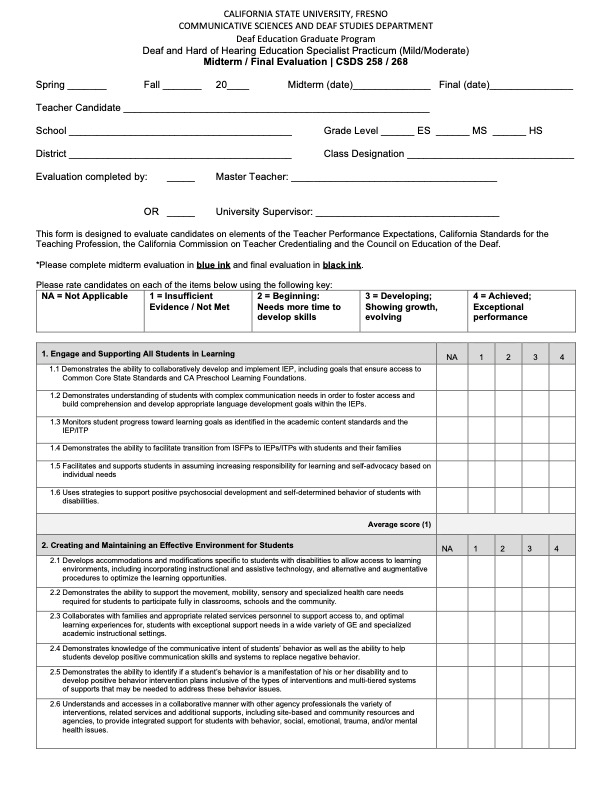
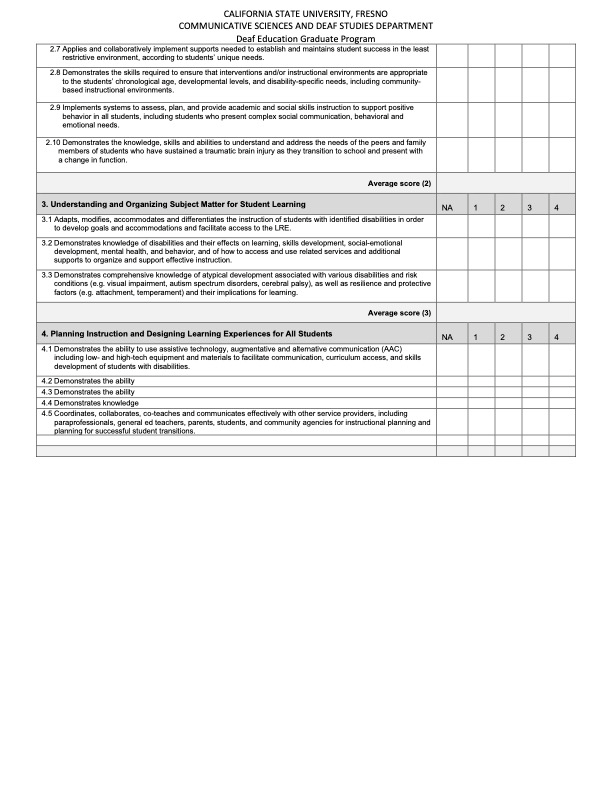
- Student Teaching Evaluation. Each semester, master teachers complete an evaluation of students under their supervision. Those items reflecting on student performance will be averaged (per area) and tracked across semesters. At least 80% of students will score at or above “present (3)” for student teaching evaluations when their scores on applicable items are averaged (See Appendix A: Evaluation of Student Teacher).
- Comprehensive Examination Results. Percent of students passing, passing in oral examinations, and failing the comprehensive examination will be tracked each academic year. At least 80% of students will pass the comprehensive examinations in each area.
B. Indirect Measures (Department/Program must use a minimum of one indirect measure)
- Exit Survey. Graduate students in their final semester will be asked to complete an online Graduate Student Exit Survey (See Appendix B: Graduate Student Exit Survey). Should at least 80% of students indicate that they “agree” or “strongly agree” with relevant items on the exit survey, the individual SLOs mapped to this indirect measure shall be considered met.
- Employer Survey. An online employer survey will be sent to school districts, residential schools, private companies, and other entities that are known to employ our graduates. We will reach out to them using our department database, as well as social media contacts. Should at least an average rating of “good” on applicable items of the employer survey be reported, the SLOs aligned with this indirect measure will be considered met (See Appendix C: Employer Survey).
- Minutes of Advisory Committee. Selected professionals from the surrounding region are members of the Deaf Education Advisory Committee. The Deaf Education Advisory Committee meets to provide feedback regarding program development in the Deaf Education program. The minutes of this committee’s meeting will be analyzed and areas of strength or needed change will be noted and summarized. While no quantitative target is set, it is expected that themes from this measurement tool largely indicate that our students are effectively prepared to enter the workforce (See Appendix D for a list of questions that will be proposed during the Deaf Education Advisory Committee Meeting).
V. Assessment Schedule/Timeline [g]
| Academic Year | Measure | SLO 1.1 | SLO 1.2 | SLO 2.1 | SLO 2.2 | SLO 3.1 | SLO 4.1 | SLO 5.1 | SLO 5.2 | SLO 6.1 | SLO 6.2 |
|---|---|---|---|---|---|---|---|---|---|---|---|
| 2021-2022 | Graduate Writing Requirement COMPS Results |
X | X | X | X | X | X | X | X | X | |
| 2022-2023 | COMPS Results Student Teaching Evaluations |
X | X | X | X | X | X | X | |||
| 2023-2024 | Student Teaching Evaluations Exit Survey |
X | X | X | X | X | X | X | |||
| 2024-2025 | Exit Survey Advisory Committee Meeting |
X | X | X | X | X | X | X | |||
| 2025-2026 | Employer Survey Graduate Writing Requirement |
X | X | X | X | X | X | X | X | X | X |
| 2026-2027 | Graduate Writing Requirement COMPS Results |
X | X | X | X | X | X | X | X | X | |
| 2027-2028 | COMPS Results Student Teaching Evaluations |
X | X | X | X | X | X | X | |||
| 2028-2029 | Student Teaching Evaluations Exit Survey |
X | X | X | X | X | X | X | |||
| 2029-2030 | Exit Survey Advisory Committee Meeting |
X | X | X | X | X | X | X |
VI.Closing the Loop [h,j,k]
Fresno State Closing the Loop process is described immediately below.
VII.
A major assessment report, which focuses on assessment activities carried out the previous academic year, is submitted in September of each academic year and evaluated by the Learning Assessment Team and Director of Assessment at Fresno State.
Program/Department Closing the Loop process: Data are collected and analyzed according to the implementation schedule above. This information is then used to write a report, “Summary of Outcome Assessment Results,” for the academic year in which the data are collected. Shortly after the report is complied, it is presented to and reviewed by the departmental faculty. The findings are discussed and an action plan may be decided upon, as appropriate. If it is decided that an action needs to be taken or a change needs to be made, responsibilities are assigned. It is then up to the assessment coordinator to follow up on any actions or changes in terms of additional data collected in subsequent years. Examples of summary assessment result reports will clearly identify actions that have been taken and are available upon request.
VIII. List of Appendices
Appendix A: Student Teacher Evaluation Form
Appendix B: Exit Survey
Appendix C: Employer Survey
Appendix D: Questions to be Presented at the Deaf Education Advisory Committee Meeting
Appendix A
Student Teacher Evaluation Form
Appendix B
Exit Survey
Identify your major: Deaf Education
Speech-Language Pathology
Rate each of the following statements: 0 = no opinion
1 = strongly disagree
2 = disagree
3 = agree
4 = strongly agree
- Advising was helpful.
- My undergraduate studies and learning experiences at CSUF prepared me for graduate
school.
Ø If you did not attend CSUF for your undergraduate studies, please select “0” - My graduate classes and learning experiences prepared me for my internships, externships, and/or student teaching.
- I feel prepared to communicate with parents, clients, students, and other professionals.
- I am confident in my abilities to assess a client’s or student’s communication abilities.
- I am confident in my abilities to plan and implement educational or clinical interventions across a wide range of students or clients.
- I am comfortable locating, reading, and evaluating professional literature (e.g., peer reviewed journals) in my field of study.
- I appreciate, understand, and productively apply multicultural information when assessing or treating/teaching clients or students.
- I am planning to pursue a doctoral degree.
Narrative Questions:
- For which areas of your field do you feel most prepared?
- In which areas of your field do you feel you are lacking skills?
- What type of setting are you planning to work in now that you have completed the program?
Appendix C
Employer Evaluation of Program
Dear Employer:
Our records show that your employee, , took courses in the Dept. of Communicative Sciences and Deaf Studies. As a requirement of our accreditation process, this evaluation is being sent to employers of our graduates to secure data which will help us evaluate and improve our program. The results will be confidential, and in any reporting of data, your employee’s name will not be used. Please rate on the scale below. Thank you in advance for your assistance.
| Item | Excellent | Good | Fair | Poor | N/A |
|---|---|---|---|---|---|
| 1. Skill in Treatment / Teaching Ability to develop a treatment or educational program appropriate to client’s or student’s needs. | ❒ | ❒ | ❒ | ❒ | ❒ |
| 2. Skill in Management of Behavior (maintain on-task behavior.) | ❒ | ❒ | ❒ | ❒ | ❒ |
| 3. Skill in Assessment (assessment is ongoing in nature, using observational, recorded, standardized and non-standardized measurement procedures and techniques. | ❒ | ❒ | ❒ | ❒ | ❒ |
| a. Knowledge and implementation of diagnostic tools available. | ❒ | ❒ | ❒ | ❒ | ❒ |
| b. Adequate knowledge of specific characteristics of type of population served. | ❒ | ❒ | ❒ | ❒ | ❒ |
| 4. Skill in Reporting (written reports pertinent and accurate.) | ❒ | ❒ | ❒ | ❒ | ❒ |
| 5. Organizational Skills | ❒ | ❒ | ❒ | ❒ | ❒ |
| 6. Ability to communicate with families. | ❒ | ❒ | ❒ | ❒ | ❒ |
| 7. Ability to communicate with colleagues and other disciplines on a professional level. | ❒ | ❒ | ❒ | ❒ | ❒ |
| 8. Ability to communicate with clients or students. | ❒ | ❒ | ❒ | ❒ | ❒ |
| 9. Preparedness to effectively serve clients or students from culturally and linguistically diverse backgrounds. | ❒ | ❒ | ❒ | ❒ | ❒ |
| Overall, how would you rate the quality of service rendered by this person? | ❒ | ❒ | ❒ | ❒ | ❒ |
| What is the number of clients or students presently served by this person? | |||||
Appendix D
Questions to be Presented at the Deaf Education Advisory Committee Meeting
Please take minutes during the Deaf Education Advisory Committee Meeting.
The advisory committee meeting is meant to be an opportunity for open discussion regarding the strengths and limitations of our graduate program in Deaf Education, the quality of services being performed by our graduates, and the degree to which we are able to meet the needs of our community. Please feel free to comment on any areas that you feel are important. In addition, at some point during the meeting, please propose the following questions for discussion:
- How do you feel about our past students’ understanding and ability to apply foundational information in anatomical, physiological, neurological, psychological, and sociological aspects of human communication?
- What do you feel are the strengths and/or weaknesses regarding the assessment and treatment skills being performed by our alumni out in the community? Do you feel they are prepared to work with a wide range of students and/or clients?
- How well do our past students develop professional relationships with clients/students, caregivers, family members, and other professionals?
- Do our past students appreciate, understand, and productively apply multicultural and multilingual information?
This HTML version was generated with AI assistance and may contain errors or omissions. The original approved PDF remains the official document of record. An alternative accessible format is available upon request from the document creator in accordance with Title II of the ADA.