Communicative Sciences and Deaf Studies, BA
California State University, Fresno
CHHS
Deaf Studies: Deaf Studies, Deaf Education, and Interpreting Options
Department/Program Assessment Coordinator [i]: Brooke Findley, Ed.D., CCC-SLP, BCBA
Student Outcomes Assessment Plan (SOAP)
I. Mission Statement
The Mission of the Department of Communicative Sciences and Deaf Studies at California State University, Fresno is to disseminate knowledge and to train professionals who will provide quality service to the public. The department will accomplish this mission by providing a stimulating learning environment for enhancing personal and educational development, promoting an understanding of people of various cultures, and offering opportunities for research and scholarship in Communicative Sciences and Deaf Studies.
I. Institutional Learning Outcomes, Program Learning Outcomes/Goals, and SLOs [a,b,c]
A. Institutional Learning Outcomes
Fresno State ILOs are posted on the following webpage: http://fresnostate.edu/academics/oie/assessment/fresno-state-assessment.html. They include:
- Developing a foundational, broad, and integrative knowledge
- Acquiring specialized knowledge
- Improving intellectual knowledge
- Applying knowledge
- Exemplifying equity, ethics, and engagement
B. Program Learning Outcomes and SLOs
- PLO: Demonstrate understanding and application of knowledge within their selected
discipline/option.
- SLO: Students will understand the social, emotional, linguistic, vocational, and intellectual aspects of Deaf culture
- SLO: Students will understand the basic process of teaching academics to children who are Deaf or hard of hearing
- SLO: Students will understand theoretical foundations and technical skills needed to interpret in professional settings for children and adults who are Deaf or hard of hearing
- PLO: Demonstrate proficiency in written communication
- SLO: Demonstrate proficiency in scholarly and/or professional writing by writing a research paper or lesson plan
- PLO: Establish appropriate lesson plans for potential clients or students
- SLO: Students will assimilate and apply knowledge regarding present levels of performance, curriculum requirements, and instructional approaches
- SLO: Students will apply their knowledge to establish appropriate lesson plans for assigned clients and/or students
- PLO: Communicate effectively with potential clients, students, or consumers
- SLO: Students will communicate effectively with adults and children who are Deaf or hard of hearing using a variety of communication strategies
- SLO: Students will synthesize and evaluate the communication environment and match their language to their clients
- SLO: Students will demonstrate their effective communication skills using American Sign Language (ASL)
- PLO: Demonstrate professional behavior within their selected discipline
- SLO: Students will demonstrate professional behavior during their interactions with clients, students, and/or parents
II. Curriculum Map [d]: Courses in which SLO’s are addressed and evaluated (DE= Deaf Education, DS= Deaf Studies, I= Interpreting)
| Course | SLO 1.1 | SLO 1.2 | SLO 1.3 | SLO 2.1 | SLO 3.1 | SLO 3.2 | SLO 4.1 | SLO 4.2 | SLO 4.3 | SLO 5.1 |
|---|---|---|---|---|---|---|---|---|---|---|
| CSDS 66 (I) | I | I | I | I | I | |||||
| CSDS 80 (DE, DS, I) | I | I | I | |||||||
| CSDS 90 (DS) | I | |||||||||
| CSDS 91 (DE, DS, I) | I | I | I | I | I | |||||
| CSDS 92 (DE, DS, I) | I | I | I | I | I | |||||
| CSDS 93 (DE, DS, I) | D | D | I | I | I | |||||
| CSDS 94S (DE, DS, I) | D | D | D | D | D | I | ||||
| CSDS 95 (DE, DS, I) | I | I | I | |||||||
| CSDS 96 (DE, DS, I) | D | D | I | I | I | |||||
| CSDS 98 (DS) | I | I | I | |||||||
| CSDS 106 (DE, DS, I) | D | D | D | D | D | D | ||||
| CSDS 114 (DE) | I | I | I | I | I | I | ||||
| CSDS 121 (DE) | D | D | ||||||||
| CSDS 128 (DE) | D | D | ||||||||
| CSDS 131 (DE) | D | D | ||||||||
| CSDS 136S (DE, DS, I) | M | M | M | D | D | D | ||||
| CSDS 137 (DE, DS, I) | M | M | M | D | D | D | ||||
| CSDS 139 (DE, DS, I) | M | D | D, M | D | D | |||||
| CSDS 141 (DE, DS, I) | D | D | D | D | ||||||
| CSDS 162 (DE) | D | D | D | D | ||||||
| CSDS 163 (DE) | M | |||||||||
| CSDS 164 (DE) | M | M | M | M | M | M | M | M | M | |
| CSDS 168S (I) | M | M | M | M | M | M | ||||
| CSDS 169 (I) | D | D | ||||||||
| CSDS 170 (I) | D | D | D | D | D | |||||
| CSDS 175I (I) | M | M | M | M | M | M |
I = Introduced D = Developed M=Mastered
III. SLOs Mapped to Assessment Measures and Methods [e]
| Assessment Measure | Evaluation Method | SLO 1.1 | SLO 1.2 | SLO 1.3 | SLO 2.1 | SLO 3.1 | SLO 3.2 | SLO 4.1 | SLO 4.2 | SLO 4.3 | SLO 5.1 |
|---|---|---|---|---|---|---|---|---|---|---|---|
| Deaf Culture Paper | Score | X | X | ||||||||
| CSDS 136S Final Exam | Score | X | X | X | |||||||
| Lesson Plans | Score | X | X | X | X | ||||||
| Evaluation of Lesson Presentation | Score | X | X | X | X | X | X | X | |||
| Evaluation of Interpreting Services | Score | X | X | X | X | X | X | ||||
| Exit Questionnaire | Score | X | X | X | X | X | X | X | X | X |
IV. Assessment Measures: Description of Assignment and Method (rubric, criteria, etc.) used to evaluate the assignment [f]
A. Direct Measures (Department/Program must use a minimum of three different direct measures)
- Deaf Culture Paper: Students in CSDS 139 are assigned a research paper that requires them to define the term culture, describe their own cultural influences, and compare/contrast their own culture with concepts they have learned about Deaf Culture throughout the course. Should at least 80% of students demonstrate satisfactory performance on this assignment (See Appendix A: CSDS 139 Culture Paper Rubric), the individual SLOs mapped to this direct measure shall be considered met.
- CSDS 136S Final Exam: CSDS 136S focuses on building ASL vocabulary to promote conversational competence skills. As part of the cumulative final exam in this course, students are expected to demonstrate the ASL proficiency they have developed across their previous coursework. Should at least 80% of students demonstrate satisfactory performance on this final examination, the individual SLOs mapped to this direct measure shall be considered met.
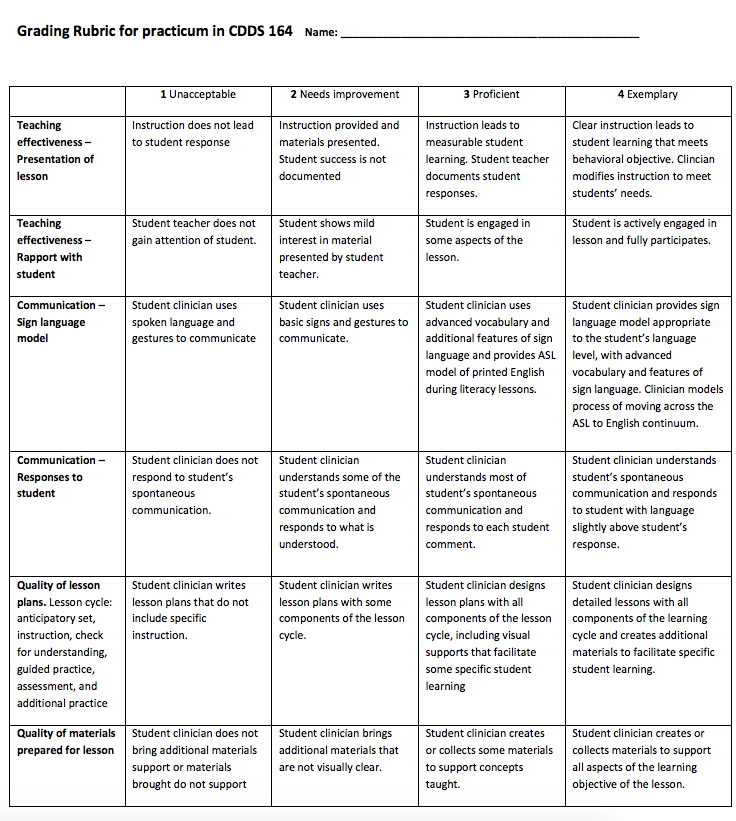
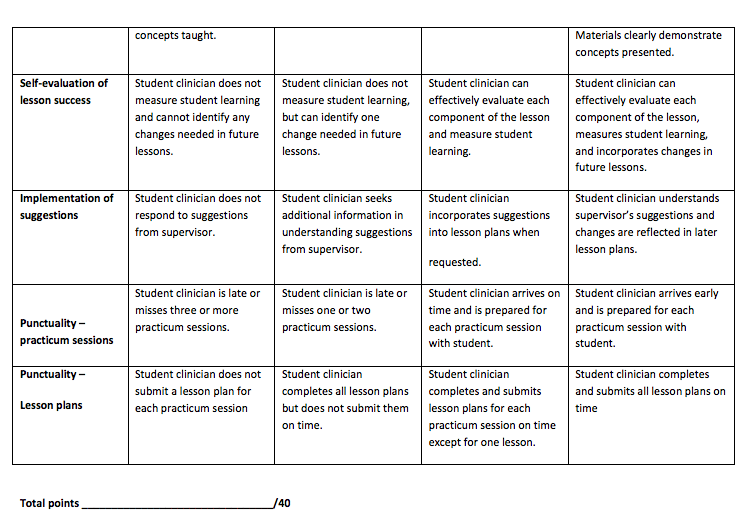
- Lesson Plans: As a part of their CSDS 164 practicum, students are assigned to a school site one day a week for the semester. Within this practicum placement, students are graded on their ability to effectively develop a weekly lesson plan. Should at least 80% of students demonstrate satisfactory performance across relevant items on the practicum grading rubric (See Appendix B: CSDS 164 Practicum Evaluation Rubric), the individual SLOs mapped to this direct measure shall be considered met.
- Evaluation of Lesson Presentation: As a part of their CSDS 164 practicum, students are assigned to a school site one day a week for the semester. Within this practicum placement, students are graded on their ability to effectively deliver a lesson to a classroom of students. Their supervisor grades the students on their teaching effectiveness, communication skills, quality of lesson plans and materials, implementation of suggestions, punctuality, and self-reflection skills. Should at least 80% of students demonstrate satisfactory performance across relevant items on the practicum grading rubric (See Appendix B: CSDS 164 Practicum Evaluation Rubric), the individual SLOs mapped to this direct measure shall be considered met.
- Evaluation of Interpreting Services: As a part of their interpreting internship in CSDS 175I, students are required to provide supervised interpreting services in a variety of professional settings. Students are evaluated on their professionalism, dependability, professional appearance, ability to work with others, ability to accept feedback, adherence to the professional code of conduct, ability to synthesize and evaluation situations, and tier interpretation and transliteration skills. Should at least 80% of students demonstrate satisfactory performance across relevant items on the practicum grading rubric (See Appendix C: CSDS 175I Rubric), the individual SLOs mapped to this direct measure shall be considered met.
B. Indirect Measures (Department/Program must use a minimum of one indirect measure)
- Exit Questionnaire: Undergraduate students in their final semester will be asked to complete an exit questionnaire (See Appendix D: Exit Survey for Undergraduate Students). Should at least 80% of students indicate that they “agree” or “strongly agree” with relevant items on the exit survey, the individual SLOs mapped to this indirect measure shall be considered met.
V. Assessment Schedule/Timeline [g]
| Academic Year | Measure | SLO 1.1 | SLO 1.2 | SLO 1.3 | SLO 2.1 | SLO 3.1 | SLO 3.2 | SLO 4.1 | SLO 4.2 | SLO 4.3 | SLO 5.1 |
|---|---|---|---|---|---|---|---|---|---|---|---|
| 2021-2022 | Deaf Culture Paper CSDS 136S Final Exam |
X | X | X | X | ||||||
| 2022-2023 | CSDS 136S Final Exam Lesson Plan |
X | X | X | X | X | X | X | |||
| 2023-2024 | Lesson Plan Lesson Presentation |
X | X | X | X | X | X | X | X | X | |
| 2024-2025 | Lesson Presentation Eval of Interpreting Services |
X | X | X | X | X | X | X | X | X | |
| 2025-2026 | Eval of Interpreting Services Exit Questionnaire |
X | X | X | X | X | X | X | X | X | X |
| 2026-2027 | Exit Questionnaire Deaf Culture Paper |
X | X | X | X | X | X | X | X | X | X |
| 2027-2028 | Deaf Culture Paper CSDS 136S Final Exam |
X | X | X | X | ||||||
| 2028-2029 | CSDS 136S Final Exam Lesson Plan |
X | X | X | X | X | X | X | |||
| 2029-2030 | Lesson Plan Lesson Presentation |
X | X | X | X | X | X | X | X | X |
VI. Closing the Loop [h,j,k]
Fresno State Closing the Loop process is described immediately below.
A major assessment report, which focuses on assessment activities carried out the previous academic year, is submitted in September of each academic year and evaluated by the Learning Assessment Team and Director of Assessment at Fresno State.
Program/Department Closing the Loop process: Data are collected and analyzed according to the implementation schedule above. This information is then used to write a report, “Summary of Outcome Assessment Results,” for the academic year in which the data are collected. Shortly after the report is complied, it is presented to and reviewed by the departmental faculty. The findings are discussed and an action plan may be decided upon, as appropriate. If it is decided that an action needs to be taken or a change needs to be made, responsibilities are assigned. It is then up to the assessment coordinator to follow up on any actions or changes in terms of additional data collected in subsequent years. Examples of summary assessment result reports will clearly identify actions that have been taken and are available upon request.
VII. List of Appendices
Appendix A: CSDS 139 Deaf Culture Paper Rubric
Appendix B: CSDS 164 Practicum Evaluation Rubric
Appendix C: CSDS 175I Rubric
Appendix D: Exit Survey
Appendix A: CSDS 139 Deaf Culture Paper Rubric
Culture Paper Rubric
| Criterion | Description | Points |
|---|---|---|
| A. APA Format (10 points) | ||
| A minimum of five references from appropriate sources. | (2) | |
| The reference page is formatted according to APA guidelines. | (2) | |
| APA format is used throughout the paper to cite references. | (2) | |
| APA format is used on the title page. | (2) | |
| Running header is used in APA format. | (2) | |
| Direct quotes, if used, are used according to APA format. | ||
| Block quotes, if used, are used according to APA format. | ||
| B. Organization (14 points) | ||
| The paper explores the assigned topic. | (2) | |
| There are identifiable sections of the project (introduction, body, and conclusion). | (2) | |
| Ideas in the paper are supported by appropriate references. | (2) | |
| The main ideas in the paper are clear. | (2) | |
| The conclusion provides a clear summary of the paper and concluding remarks. | (2) | |
| There is a flow to the organization of the paper. | (2) | |
| The paper is the required length. | (2) | |
| C. Writing Style (8 points) | ||
| The paper demonstrates university level spelling. | (2) | |
| The paper demonstrates university level grammar. | (2) | |
| There are no careless errors such as spelling, grammar, and punctuation. | (2) | |
| The paper has been proof read. | (2) | |
| D. Content (10 points) | ||
| The quality of the subject being discussed demonstrates critical thinking. | (2) | |
| The assigned topic is explored appropriately. | (2) | |
| Culture is explored and defined from Deaf/hearing and other culture perspectives. | (2) | |
| The students own cultural influences are described. | (2) | |
| When appropriate, issues related to the D/d/HH community are incorporated. | (2) | |
| F. Clarity of Expression / Style (8 points) | ||
| The paper demonstrates university level work. | (4) | |
| The paper includes personal reflection/insights and application of the material. | (4) |
Grades have the following meanings:
A 45 - 50 points: An outstanding paper that represents all the required elements completed in an insightful manner. The quality of this assignment clearly demonstrates a clear understanding of culture, integration with course content, careful reflection, important insights and university level presentation.
B 40 - 44 points: A very good project that clearly meets the criteria. It is less developed than the “A” project and may slight some elements. It may have minor problems with areas in the grading criteria, development, clarity, depth of analysis, level of integration with course concepts, and presentation.
C 35 - 39 points: A good project that is satisfactory in meeting the criteria. The presentation is weaker in depth, substance, expression, and/or development than the A or B papers. The insights may be general and less integrated.
D 30 - 34 points: A minimally acceptable project that does not represent university level development of ideas, critical thinking, and integration.
F 29 – 0 points. This assignment was not handed in or has major deficiencies and does not meet the minimum requirements for a passing grade.
Appendix B: CSDS 164 Practicum Evaluation Rubric
The following rubric pages contain the CSDS 164 Practicum Evaluation Rubric.
Appendix C: CSDS 175I Rubric
Student Name: Rater Name: Date:
OVERALL SCORE
Ethics – Pass Defend Fail
ENGLISH to ASL – Pass Defend Fail
ASL to ENGLISH – Pass Defend Fail
OVERALL SCORE : Pass Defend Fail
Student Name:
Rater Name:
ETHICS SCENARIO RUBRIC
| AREA | EXCELLENT 4 Points |
GOOD 3 Points |
EMERGING 2 Points |
WEAK 1 Point |
SCORE |
|---|---|---|---|---|---|
| Ethics scenario | Comprehensive answer including all pertinent parts: appropriate CPC tenets; in-depth reference to, and discussion of, tenet; impact on various consumers, interpreter and profession; presents possible solution, or elaborates on conflicts; demonstrates real world knowledge, and cultural sensitivity | Generally strong answer includes several considerations from those listed below: appropriate CPC tenets; in-depth reference to, and discussion of, tenet; impact on various consumers, interpreter and profession; presents possible solution, or elaborates on conflicts; demonstrates real world knowledge, and cultural sensitivity | Answer includes a few considerations from those listed below: appropriate CPC tenets; in-depth reference to, and discussion of, tenet; impact on various consumers, interpreter and profession; presents possible solution, or elaborates on conflicts; demonstrates real world knowledge, and cultural sensitivity | Incomplete or inaccurate answer includes, little to no pertinent parts listed below: appropriate CPC tenets; in-depth reference to, and discussion of, tenet; impact on various consumers, interpreter and profession; presents possible solution, or elaborates on conflicts; demonstrates real world knowledge, and cultural sensitivity | ______ |
TOTAL ______
Comps Interns
3 - 4 points = PASS
2 points = Defend
0-1 points = FAIL
Screening Interns
3-4 points = PASS
1-2 points = Defend
0 points = FAIL
NOTES:
ENGLISH TO ASL COMPS RUBRIC
Student Name: 1st Semester/2nd Semester Intern _____
Rater Name:
| AREA | EXCELLENT 4 Points |
GOOD 3 Points |
EMERGING 2 Points |
WEAK 1 Point |
SCORE |
|---|---|---|---|---|---|
| MESSAGE ACCURACY | Consistently accurate message, main points and details included; signs are consistently conceptually accurate, drops form consistently | Generally accurate message, most main points and some details included. Signs are generally conceptually accurate with some errors in dropping form | Some parts of the message included, some main points and few details included; signs are only conceptually accurate at times, with rare evidence of dropping form | Little message accuracy, main point missed, little to no details, signs are generally not conceptually accurate, message sticks too closely to the source language | _____ |
| SIGN PRODUCTION & USE OF VOCABULRY | Sign parameters are accurate, good use of varied vocabulary | Signs are generally accurate with some minor errors, some varied vocabulary | Signs are only occasionally accurate with frequent errors, limited vocabulary | Signs frequently produced with errors, very limited vocabulary | _____ |
| ASL FEATURES & SYNTAX | Consistent and appropriate use of ASL features (ex: listing feature, constructed action/dialogue, classifiers, etc.). Consistent and appropriate use of Topic-Comment structure, RH?’s, Conditionals etc.) | Generally appropriate use of ASL features (ex: listing feature, constructed action/dialogue, classifiers, etc.). Generally appropriate use of Topic-Comment structure, RH?’s, Conditionals etc.) | Some appropriate use of ASL features (ex: listing feature, constructed action/dialogue, classifiers, etc.). Some appropriate use of Topic-Comment structure, RH?’s, Conditionals etc.) | Little to no use of ASL features (ex: listing feature, constructed action/dialogue, classifiers, etc.). Little to no use of Topic-Comment structure, RH?’s, Conditionals etc.) | _____ |
| Use of Space | Signing size is appropriate and space is consistently used effectively | Signing size generally appropriate and space is generally used effectively | Signing size is appropriate at times, and space is used effectively, but infrequently | Signing size is not appropriate and space is used effectively very rarely, or not at all | _____ |
| Affect and Register | Appropriate match for emotion, intent and pragmatic use of language | Somewhat appropriate match for emotion, intent and pragmatic use of language | Occasional match for emotion, intent and pragmatic use of language | Inappropriate match for emotion, intent and pragmatic use of language | _____ |
| Prosody | Consistently appropriate and effective fluency and use of pauses. | Frequently appropriate and effective fluency and use of pauses. | Occasionally appropriate and effective fluency and use of pauses. | Little to no fluency, and inappropriate use of pauses. | _____ |
TOTAL ______
ENGLISH TO ASL Notes:
Comps Interns
15-24 points = PASS
12-14 points = Defend
0 – 11 points = FAIL
Screening Interns
13-24 points = PASS
10 - 12 points = Defend
0 – 9 points = FAIL
ASL TO ENGLISH COMPS RUBRIC
Student Name: 1st Semester/2nd Semester Intern _____
Rater Name:
| AREA | EXCELLENT 4 Points |
GOOD 3 Points |
EMERGING 2 Points |
WEAK 1 Point |
SCORE |
|---|---|---|---|---|---|
| MESSAGE ACCURACY | Consistently accurate message, main points and details included | Generally accurate message, most main points and some details included | Some parts of the message included, some main points and few details included | Little message accuracy, main point missed, little to no details | ____ |
| SYNTAX | Good command of English, use of complex sentence structure, some use of idioms/figurative speech, errors are corrected and do not impact overall message | Overall command of English with few errors, general use of complex sentence structure, occasional use of idioms/figurative speech, errors are corrected but have minor negative impact to message | Some command of English, some use of complex sentence structure, limited use of idioms/figurative speech, errors are recognized but not corrected | Struggles with command of English, use of simple sentence structure, no use of idioms/figurative speech, errors are not realized | _____ |
| VOCABULARY | Consistent use of appropriate and varied vocabulary. Avoids circumlocution | Generally consistent use of appropriate and varied vocabulary. Generally, avoids circumlocution | Inconsistent use of appropriate and varied vocabulary. Some limited use of circumlocution | Limited use of appropriate and varied vocabulary. Circumlocution used throughout | _____ |
| PROSODY | Consistently appropriate and effective fluency and use of pauses | Frequently appropriate and effective fluency and use of pauses with minimal hesitation | Occasionally appropriate and effective fluency and use of pauses. Frequent hesitation | Little to no fluency. Inappropriate use of pauses. Frequent hesitation | _____ |
TOTAL _____
Comps Interns
13 - 16 points = PASS
9 - 12 points = DEFEND
0 – 8 points = FAIL
Screening Interns
11-16 points = PASS
6 - 10 points = DEFEND
0 – 5 points = FAIL
ASL TO ENGLISH
NOTES:
Appendix D: Exit Survey for Undergraduate Students
Our Undergraduate Exit Questionnaire is distributed as an on-line survey using “Qualtrics”. The students respond to each statement using a five point scale: “no opinion”, “strongly agree”, “agree”, disagree”, and “strongly disagree”. It includes the following statements:
- The program provided me with the writing skills needed within my discipline.
- The program provided me with the skills needed to communicate effectively with potential clients, students, or consumers.
- The program provided me with the skills needed to demonstrate professional behavior within my discipline.
- The program provided me with the skills needed to establish appropriate measurable goals for potential clients or students.
- The program provided me with an understanding of the primary components of Deaf culture.
- I completed the requirements needed to enter the workforce or apply to a graduate program in my selected field.
- In addition, the survey contains a narrative area for students to comment on “any areas in the curriculum which affected their level of satisfaction with the program.”
This HTML version was generated with AI assistance and may contain errors or omissions. The original approved PDF remains the official document of record. An alternative accessible format is available upon request from the document creator in accordance with Title II of the ADA.