CRDP Sweet Potato Year 1 Evaluation Data Report
PREPARED BY CENTRAL VALLEY HEALTH POLICY INSTITUTE
OCTOBER 2019
Still I Rise
You may write me down in history
With your bitter, twisted lies,
You may trod me in the very dirt
But still, like dust, I'll rise.
Does my sassiness upset you?
Why are you beset with gloom?
’Cause I walk like I've got oil wells
Pumping in my living room.
Just like moons and like suns,
With the certainty of tides,
Just like hopes springing high,
Still I'll rise.
Did you want to see me broken?
Bowed head and lowered eyes?
Shoulders falling down like teardrops,
Weakened by my soulful cries?
Does my haughtiness offend you?
Don't you take it awful hard
’Cause I laugh like I've got gold mines
Diggin’ in my own backyard.
You may shoot me with your words,
You may cut me with your eyes,
You may kill me with your hatefulness,
But still, like air, I’ll rise.
Does my sexiness upset you?
Does it come as a surprise
That I dance like I've got diamonds
At the meeting of my thighs?
Out of the huts of history’s shame
I rise
Up from a past that’s rooted in pain
I rise
I'm a black ocean, leaping and wide,
Welling and swelling I bear in the tide.
Leaving behind nights of terror and fear
I rise
Into a daybreak that’s wondrously clear
I rise
Bringing the gifts that my ancestors gave,
I am the dream and the hope of the slave.
I rise
I rise
I rise.
Still I Rise- Maya Angelou
Suggested Citation
Ward, L., Mendoza, S., Pacheco-Werner, T.(2019). CRDP Sweet Potato Year 1 Evaluation Data Report. Central Valley Health Policy Institute. URL: https://chhs.fresnostate.edu/cvhpi/ documents/sweetpotatoyear1.pdf
SWEET POTATO PROJECT
CREATING HOPEFUL, RESILIENT, LEADERS
Executive summary
The Sweet Potato Project is a part of the California Reducing Disparities Project, which seeks to reduce mental health disparities across California. The Sweet Potato Project (SWP) at the West Fresno Family Resource Center is an implementation project that seeks to demonstrate the effectiveness of a culturally relevant approach to addressing mental health disparity in the community of West Fresno. It aims to prevent and/or reduce stigmatization surrounding mental health issues for African American youth ages 12-15 by increasing educational opportunities for young men and women in Southwest Fresno, and providing the opportunity to earn money and gain job training through dignified work.
The focus of the club is to instill leadership skills into the students and for them to specifically see themselves as African American leaders. Through mentorship and skill-based farming education, students are in a community surrounding that is intended to promote well-being. It also does so through neighborhood safety, increasing a sense of community and thus reducing gang activity to the end of supporting a southwest Fresno neighborhood that is safer, and more economically reliant and self-sustainable.
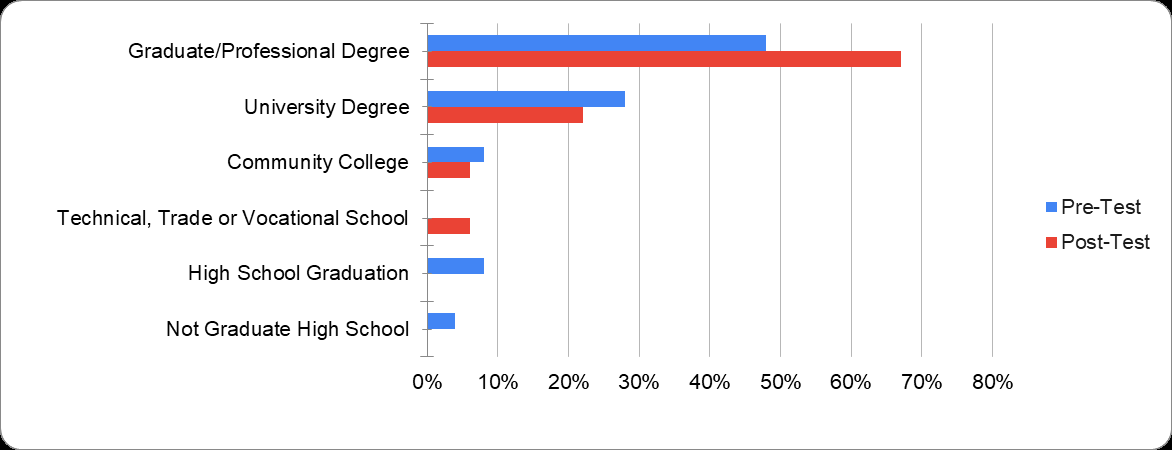
The results show that the program is being successful in bringing together young people and helping them see a better future for themselves than they did before. It also demonstrates that they seeing themselves as contributing to their community, which is a sign of leadership. They also are demonstrating more self-efficacy than they did before going through the program, with the majority of them agreeing that they will be able to handle problems that may come up in their lives. Table I below illustrates the results of the question “How far would you like to go to school?” as asked to students in the beginning of the program and at the end. In the beginning of the program, some students said they did not think that they would even finish high school. However, by the end of the program all of the students saw themselves at least completing some college or vocational degree and the vast majority saw themselves receiving a postgraduate education. This is a significant finding (p<.05) that points to the program instilling a hope for the future for the students.
Table I. Student Survey Question Pre-test and Post-Test: How far would you like to go in School?
We hope in the future years of data collection to continue to tap into the “secret sauce” of the program and be able to describe its most successful components. We also intend to collect more qualitative data to be more specific about which mental health risk and resilience factors are changing as a result of the program. The early results are optimistic that this program is positively influencing the lives of participants.
Background and Purpose
The Sweet Potato Project evaluation provides information about how the goals of the CRDP (California Reducing Disparities Project) has been implemented in Fresno’s Sweet Potato Project through the implementation of a “prevention program.” The goal of a prevention program in the CRDP model is to “reduce individual/family or community risk factors or stressors, build protective factors and skills, and increasing support; promote positive cognitive, social and emotional development and encourage a state of well-being.” 1 Prevention includes building protective factors and skills, increasing support, and reducing risk factors or stressors prior to a diagnosis of mental illness
The findings need to be framed in to two domains that capture both what it means to be an “at-risk” youth, being resilient and overcoming barriers within neighborhoods and systems where they face challenges.
There are things that are in the student’s internal sphere of control, which is not just a mentality of “me having control of what is happening around me,” but speaking to the real things that they can control in the context in which they live. The other domain in which they operate and make decisions in is the external sphere of control, which speaks to items that are reflection of what is happening in their neighborhood, with their family that they are impacted by but do not control directly. As the lyrics here demonstrate, they have to respond to and experience many things that shape their decisions to interact with institutions and people around them.
You know it’s crazy out here in these fields
Many of us thrive to survive while some of us kill
Every 3 seconds someone dies to a gang
1 California Reducing Disparities Project. 2017. “Phase 2 Statewide Evaluation Guidelines”
While many struggle to prepare food for the next day. ---Lyrics by Sweet Potato Participant
EVALUATION COMPONENT DESCRIPTION
The evaluation examines if participation in the Sweet Potato project has short-term effects that improve African American middle school students’ well-being and academic performance, and longer-term effects in terms of reducing school dropout rates, promoting well-being, positive adult relationships, and leadership skills. The data to describe these outcomes is drawn from surveys with participants and controls at intake, at one and two-year follow-ups, interviews with youths’ parents and other significant adults, and qualitative descriptions by the youth about program and health risk and protective/resilience factors. The evaluation provides training to African American and Latino graduate students as interviewers and focus group co-facilitators. CVHPI will also be looking in Year 2 at the fidelity of the curriculum through secondary data analysis. A detailed description of the evaluation component methodology can be found in Appendix A. The figure below describes all evaluation components:
In Year 2 of the study, we will be launching the fidelity component of the study, in which we will review the curriculum that is delivered in the summer program and in the sweet potato club. In addition, we will do follow up interviews with those participants that were part of the program in the pilot year and/or year 1 to capture long-term effect of the program. We will also ask those students about academic success.
PROGRAM HAS A UNIQUE REACH TO YOUTH IN WEST FRESNO
Demographics
Figure 1. Age Distribution of Sweet Potato Participants Y1
The students participating in the group are mostly middle school-aged, with 64% being between the ages of 12 and 14 years old (Figure 1). In addition, there were 60% male and 40% female students. The students were mostly African American (84%), with some of the participants also identifying as Latino/Hispanic and Multi-Racial (Table 1).
Table 1. Race and Ethnicity of Participants
| /RaceEthnicity | Number of Students | % of Students |
|---|---|---|
| Black/African American | 21 | 84 |
| Latino/Hispanic | 1 | 4 |
| Multi-Racial | 3 | 12 |
Major Findings
PARTICIPANT SURVEYS
Self-efficacy and hope for the future are key protective mental health factors. Year 1 data reveals Sweet Potato Participants want to go further in their education and have better sense of overcoming adversity after they participate.
Table 2. Student Survey Question Pre-test and Post-Test: How far would you like to go in School?
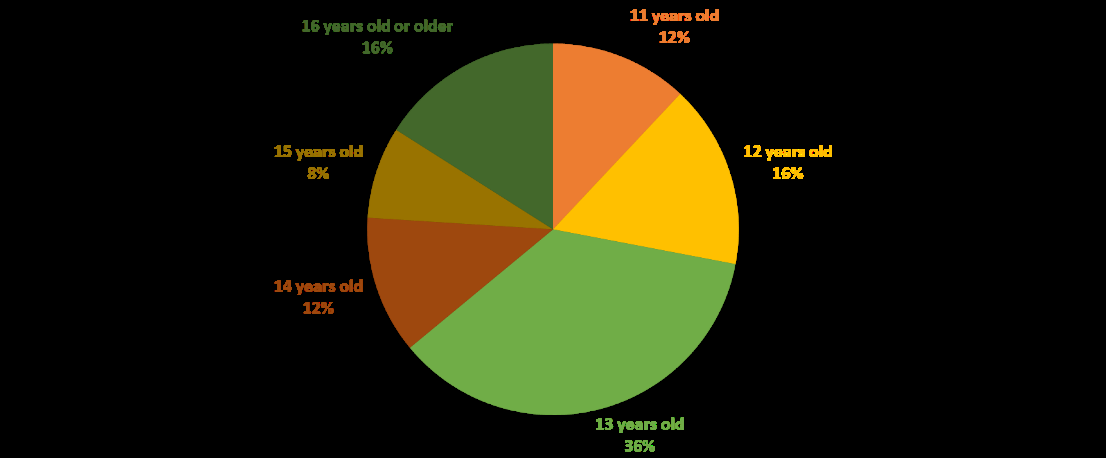
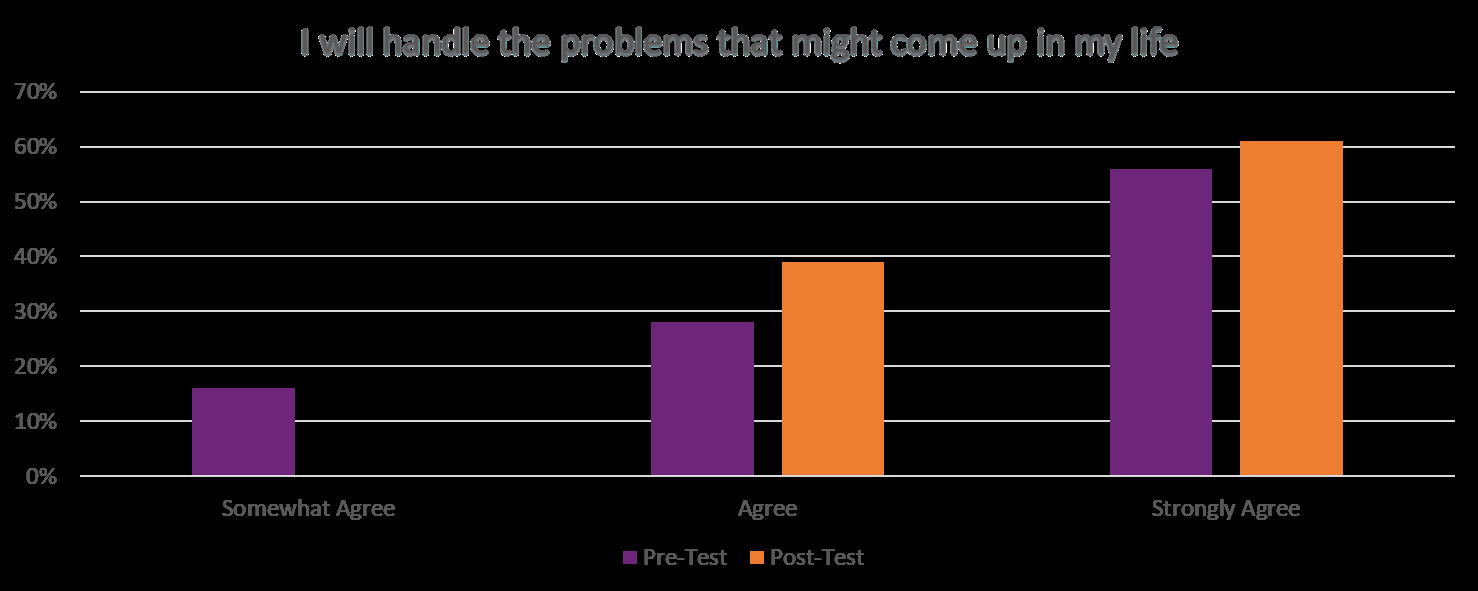
Table 3. Student Survey Question Pre-test and Post-Test: I will handle the problems that might come up in life
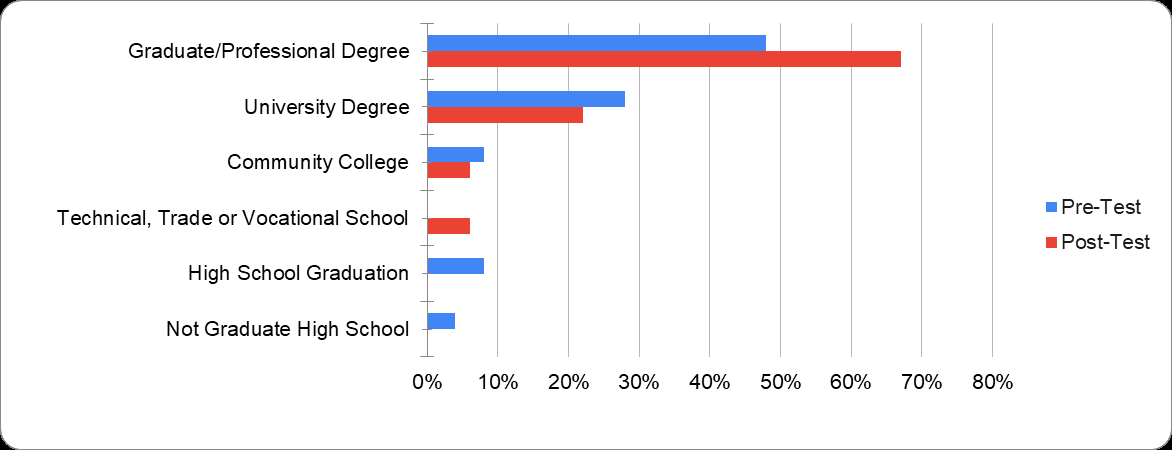
In Table 1, participants were asked how far they would like to make it in school. In the beginning, some mentioned they would not make it past high school, but in the post test none of the participants saw themselves there and the majority wanted to go beyond even a bachelor’s degree. Participants were also asked to answer how much they agreed with the statement about being able to handle the problems that come up in their life, by the end, most thought they could, indicating self-efficacy (Table 2).
Table 4. Student Survey Pre-test and Post-Test: My past experiences have prepared me for my future.
My past experiences have prepared me for my future.
- Don't know
- Neither agree nor disagree
- Somewhat agree
- Agree
- Strongly agree
0 2 4 6 8 10 12 14 16
Post-Test Pre-Test
In addition, they were asked how much they agreed with the statement: “My past experiences have prepared me for my future. “In the beginning of the program, some of the participants said they didn’t know or neither agreed or disagreed. By the end of the program, the participants mostly agreed with the statement (Table 3). Participant perceptions about past experiences have changed. Also by the end of the program, more participants were reporting that they had never been suspended, and those that were reporting 1-2 suspension dropped from 25% of participants to 15.8% of participants.
SPOKEN WORD
Project participants met for meetings on two days per week throughout the fall semester. Between late September and mid-November, each Friday was dedicated to producing a creative work that included lyrics, poetry, and/or spoken word set to music. The participants were formed into groups aligned with group selected subjects. The subject areas that were agreed upon by participants were: Community, Self-Esteem, and Goals. Participants were asked to say one word that came to mind relative to each. They were then instructed to compose at least one sentence associated with their group’s subject. Most provided longer, more detailed works. Each week, members met to refine their statements that best suited their feelings around the subject and to improve fluidity in the work as a whole. Each group also chose a musical interlude or backdrop to support the lyrical content. The last session included recording student presentations of these poetic/lyrical samples and preparing these performances for later upload to SoundCloud for public access.
Analysis of the lyrical content revealed the following:
Table 5. Spoken Word/Creative Expressions
| Emergent Theme | Example |
|---|---|
| Self-Reflection/ Awareness |
“I think about my life like “wow.” What happened to the kids I used to see down the street? My life is great, I just don’t want it to end “Some people clownin’ in life with no direction at all. I keep my mind on what’s right & I isolate them all.” “I’m different from these kids shooting all these guns. They say I’m not smart but the are really the ones.” “They’re trying to steal my shine but I’m one of a kind.” |
| Concern |
“Hey it’s me, the same kid you see on the streets. You know the one you gave the gun to, to make “peace.” Remember me” I just joined your crew, the same crew that killed my dad and got my brother locked up too.” “Y’all know it’s crazy out here in these fields. Many of us (strive ) to survive while some of us kill.” “So much violence in my head, I feel by myself. Pull me down so many times I ain’t have no help.” |
| Optimism |
“I gotta get straight A’s to get paid. I’m trying to get paid so I can count these didends. So, I’m a have to get a job so I can pay for my Benz.” “”we all have got a dream inside us. We all want to be someone and make it in life.” “I know y’all see me as a child. A Disney kid, too goofy and I’m a little wild but there’s a dream inside this girl wanting to scream loud. I want to be an artist and perform in front of big crowds…” |
| Resilience |
“I’m workin’ hard every day, I’m working hard on my grades… Some people say that I’m lazy, But I go away with them hatin“ “People gon’ get in the way and say some silly stuff. But words don’t hurt so I keep my head up.” |
The expressions created by the participants indicate that they are well-aware of the dangers that they and/or their peers face on a daily basis. Yet, in spite of adversity, they are forward thinking and aspire to ascend over their current circumstances.
STAKEHOLDER FOCUS GROUPS
Table 6: Stakeholder Focus Groups Themes
| Theme | Frequency |
|---|---|
| Witnessing personal growth and improvement from the youth participants during the duration of the summer program | 17 |
| Social support: parents, community partners and | 15 |
| Development of great Curriculum: economic, business, marketing, field trips | 14 |
| African American guest speakers and the impact it had on the youth participants | 11 |
| Improvements on the program for the curriculum and the summer program | 8 |
| Youth participants collaborating together in a work environment | 7 |
| Personal and impactful stories from the youth participants. | 6 |
| Importance of African American Farmers and mentors | 6 |
| Participants hopeful for youth participants (hopeful for college experience) | 6 |
| No Afrocentric cultural values or history developed into summer program curriculum | 5 |
Stakeholders report that they are first-hand witnessing personal growth and improvement from the participants. Positivity can enable youth participants to gain a sense of hope, motivation and capability to refrain from gang affiliations. Social support yielded the second highest rate that was thoroughly mentioned throughout the series of questions. This positive impact can inspire a future generation and allow other community members to positively influence youth participants.
The development of the curriculum was centralized around business management, marketing, economics and field trips taken by the youth participants. The executive director of West Fresno Family Resource Center envisioned the curriculum along with program director Patrick, and the Fresno State faculty. According to the findings, no Afrocentric cultural values or history were incorporated in the summer program. The executive director of West Fresno Family Resource Center centered the summer program around business, marketing strategies and collaboration. This coincides with increased youth participant collaboration in a steady work environment. Although, collaboration and the summer program created value marketing and business strategies, the youth participants did not gain further African American cultural values.
The evidence suggests African American guest speakers were a sense of motivation and hope for the youth participants. The guest speakers had similar demographics, and experienced many of the same challenges the current youth participants may experience in their communities. Mentors served as an important factor to encourage youth participants and African American Farmers were also resourceful hopes for the youth participants. Participants provided these guest speakers and were also impacted by the stories some of the youth had endured in their communities. Historical Afrocentric roots should be incorporated in the curriculum to demonstrate that youth can be proud of their Afrocentric roots and envision sustainability. Additionally, this can limit the institutional racism and oppression youth participants may endeavor.
Findings demonstrate that continued improvements in the program are a key priority to sustain the program and encourage the youth participants. When youth participants were exposed to the college campus, participants were able to visualize the enthusiasm displayed by youth participants. Participants noted that college was attainable to the youth participants and youth were responsive to this new mindset.
COMPARISON GROUP
We also have a comparison group who get weekly motivational messages, but are not in the program. In order to test if the Sweet Potato intervention itself was beneficial on top of just attending the WFFRC, we developed a comparison group. This is a group of students that are from the neighborhood, similar in demographics. We e-mailed comparison group inspirational quotes from prominent African Americans throughout history. The participants in this group would then let our staff know that they read the quote. Early results point to more self-efficacy, hope for the future, and sense of community from program participants than the comparison group. Program participants were significantly more likely to agree with the statement: It is important for me to contribute to my community.
It is important for me to contribute to my community.
Strongly agree Agree Somewhat agree Neither agree nor disagree Don't know
Sweet Potato Local Comparison Group
Appendix A: Methods
LOCAL EVALUATION SURVEY
We addressed the survey attempting to ask three research questions. The first research question is “what are social and mental health risk characteristics of Sweet Potato participants and controls?” To answer this question, we collected survey questions on the following mental health risk and resilience domains:
- Substance use
- Gang Involvement
- College Intentions
- School Participation
- Collective efficacy (neighborhood questions)
- Hopefulness
The method also included having a comparison group, so these same questions were asked pre-test and post-test for both the sweet potato project participants and the comparison. In addition, the participants that are in the club for more than one year are also being tracked and analyzed for significant differences of those participants in the analysis. For the questions, we used tested measures from other sources. See below:
1) Substance use. Youth Risk Behavior Surveillance System (YRBSS)
2) College intentions. Jackson et al National Survey of American Life Adolescent Supplement
3) Gang participation/school performance. National Gang Center: A Guide to Assessing Your Community’s Youth Gang Problem
STATEWIDE EVALUATION SURVEY
Cultural Connection Scale
Culture means many different things to different people but it is something that is usually shared by a relatively large group of people. For some it refers to customs and traditions. For others, it brings to mind their heritage and way of life. It can refer to beliefs, values and attitudes, your identity, and common history and membership in a group. These questions were assigned to measure how connected the participants are to their culture. For example, participants were asked how their culture gives them strength. We assigned a score of 1 to responses where they strongly disagreed to a statement about cultural connection. A score of 5 to the statements where they strongly agreed. The scale was a 5 point scale. Based on the data, 4 was the lowest possible score and 20 would yield the highest score.
Isolation Scale
Isolation can entail social isolation and feeling disconnected from your social support or culture. These questions were assigned to measure the perceived isolation from school, or marginalized from society. For example, participants were asked if they were marginalized or excluded from society. We assigned a score of 1 to responses where they felt it none of the time. A score of 5 was assigned to the statements where they felt it all the time. The scale was a 5 point scale. Based on the data, 4 was the lowest possible score and 20 would yield the highest score.
Psychological Distress
Psychological distress was measured on a 5 point scale. Participants were asked about if they ever felt they were nervous, hopeless and felt if they were so depressed, nothing could cheer up the participants. We assigned a score of 1 to responses where they felt it none of the time. A score of 5 was assigned to the statements where they felt it all the time. Based on the data, the lowest possible score was 6 and the highest possible score was 30.
Psychological Functioning
Psychological functioning was a 3 point scale. Participants were asked questions about how fears and worries may interfere with their daily lives. We assigned a score of 1 to responses where they felt it none of the time. A score was 3 was assigned to the statements where they felt it all the time. Based on the data, the lowest possible score was 3 and the highest possible will yield 12.
SUMMER FRESNO STATE FOCUS GROUP
Stakeholder focus groups were conducted in March 2018 through May 2018. The participants were professionals and staff from California State University, Fresno, Lyles Center for Innovation and Entrepreneurship and community members involved in the project. Participants consisted of an associate professor, administrators from the Lyles Center for Innovation, and Entrepreneurship, a masters student, and two community members from Washington Union School District.
This HTML version was generated with AI assistance and may contain errors or omissions. The original approved PDF remains the official document of record. An alternative accessible format is available upon request from the document creator in accordance with Title II of the ADA.