Fresno “What the FAX” Campaign: A Youth-Led Initiative for Public Transportation
Written by: The Central Valley Health Policy Institute
September 2021
Introduction
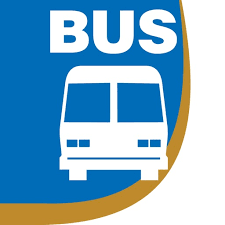
The Fresno Area Express, also known as the FAX, is Fresno’s regional public transportation system and the largest mass transportation provider in the San Joaquin Valley. It officially became the Fresno Area Express in 1989, but transportation around the city has roots in horse drawn buggies and electric streetcars. The FAX has connected the larger Fresno metropolitan area to provide residents with transportation to work and school, shopping, as well as general travel around the city with more than 100 buses covering 17 fixed routes. FAX receives most of its funding from federal and state grants, as well as $4 million in ridership fares. Using the FAX costs $1.25 per ride, or a monthly pass costs $46.
Fresno Building Healthy Communities (BHC), funded by The California Endowment, has been working to empower residents to use their voice and promote change to systems that should effectively serve community needs since 2010. Fresno BHC’s focus on health equity translates to ensuring all Fresno residents can live a happy, healthy, and productive life regardless of income, age, gender, sexual orientation, and resources including transportation. BHC and partner organizations were interested in pushing the broader objectives of equity and mobilizing support around positive change--not necessarily focused on an individual campaign topic. The “What the FAX” campaign started as community frustration that led to youth-driven and adult ally supported data collection and organizing efforts, and their collective push for improved public transportation infrastructure throughout the city of Fresno.
In general, public transportation plays a vital role in reducing traffic and pollution from environmental, city-planning, and equity perspectives. Considering the pollution burden the City of Fresno continues to face, public transportation can provide environmentally cleaner alternatives. According to the CalEnviroScreen 4.0, most Fresno City census tracts have a heavy pollution burden, and high exposures to ozone, particulate matter, diesel particulate matter, toxic releases, and traffic.
Who rides the bus in Fresno? Thousands of Fresno residents use the bus everyday for transportation to work, school, and essential services. According to a 2018 FAX Customer Satisfaction Report that surveyed 1,803 riders across Fresno, 77% of riders did not have a car or other vehicle. Three out of four FAX riders (76%) earned less than $20,000 annually. Most of the residents surveyed on the bus live in a few Fresno zip codes including 93702, 93706, 93726, and 93727. Although annual ridership peaked at nearly 1.4 million bus rides in October 2008, ridership has steadily declined in recent years, decreasing 59% from 2008 to 2017. Those with other ways of traveling or the resources to purchase cars rode the bus less or stopped riding the bus altogether. Since the decline in ridership, FAX restructured some of its routes, but this meant some parts of the city did not have easily accessible bus routes (also known as “bus deserts”).
One study on Fair Accessibility examined whether transportation inequity exists in Fresno since not everyone can afford or has access to a private vehicle and transportation shapes residents’ economic opportunities, physical activities, and social interactions. Based on their results, they suggested the city improve the efficiency of the bus system to provide faster and wider service areas for more urban opportunities, suggesting students as a good target group.
76%
Three out of four FAX riders (76%) earned less than $20,000 annually
Inspiration for the campaign
In September 2017, a Fresno City College student rushed into the downtown office of Youth Leadership Institute (YLI), sweating and trying to catch his breath before the start of the meeting. Sher Moua, program manager of YLI’s Boys and Men of Color (BMOC), asked the student what happened. The student started to explain how he waited for a FAX bus from Fresno City College at an unshaded bus stop which was fully exposed to the hot Central Valley summer sun.
“We wanted to [have a slogan] that grabbed people’s attention. Something that was in some ways provocative. But in ways that captured the frustrations of young riders that were being skipped and felt like their voices were not being heard, so we thought “What the FAX” was a play on words.”
Sher and other adult allies at YLI soon realized that many of the BMOC youth leaders have had experiences with or currently ride the bus to school and meetings. As a way to experience the FAX firsthand, the BMOC team split into groups and took the bus from different parts of the city to see how long it would take. While on the bus, youth and BMOC staff informally talked with riders about their experience on the bus. First, they found that it took nearly twice as long to take the bus compared to driving in a car. Some groups missed their transfer bus by minutes. When all groups met to have lunch downtown, they debriefed on their experiences. These bus rides revealed some of the concerns that were previously known.
The idea to illuminate the issues with the FAX system was already underway. A few months later, Fresno BHC informed YLI about FAX holding Fixed-Route System Restructure Study workshops throughout the city. These community workshops were held by FAX to gain input on City of Fresno investments to improve FAX services. YLI was informed of the workshops in December 2017, YLI attended the last of these workshops in Pinedale, which was a wrap-up workshop and meant FAX was no longer taking public comments. This limited the conversation to FAX and their findings, without asking the public for further input. Also, those who attended these workshops were not representative of those who rode the bus. YLI and other organizations decided to further explore the issue on their own.
Coming Together
Since 2010, Fresno BHC has worked to promote health equity within schools, neighborhoods, and through prevention. Fresno BHC, along with the Leadership Council for Justice and Accountability, provided resources, the “know how”, and helped craft campaign messaging. The campaign’s strategy was to illuminate issues with the FAX from the perspectives of youth by lifting their voices through stories and data. The goal was to hold the FAX accountable to its riders.
This grassroots campaign around public transportation in Fresno came directly from Fresno Barrios Unidos’ Womxn Empowered and Youth Leadership Institute’s Boys and Men of Color, as these organizations came together for a common goal of supporting youth. As more discussions about public transportation came to the surface, youth and some organization staff had a shared experience of riding the bus as their primary source of transportation, and knew first hand some of the challenges relying on the FAX. Sher Moua explains, “I think [Womxn Empowered and BMOC collaboration] worked because there was a shared interest. There was a shared interest in the issue that affected young people…they were able to connect on that and build on the campaign and trust based on those shared experiences.”
Survey Data Collection
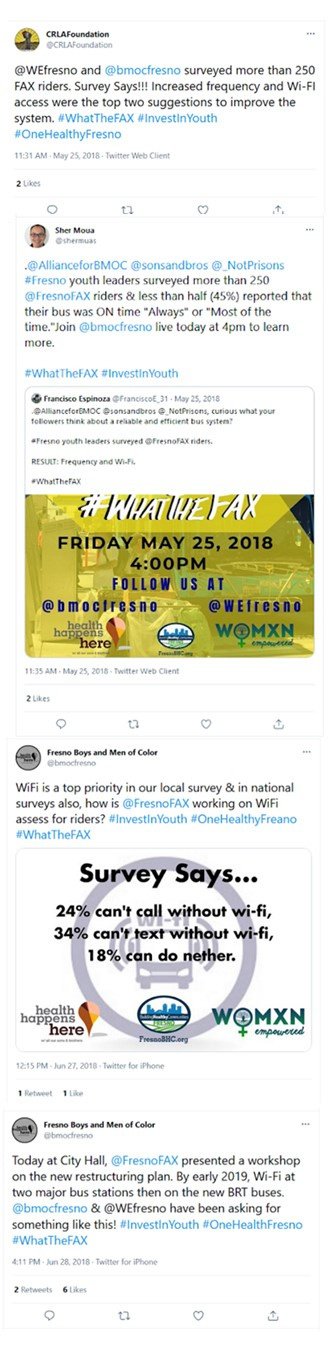
- In a May 25, 2018 post, CRLA Foundation reported that @WEfresno and @bmocfresno surveyed more than 250 FAX riders. Increased bus frequency and Wi-Fi access were the top two suggested improvements.
- Sher Moua reported that 45% of surveyed young riders said their bus was on time “Always” or “Most of the time.”
- A “Survey Says…” graphic reported: 24% can’t call without Wi-Fi, 34% can’t text without Wi-Fi, and 18% can do neither.
- A #WhatTheFAX announcement invited participants to a live social media event on Friday, May 25, 2018 at 4:00 PM.
To inform the public and city leaders of youth sentiment, those involved with the campaign wanted to collect their own data, with a larger sample of youth to ensure youth voices were represented and heard. Gathering data from riders was one of the first steps in promoting health equity.
BMOC and Womxn Empowered mobilized youth to participate in the campaign in several ways. Youth leaders gained skills in developing the surveys and social media presence. They also traveled to a few Fresno high schools to survey students, and asked them a series of questions on their experiences and ways to improve the FAX. The survey had to be short enough that youth could complete it while waiting for the bus.
An important component of the campaign was social media and communication outreach. Live Twitter event to spread the word of the campaign, using the hashtag #WhatTheFAX.
Overall, youth had a large role in the execution of the campaign. Youth engaged directly with riders, collected surveys, talked to other young people, met weekly to develop continued campaign plans, facilitated the events, sent letters to City Council members, and met with city officials.
Presenting the Data
Young riders identified their top two priorities regarding FAX:
- having WiFi on buses, and
- increasing the frequency of buses on each route.
Other important features youth highlighted involved safety. Youth wanted bus stops with lights and some requested some sort of security personnel on buses.
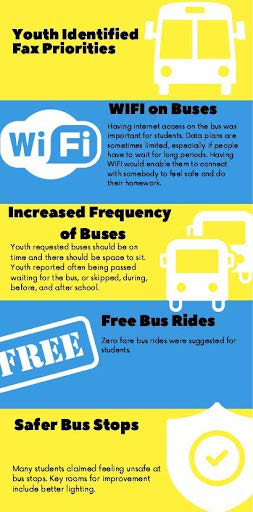
- WIFI on Buses
- Having internet access on the bus was important for students. Data plans are sometimes limited, especially if people have to wait for long periods. Wi-Fi can help students contact somebody to feel safe and complete their homework.
- Increased Frequency of Buses
- Youth requested buses that arrive on time and have space to sit. Youth reported often being passed or skipped while waiting for the bus before, during, and after school.
- Free Bus Rides
- Zero fare bus rides were suggested for students.
- Safer Bus Stops
- Many students reported feeling unsafe at bus stops. Better lighting was among the suggested improvements.
Other common sentiments from youth and FAX riders included missing the bus transfer by minutes and needing to wait for the next bus, being skipped because it was too full, or concerns over safety at bus stops and on the bus. High school students cited poor bus stop infrastructure and not shade or shelter from the elements. In addition, they expressed frustration with bus delays, being skipped due to overcrowded buses, and infrequency of buses. One high school student they surveyed explained it took him 2.5 hours to commute to school.
“It was students who lived further away from the school, who did not have access to school buses, who were relying on the bus to get to school.”
As more data was collected, there were conversations around how many changes should be accomplished as a part of the campaign. There was back and forth discussions around what should be asked from policymakers versus what this campaign should realistically accomplish based on a six-month timeline.
Once all the data was collected, there were several important meetings with youth and organizations that started based on the relationships built from partnering organizations. The Deputy Director of the Department of Transportation was willing to have a constructive discussion about the FAX, listen to youth concerns, and bring up FAX based on budget constraints. Mayor Lee Brand was also a big supporter of their findings. When he was just starting his career, growing up in Fresno, he had to ride the bus and was an intern in the Department of Transportation. He could empathize and validate their concerns. Additionally, Councilmember Soria met with youth and listened to their concerns. These three examples of adult allies willing to listen to youth about their data.
In June 2018, there were a series of Budget hearing meetings. The City Council Board met to discuss the city budget, including the Department of Transportation. During the meeting, Council president, Esmerelda Soria, cited her discussions with youth and adult allies involved with the What the FAX campaign. On June 28, 2018, there was a Transit Restructure and FTA Title VI Workshop, which the Department of Transportation responded with future plans based on community input. During the meeting, the FAX made a commitment to bringing WiFi to buses starting Spring 2021.
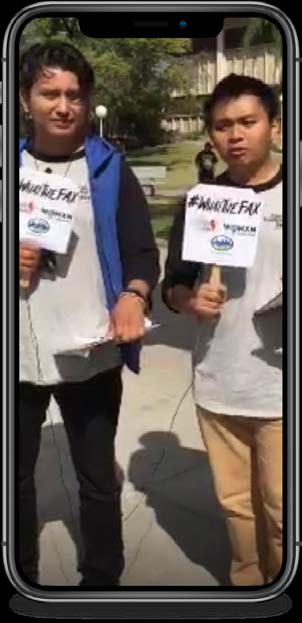
“Engaging directly with the riders right there and explaining to them what we were doing and why we were doing this was probably one of the most effective ways to do this.”
Reflections of the Campaign from a Youth Advocate
“I think the most impactful [part of presenting the data came from a meeting with] the Department of Transportation for the City of Fresno. We had to really work at first at getting their attention, sending them emails, tagging their social media, and like when we were talking about stuff on Twitter about like, “Hey guys, why is this bus unsafe? Why is it taking an hour and a half to get on?” Normal tactics for policy and politics. So eventually, the cool thing is...the Deputy Director of the Department of Transportation was like you know what you bring up a lot of valid criticisms but I feel you need a little more education [on the topic of Fresno public transportation], I’m going to come into your space, we’re going to break bread. We had dinner at the time, and we are going to talk about a lot of the challenges and I want to hear what you are proposing and see if it fits into the next plan we have for the next fiscal year. Which as a 18, 19 year old, that’s a pretty good deal like you don’t know at what level it takes to get those types of meetings--obviously later on in your career it’s not as hard--but as a bunch of young folks at the time that was really cool. He sat down, gave a presentation brought down to a level that [us youth] could understand about fiscal policy. How does the Fresno Department of Transportation prioritize budgeting both for every fiscal year and long term goals, he broke down the operation costs of a single bus, how does that play into like larger transportation, where does the money come from. He gave credit like, “Yes you are right in some areas like if we move this money towards different things that benefit specifically young people, we could do that, here’s why we don’t, here is where I would relent if like you could garner like support.” Still overall, even though we only met less than five time between the whole Department of Transportation, they were extremely insightful in providing us information on how to bring compromise to the political arena, how can we get things passed that benefits both us as young people, both as community organizers as in we did it. It also benefits the Department of Transportation because we were asking for more money allocated to them to do these specific needs, which they probably liked.”
Lessons Learned
The FAX has been known for its limitations, safety concerns, and long wait times that affect low-income and young Fresno residents, making it an equity issue. The “What the FAX” campaign mobilized youth to express their feelings about the bus system in Fresno and served as an opportunity to study the extent of an issue, address the health equity impacts, and give the opportunity for staff and students to learn the skills necessary for policy change. Bold campaigns like this can be replicated in other communities. Some important takeaways from the campaign include:
-
Work with youth in ways that build their skills and assets
Having passionate youth invested in civic engagement and participation is important for a campaign. Bringing on youth on projects like this one is an asset; however, it is critical to compensate them fairly--through stipends or marketable skills. Many youth have untapped potential and skills that need to be cultivated and strengthened. With the right mentorship and encouragement, youth have the ability to make informed decisions and can shape a campaign’s success. Skills learned from campaigns like these can help youth build skills for advocacy work and policy change, increasing their civic engagement.
-
Allow adequate time to accomplish campaign goals
Although the campaign was a success in bringing awareness to the FAX system challenges, campaigns like these take a tremendous amount of time and resources. It takes time to engage with the community, connect with residents, plan and strategize, and build relationships with policy makers to achieve the goals of a campaign. The amount of work it takes to make systematic changes cannot be underscored.
-
Build relationships with city leaders
Local policymakers have the power to make systematic changes. In order to build a successful campaign, it is critical to form authentic relationships with influential city leaders, as youth did with Councilmembers, the mayor, and the Department of Transportation. Presenting data and having honest conversations with leaders may inform them of an issue they were unaware of and sway them onto your campaign’s side.
-
Celebrate victories, regardless of size
Although the campaign did not immediately change the entire FAX system, the partner organizations and youth advocates were able to elevate these issues to influential city leaders. Systemic change often takes time. Celebrating the small victories of completing the campaign and having youth present the data to DOT and the City Council elevated these concerns to those in positions of power to make a difference.
FAX and Beyond – What has happened since the campaign
Since the end of the “What the Fax” campaign, FAX has conducted community outreach through their website and updated their Mission, Vision and Value statements to reflect community feedback. In response to COVID-19, the Fresno City Council approved the Zero Fare Clean Air Act to make ridership free and has looked for ways to maintain free ridership indefinitely. As CARES funding has been necessary to support the FAX system, free ridership is scheduled to end in Fall 2021, though for Fresno Unified School District and local college students, children under 12, and veterans it will continue to be free. Although the elimination of bus fares may not have necessarily come directly from the campaign, the work of youth seems to have left an impact on transportation policy, particularly during the pandemic
As with all campaigns, implementation is often a challenging aspect of policy change. Currently, the Fresno City Council is considering bids to build the Wi-Fi network for FAX buses, and is also exploring Wi-Fi access security options for riders. As the details are worked out, we reflect back on Fresno BHC’s role. By providing the know-how and sustaining relationships with policymakers, Fresno BHC played a role in building the capacity to change and organizing mobilization for youth and community to participate in decision making, including at the FAX held workshops. Moreso, the campaign changed the narrative on local transportation issues and gave voice to residents who rely on FAX. The culmination of the campaign is a testament to the work that Fresno BHC brings to the City, and adds to the list of wins that continues to drive multiple initiatives and campaigns forward in the future.
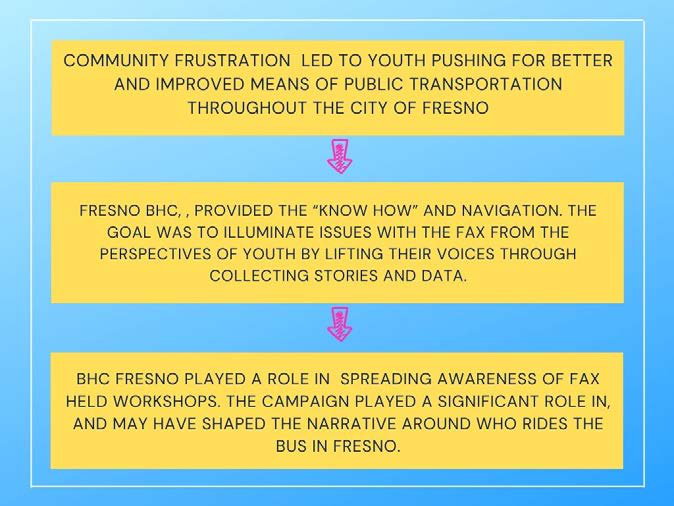
- COMMUNITY FRUSTRATION LED TO YOUTH PUSHING FOR BETTER AND IMPROVED MEANS OF PUBLIC TRANSPORTATION THROUGHOUT THE CITY OF FRESNO
- FRESNO BHC., PROVIDED THE “KNOW HOW” AND NAVIGATION. THE GOAL WAS TO ILLUMINATE ISSUES WITH THE FAX FROM THE PERSPECTIVES OF YOUTH BY LIFTING THEIR VOICES THROUGH COLLECTING STORIES AND DATA.
- BHC FRESNO PLAYED A ROLE IN SPREADING AWARENESS OF FAX HELD WORKSHOPS. THE CAMPAIGN PLAYED A SIGNIFICANT ROLE IN, AND MAY HAVE SHAPED THE NARRATIVE AROUND WHO RIDES THE BUS IN FRESNO.