West Fresno Family Resource Center Evaluation Report: Executive Summary
PROGRAM BACKGROUND
The Sweet Potato Project is a part of the California Reducing Disparities Project (CRDP), a first kind Prevention and Early Intervention initiative funded by the Mental Health Services Act (MHSA, OR Proposition 63). The Sweet Potato Project is implemented as a Pilot program at the West Fresno Family Resource Center to identify and model the effectiveness of a culturally relevant approach that addresses mental health disparities among African American youth ages 12-15 in West Fresno. The program goals include: developing self-esteem, socio-emotional wellbeing, leadership, agribusiness, and entrepreneurial skills, while also fostering improvement to social and environmental stressors among southwest Fresno’s at-risk youth by increasing academic success, hope for the future, and collective efficacy.
“I am today’s harvest changing tomorrow’s future.
I will fight against all odds that stand against me.
My circumstances shall not define me
I will not be shackled by fear, insecurities, or doubt.
My past strengthens my present, which complements my future.
I will never give up, EVER! I shall succeed. ”–Sweet Potato Creed
PROGRAM DESIGN
The Sweet Potato Project is a 9-month program that immerses middle school through high school-aged students in a club that teaches mental health resiliency skills, farming, entrepreneurship, and community engagement. Since the launch of SPP in April 2018, over 100 students who are predominately African American have participated in the Project. The program is broken up into two phases:
Phase 1:
April-July
- Introduction to program, goals expectations, and students begin to met weekly to discuss life, school, and community issues.
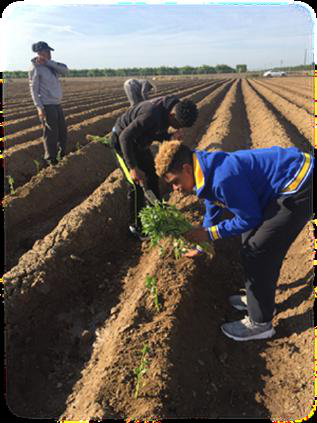
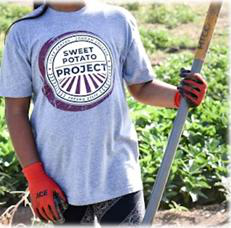
- Youth learn about urban agriculture and sustainability and plant sweet potato slips on an acre of land operated by the African American Farmers
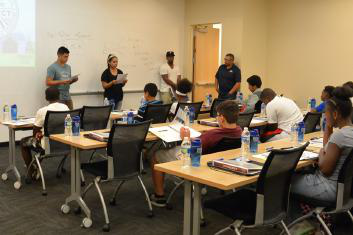
- Youth participate in entrepreneurial and business skills training taught by California State University, Fresno professionals from the Lyles School of Business. Youth learn how to create a business plan and marketing plan to turn sweet potatoes into a product that could be sold. Youth participate in a "Shark Tank" event to highlight lessons learned and promote group products.
Phase 2:
August-December
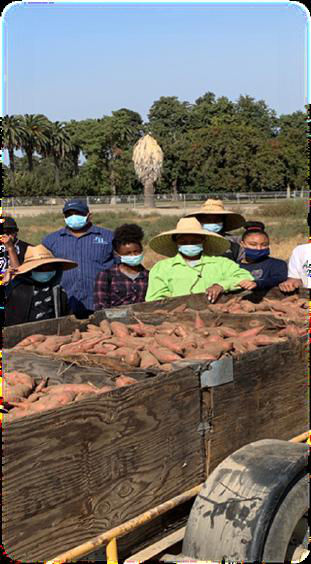
- Students harvest potatoes in groups with the supervision of farmers and program staff.
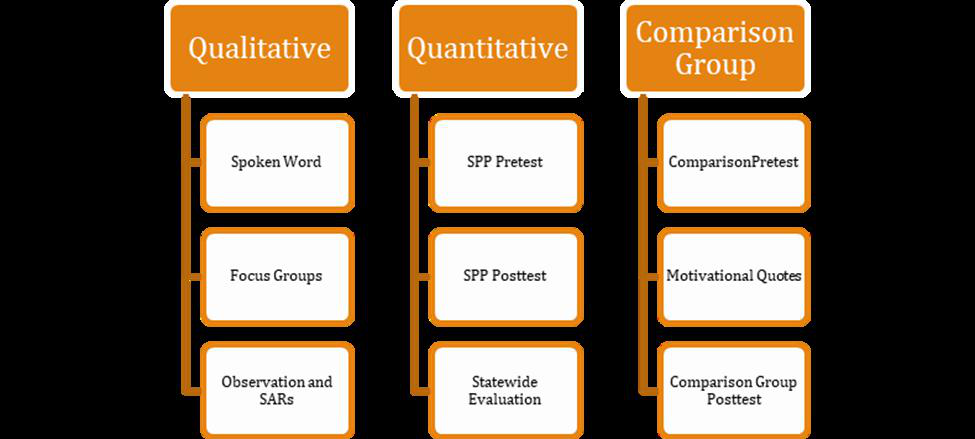
- Students use their entrepreneurial and business skills to take orders for sweet potatoes and their sweet potato products. Youth also attend farmer’s markets and cultural events to market and sell their sweet potato products.
- Students participate in community service and learn leadership and mental health resilience skills during weekly meetings
- The program concludes in the Winter with an end-of-year celebration.
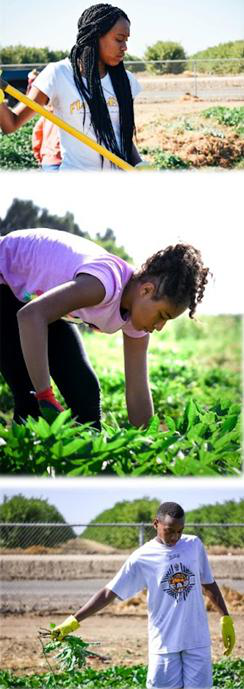
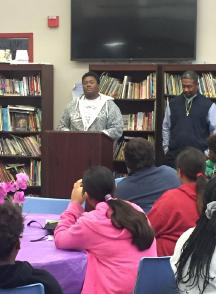
Students build relationships with local community members and leaders in West Fresno during this time. Local African American leaders, business owners, and motivational speakers in southwest Fresno visit the West Fresno Family Resource Center and engage with students. Students have the opportunity to build positive relationships with Fresno police officers through the Fresno Police Activities League (PAL). Fresno police officers attend the program as guest speakers and attend the end-of-year student celebrations each year.
SWEET POTATO PARTICIPATION BY YEARS
| Year | Participants |
|---|---|
| 2017 | 35 |
| 2018 | 35 |
| 2019 | 33 |
| 2020 | 30 |
| 2021 | 31 |
EVALUATION
Central Valley Health Policy Institute (CVHPI) conducted a 3 year evaluation design in 2018-2021, established in part by the California State University, Fresno. Evaluators used a mixed-method analysis approach, which consisted of quantitative and qualitative components. A group of students from the neighborhood recieving motivational quotes over e-mail was used as a comparison group.
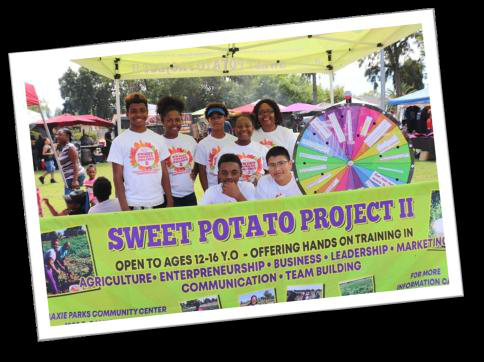
Qualitative
- Spoken Word
- Focus Groups
- Observation and SARs
Quantitative
- SPP Pretest
- SPP Posttest
- Statewide Evaluation
Comparison Group
- ComparisonPretest
- Motivational Quotes
- Comparison Group Posttest
SWEET POTATO PROJECT: EVALUATION RESULTS
Evaluation of the program intended to answer the following questions:
-
How did WFFRC adapt and implement the Sweet Potato Project for the Southwest Fresno
context?
- What activities took place?
- How often did they occur?
- How did WFFRC keep participants engaged?
-
Did the intervention and comparison groups differ at baseline?
- What were the social and mental health risk characteristics of Sweet Potato Project participants and controls?
- Differences in school participation, college intentions, gang involvement, and substance use at baseline?
- Differences in collective efficacy, internalized oppression, and hopelessness at baseline.
-
How did the intervention and comparison groups differ at follow-up and how baseline
features are related to these outcomes?
- Differences in mental health risk characteristics at follow-up
- Differences in college intentions, gang involvement, and substance use at follow-up
- Differences in collective efficacy and hopelessness at follow-up
-
How did participants and comparison group members understand the key experiences that
shape their sense of hopefulness and their potential risk activities?
- Were there program experiences that participants view as most important
SWEET POTATO PROJECT: KEY FINDININGS
-
The evaluation findings show that WFFRC could successfully adapt and implement the Sweet Potato Project in the context of an urban setting. They overcame transportation barriers to the farming site by using community assets such as parents, staff, and the local community-policing program. Staff connected with both the students and parents and helped them navigate hardships related to school, life, and relationships that would have otherwise hampered continued engagement. The Sweet Potato project helps students build their own community and gave them somewhere positive to build relationships with family, peers, and project staff.
-
The quantitative findings suggest that by the end of the project, student participants showed a statistically significant reduction in whether or not they experienced racial profiling and increased their hope for the future. These findings point to the intervention positively changing how students were experiencing the world and how they saw themselves beyond their current circumstances.
-
When focus groups were conducted throughout the years, parents and students felt like Sweet Potato had a positive change in how students were experiencing the world and how they saw themselves beyond their current circumstances.
-
The Sweet Potato Project has helped motivate the students to go further in school and has taught them never to give up. Student responses reflect an increased interest in higher education, hope for the future, increased self-esteem, and entrepreneurship.
“Kids had goals just to graduate high school, but now kids recognize higher education. They think outside the box, not to be a product of their environment, but be an example. Using the Sweet Potato Project as an example to become role models for others and their siblings.”
–Staff member explains students’ academic growth
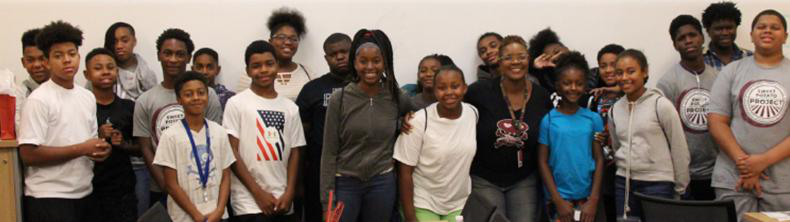
THROUGH MENTORSHIP, STUDENTS HAVE FOUND HOPE FOR THEIR FUTURE AND CONFIDENCE TO SUCCEED IN LIFE.
-
Parents mentioned that the program helped their kids access higher education, career guidance, and professional experiences. Based on the focus group discussions, the students felt empowered by their mentor, Patrick. One of the unexpected findings of the project showed how strong of a factor it is to have positive role models in the community, and it makes a difference to the students. Through this mentorship, students have found hope for their future and confidence to succeed in life. In addition, African American leadership and mentorship have helped with the student’s academic success. Whether it was college students teaching the program, project staff, or community speakers, mentors allow the students to gain confidence and see more potential in their life.
FARMING IN WEST FRESNO HAS CREATED POSITIVE SELF-EFFICACY AND POSITIVE GROWTH
-
Farming in West Fresno has created positive self-efficacy and positive growth. The farming aspect of the program is unique. It allows students to understand farming from the business and cultural significance aspects. In addition, meeting and interacting with African American Farmers will enable students and their parents to reconnect with certain parts of the valley with a recent cultural history that they had traditionally not been included.
“My career goals was about being a businessman. Shark tank stuff that helped. It boost my confidence to sell stuff, be an entrepreneur, speak in front of a big crowd.”
–Student participant explains their career goals
-
The stakeholders saw the students increasing their confidence and leadership skills. Students were able to work with African American farmers and learned how to harvest and plant sweet potatoes. They were able to learn about their cultural background and brought cultural awareness to the history of African American farming. Unity with the community through farming principles has encouraged students to have hope for their future and continue with higher learning.
STUDENTS DEVELOPED A LARGE COMMUNITY SUPPORT AND SENSE OF INTERCONNECTEDNESS WITHIN THEIR NEIGHBORHOOD
-
One of the interesting results evaluators saw in the evaluation was how much the students felt like they were a part of the community and how they created a community amongst themselves as current and past students of the Sweet Potato Project. Students’ interconnectedness demonstrated that they could give back to their community members and participate in civic engagement. The volunteer opportunities they had within the program helped them feel more connected to their neighbors and helped to give them a greater sense of responsibility for giving back to their community. Sweet Potato Students explored the foundations of community grounded in family, community, love, unity, and neighborhood support.
RECOMMENDATIONS & NEXT STEPS
- While the Sweet Potato Project has been in place for five years, evaluation staff believe Community-Based Organizations need more funding to help foster further development in African American students in Fresno County. Additional funding could help establish Sweet Potato Projects in school districts.
- The Sweet Potato Project had a decreased retention rate over time, pointing to the need to find a way to keep them connected to the program year-round.
- In addition to summer program internships, increased funding can help provide more incentives to African American students who desire to participate in the Sweet Potato Project.
- The curriculum is also evolving. Since many of the current components are part of the State of California’s Educational Pathways, including the agricultural, culinary, and business pathways, the Sweet Potato Project curriculum should be a way to earn school credits. It would allow students to get more school credits and help increase graduation rates among African American students.
- In addition, students have expressed the need for more mental health support at schools. This includes the availability of counselors and counselors who look like them and understand their everyday experiences.
ACKNOWLEGEMENT
Central Valley Health Policy Institute would like to extend gratitude to the California Department of Public Health for funding California Reducing Disparities Project Phase II. In addition, we would also like to extend gratitude to the students who participated in this study. Their contributions made it possible to complete the study. In addition, we want to thank the West Fresno Family Resource Center for their collaboration and efforts to generously provide space to conduct this study. Finally, we want to thank the community residents for advocating for young African American leaders in West Fresno.
SUGGESTED CITATION
Pacheco-Werner, T., Mendoza, S., Ward, L. West Fresno Family Resource Center Sweet Potato Project Evaluation Report: Executive Summary. (2022) Central Valley Health Policy Institute
This is the summary Report. To read the full (long-version) of the Sweet Potato Project Evaluation report, please visit cvhpi.org
Contact Information:
Yolanda Randles, Executive Director
yrandles@wfresnofrc.org
(559) 621-2967
https://www.wfresnofrc.org/sweet-potato-project