Recurrent Resource Calls: A Tool for Community Health Workers to Provide Timely and Accurate Information to Underserved Communities
Atziri Barboza, B.A., Guadalupe Corona Gomez, B.S., Ricardo Rubio Arteaga B.A., Gladys Zamora B.A, Myrka Macedo B.A., B.S., Dr. Tania Pacheco-Werner PhD, Stephanie Chan MPH., Sohan Banerjee B.A., and Miguel Garcia B.S.
Using an innovative digital tool to support ongoing CHW training by providing timely and accurate information further allowed CHWs to do their work effectively.
Introduction
- Throughout the pandemic, the Central Valley Health Policy Institute (CVHPI) developed a series of Zoom and Facebook live-streamed calls through the COVID-19 Equity Project (CEP).
- The Weekly Resources Call was delivered in English and Spanish, providing community health workers (CHW) with pandemic updates and community resources.
- Objective: The purpose of the focus groups was to determine the extent of the calls’ impact on the IRC CHW workflow.
Methods
- Two focus groups were held through Zoom (one in English and one in Spanish) with past CHWs who had engaged with the weekly call.
- The focus groups’ recordings were transcribed and a thematic analysis was conducted to analyze all data collected from the sessions.
Results
- CHWs identified the calls as a useful resource for their workflow.
- COVID-19 health information (vaccine education and updates on COVID-19 vaccines, boosters, and vaccination guidance) was the most helpful aspect of the calls.
- The calls helped CHWs connect community members to community-based resources and health services such as vaccination clinics, testing services, and food distribution events.
- The calls supported CHWs in delivering culturally and linguistically appropriate information to the communities they serve.
Conclusion
- The weekly calls helped supplement the CHW training curriculum, maintain CHWs informed about the latest health information and available resources, and strengthen the capacity of the CHWs to serve vulnerable communities.
- The findings indicate that the calls positively impacted and enhanced the CHW workflow.
- The calls were a unique approach to capacity building for CHWs because they offered CHWs another way to become a source of health and resource information and a different way to reach communities.
Additional Information
- The weekly call format: Fresno County COVID-19 cases and statistics, vaccination and testing sites, COVID-19 updates (policy and guidance changes and scientific research findings), other public health news (Monkeypox, influenza, etc.), and resources (educational infographics, food distribution events, financial assistance, immigration services, etc.).
Recommendations
- This method of recurring calls can be incorporated into CHW program models addressing other public health issues.
- Our team recommends other programs interested in using this method to make the section on public health information and updates informative yet concise, always include a thorough section on community resources, and factor in the needed time to ensure all information is culturally and linguistically appropriate.
Example of a live-streamed call
Tania Pacheco-Werner was live. May 6, 2020.
9 reactions; 4 comments; 483 views.
Video position shown: 1:49 / 35:40.
como se hace y se usa una mascarilla
Estamos en vivo en como se hace una mascarilla
¿Cómo se transmite?
- Por contacto personal cercano con una persona infectada
- A través de personas infectadas al toser o estornudar.
- Al tocar objetos o superficies contaminadas y luego tocarse la boca, la nariz o los ojos.
- Pequeñas gotas de saliva provenientes de la tos o los estornudos
- Caen sobre la piel y el cuerpo, o superficies
- Luego uno se toca la cara alrededor de la nariz o la boca
- Respirar estas gotitas puede transmitir el virus
*el COVID-19 puede correrse a través de personas que no presentan síntomas.
https://espanol.cdc.gov/coronavirus/2019-ncov/prevent-getting-sick/prevention.html
Comments shown in the screenshot
- Tania Pacheco-Werner · 1:21
- Gracias a todos por sintonizarse. ¡Disculpen que hubo una demora en empezar, todavía me estoy acostumbrando a esta tecnología!
- Tania Pacheco-Werner · 17:12
- recuerden todos, nariz, boca, barbilla. todos tienen que tener en cuenta eso en ponerse la mascarilla para el beneficio del ponersela
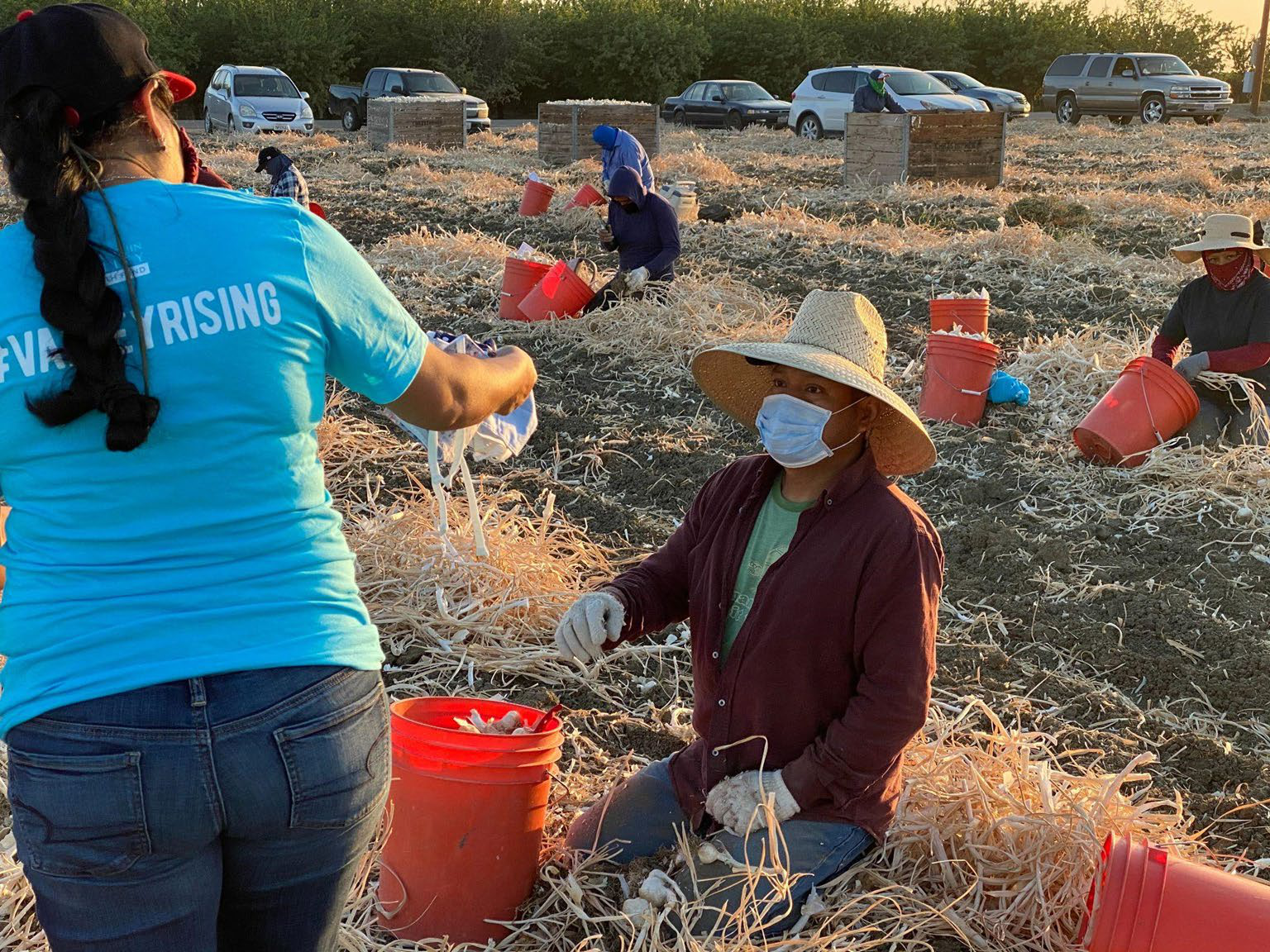
Community health workers’ activities
Photograph: A community health worker speaks with farmworkers in a field.
Original photograph caption: The image above demonstrates the work CHWs were doing during the pandemic. The CHWs supported CEP’s activities, which included contact tracing, isolation and quarantine support, community outreach, COVID-19 education, and providing COVID-19 testing and vaccination services.
Examples of educational resources
VARIANTES DE COVID-19
¿Qué es una variante?
Los virus cambian constantemente. Son tan pequeños que estos cambios en el código genético pueden dar lugar a una variante.
Se esperan nuevas variantes con el tiempo, pero no todas sobreviven y algunas desaparecen. Desde la pandemia de COVID-19, se han encontrado varias variantes del virus COVID-19 en los Estados Unidos.
¿Qué las hace diferentes?
Algunos de estos cambios permiten que los virus se propaguen más fácilmente, se vuelvan más resistentes a tratamientos o vacunas y / o faciliten que las personas se infecten nuevamente.
¿Cuáles son las variantes del virus COVID-19?
Las variantes del virus COVID-19 se han encontrado en todo el mundo. Se agrupan en dos categorías: variantes de interés y variantes de preocupación. Las variantes de interés pueden convertirse en variantes de preocupación. Por eso los científicos les prestan mucha atención.
Las variantes de preocupación pueden propagarse más rápido o cambiar la forma de tratamiento de los pacientes con COVID-19. La efectividad de la vacuna también puede cambiar con las variantes de preocupación.
Usted puede ayudar a prevenir la propagación de variantes con:
- Estar vacunado
- Usando una mascara
- Distanciamiento social
Más información
Visite los sitios web de los CDC o la OMS en:
https://www.cdc.gov/coronavirus/2019-nCoV/index.html
y https://www.who.int/emergencies/diseases/novel-coronavirus-2019
Fresno State Central Valley Health Policy Institute
Immigrant Refugee Coalition
FresnoCEP.org
VARIANTES DE COVID-19
¿Qué necesito saber?
Las variantes actuales de preocupación son Alfa, Beta, Gamma y Delta.
La variante Delta es actualmente la variante de preocupación más común. Es más contagioso que otras variantes. El CDC afirma que "el mayor riesgo de transmisión se encuentra entre las personas no vacunadas que tienen muchas más probabilidades de contraer y, por lo tanto, transmitir el virus".
Si las tasas de vacunación siguen siendo bajas, las posibles variantes de interés pueden convertirse en variantes de preocupación.
¿Qué pasa si estoy vacunado?
Las vacunas siguen siendo la forma más eficaz de prevenir enfermedades y hospitalizaciones relacionadas con COVID-19. Las tres vacunas disponibles son eficaces para la prevención del COVID-19.
Incluso después de la vacunación, sigue siendo importante continuar con las medidas preventivas. Continúe siguiendo las recomendaciones acerca de COVID-19 en su condado.
Usar una máscara
¿Qué pasa si no estoy vacunado?
Para las personas que no están vacunadas contra COVID-19, continúe ejerciendo las mejores prácticas preventivas. Esto incluye el uso de una máscara, pruebas frecuentes de COVID-19 y distanciamiento social.
- Evitar el contacto cercano
- No tocar su cara
- Limpar sus electrónicos
- Lavarse las manos con frecuencia
Más información
Visite los sitios web de los CDC o la OMS en:
https://www.cdc.gov/coronavirus/2019-nCoV/index.html
y https://www.who.int/emergencies/diseases/novel-coronavirus-2019
Fresno State Central Valley Health Policy Institute
Immigrant Refugee Coalition
FresnoCEP.org
Acknowledgment
Thank you to our CEP partners and the Fresno County and the City of Fresno for their contributions for this study.
Fresno County and the City of Fresno funded this project as a localized effort to prevent the spread of COVID-19 and address health disparities related to the pandemic among vulnerable populations in Fresno County.
For more information, contact Atziri Barboza
atzirib33@mail.fresnostate.edu
QR code link: https://bit.ly/49lz6KI?r=qr
Fresno State Central Valley Health Policy Institute
Immigrant Refugee Coalition
CEP COVID-19 Equity Project