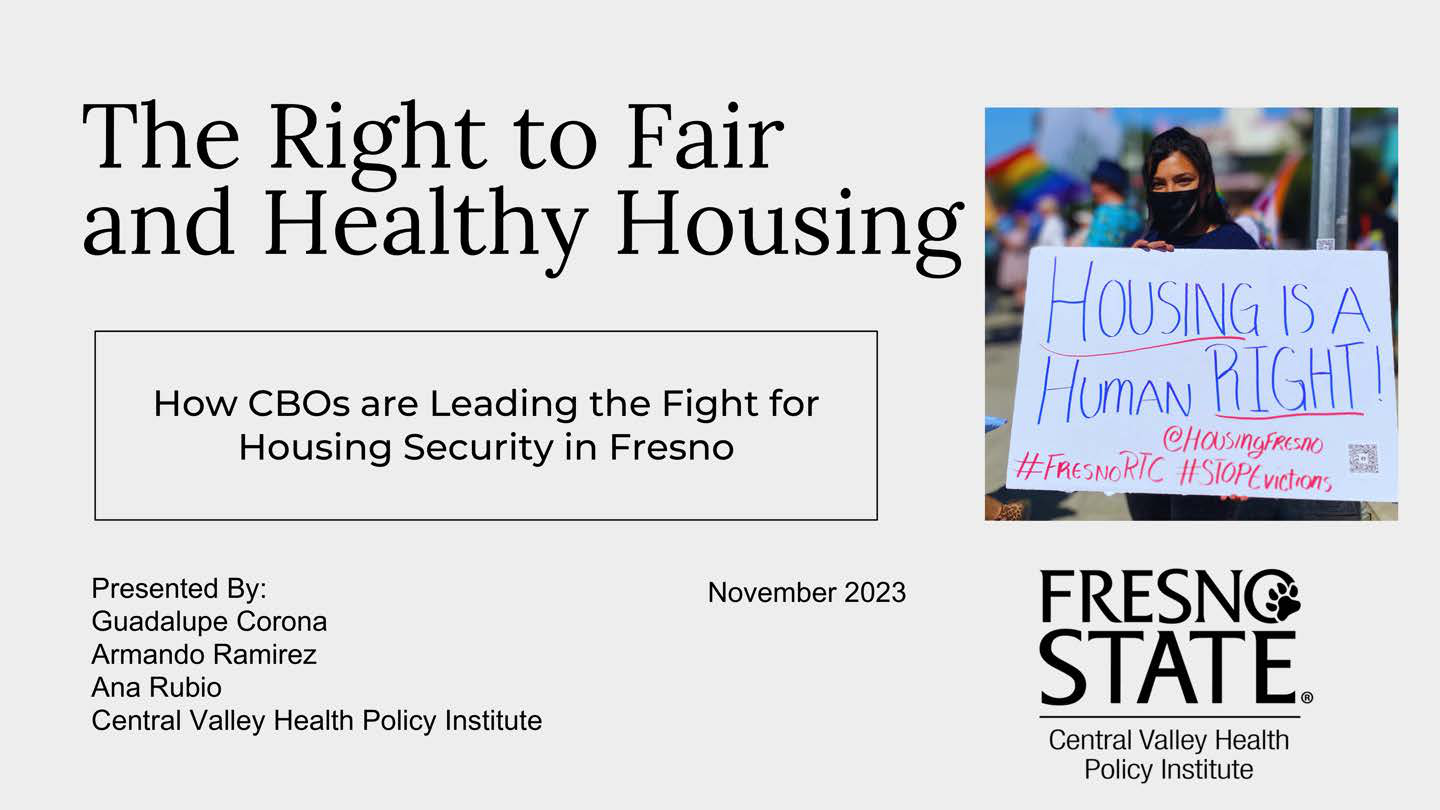
The Right to Fair and Healthy Housing
How CBOs are Leading the Fight for Housing Security in Fresno
Presented By:
Guadalupe Corona
Armando Ramirez
Ana Rubio
Central Valley Health Policy Institute
November 2023
Background
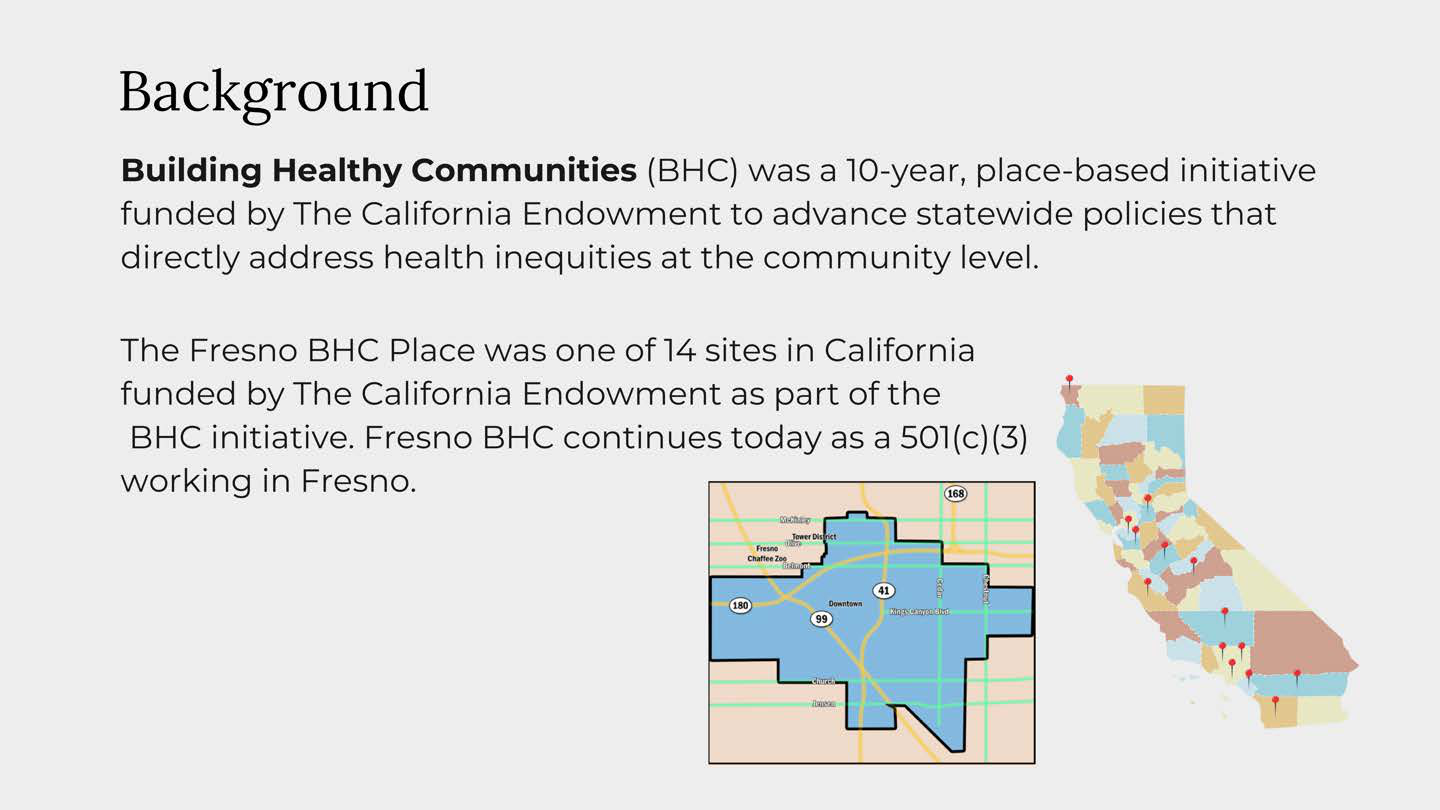
Building Healthy Communities (BHC) was a 10-year, place-based initiative funded by The California Endowment to advance statewide policies that directly address health inequities at the community level.
The Fresno BHC Place was one of 14 sites in California funded by The California Endowment as part of the BHC initiative. Fresno BHC continues today as a 501(c)(3) working in Fresno.
Introduction
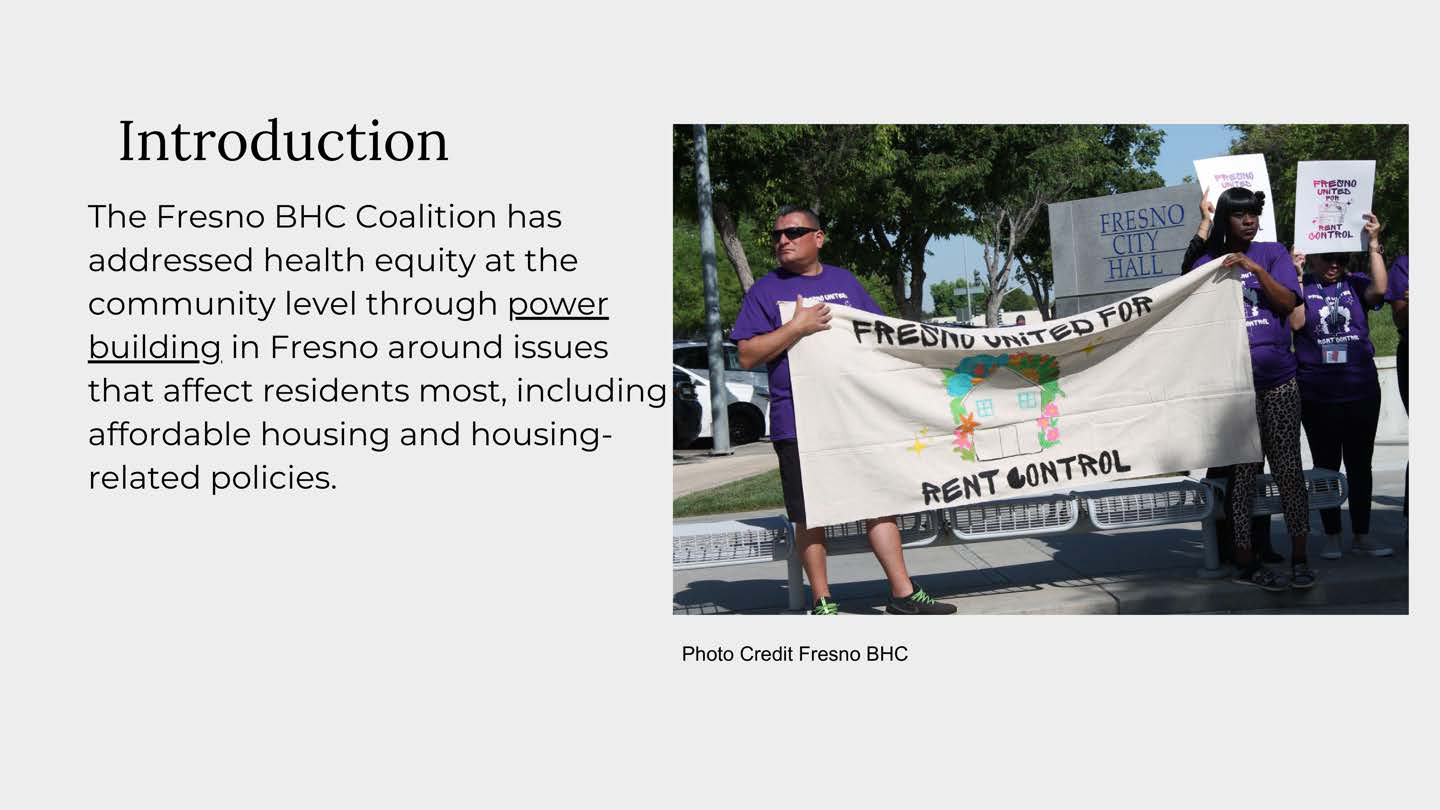
The Fresno BHC Coalition has addressed health equity at the community level through power building in Fresno around issues that affect residents most, including affordable housing and housing-related policies.
Photo Credit Fresno BHC
Housing Wins Since 2013
- BLIGHTED VACANT BUILDING ORDINANCE
The Fresno city Council adopts ordinance compelling property owners to bring blighted properties up to code. - VACANT/BLIGHTED PROPERTY REGISTRY
The ordinance mandates that vacant/blighted property owners register with the city to create a tracking system for properties. - RENTAL INSPECTION PROGRAM
Fresno Rental Housing Inspection Act lays out a framework for regular interior inspections and code enforcement action on all rental properties city wide. - RENTAL INSPECTION REQUEST PROGRAM
Renters are able to report complaints about rental housing conditions with the City taskforce.
Housing Wins Since 2013
- EVICTION PROTECTION PROGRAM
Access to legal representation when an unlawful detainer has been filed with the courts. - EMERGENCY RENTAL ASSISTANCE PROGRAM
Millions of federal and state dollars to provide rental assistance. Advocates continue to pressure City to help renters.
Glossary of Terms
Unlawful Detainer (UD)
- According to the Superior Court of Fresno: “an Unlawful Detainer lawsuit is a suit brought by a landlord to obtain possession of the rented property and receive payment of back rent. In order to legally evict a tenant (remove and lock the tenant out of the property), the landlord must file an Unlawful Detainer lawsuit.”
Right to Counsel
- A program that would provide access to legal representation for all residents facing eviction.
Eviction Protection Program (EPP)
- A fund that secured legal representation for residents facing evictions where an unlawful detainer (UD) has been filed with the courts.
Emergency Rental Assistance Program (ERAP)
- Provides renters and property owners access to funding support for rental assistance.
Right to Counsel: Addressing Evictions
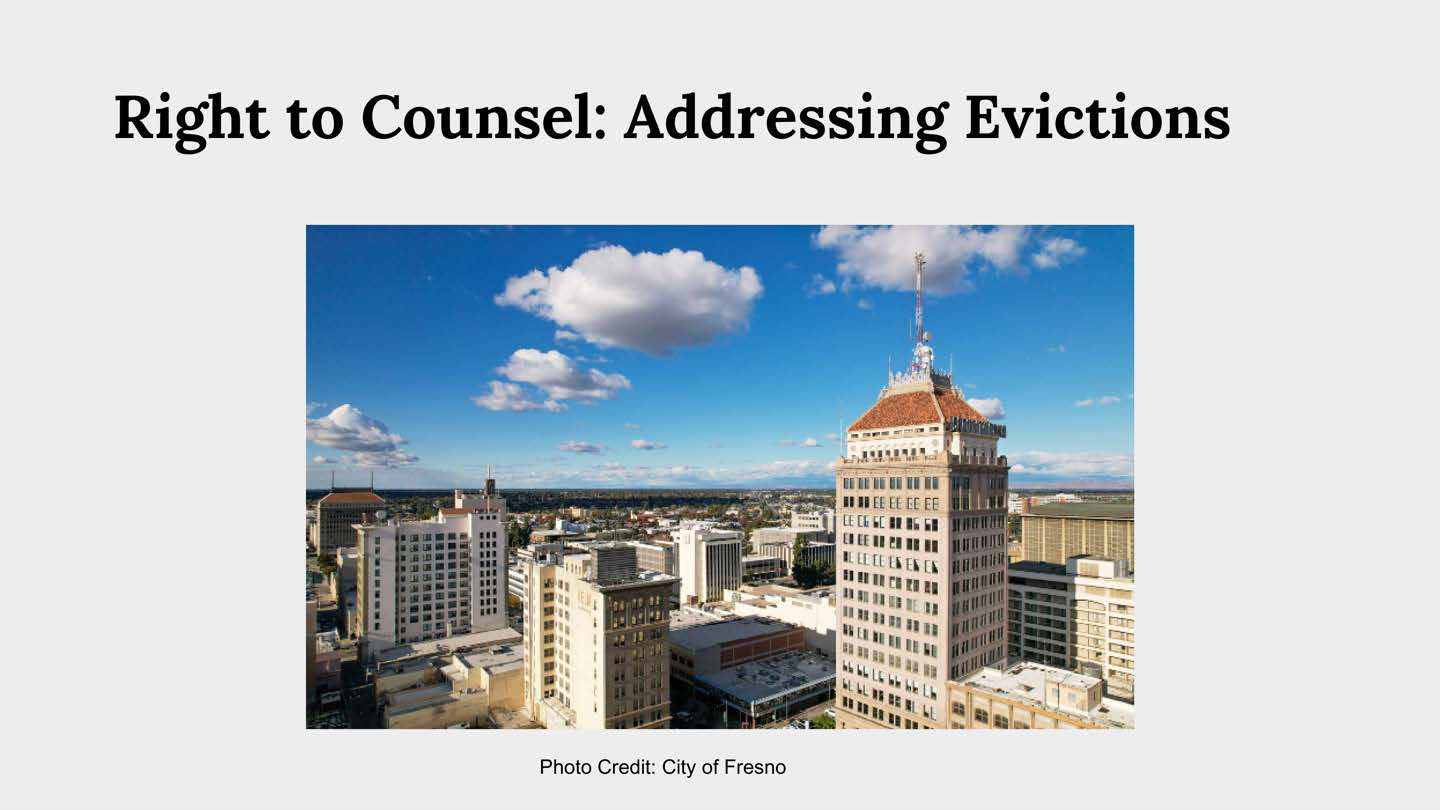
Photo Credit: City of Fresno
Addressing a Growing Issue: Evictions
Local research demonstrated evictions were a growing problem. Our case study identified two primary eviction issues where advocates and residents rallied to take action.
- Tenants lacked legal knowledge about their rights and lacked access to legal resources.
- Many resources that do exist are often monolingual, thus present language barriers.
- Tenants reported facing retaliatory evictions for requesting necessary unit repairs or reporting ordinance violations.
- Undocumented residents had a difficult time trusting the City attorney’s office due to landlords’ threats involving ICE.
Protection Against Unlawful Evictions
Advocates wanted:
- A universal right-to-counsel program that would ensure representation to residents facing eviction by way of an unlawful detainer (UD).
- Resources to be made available prior to the UD process due to tight timelines with the courts.
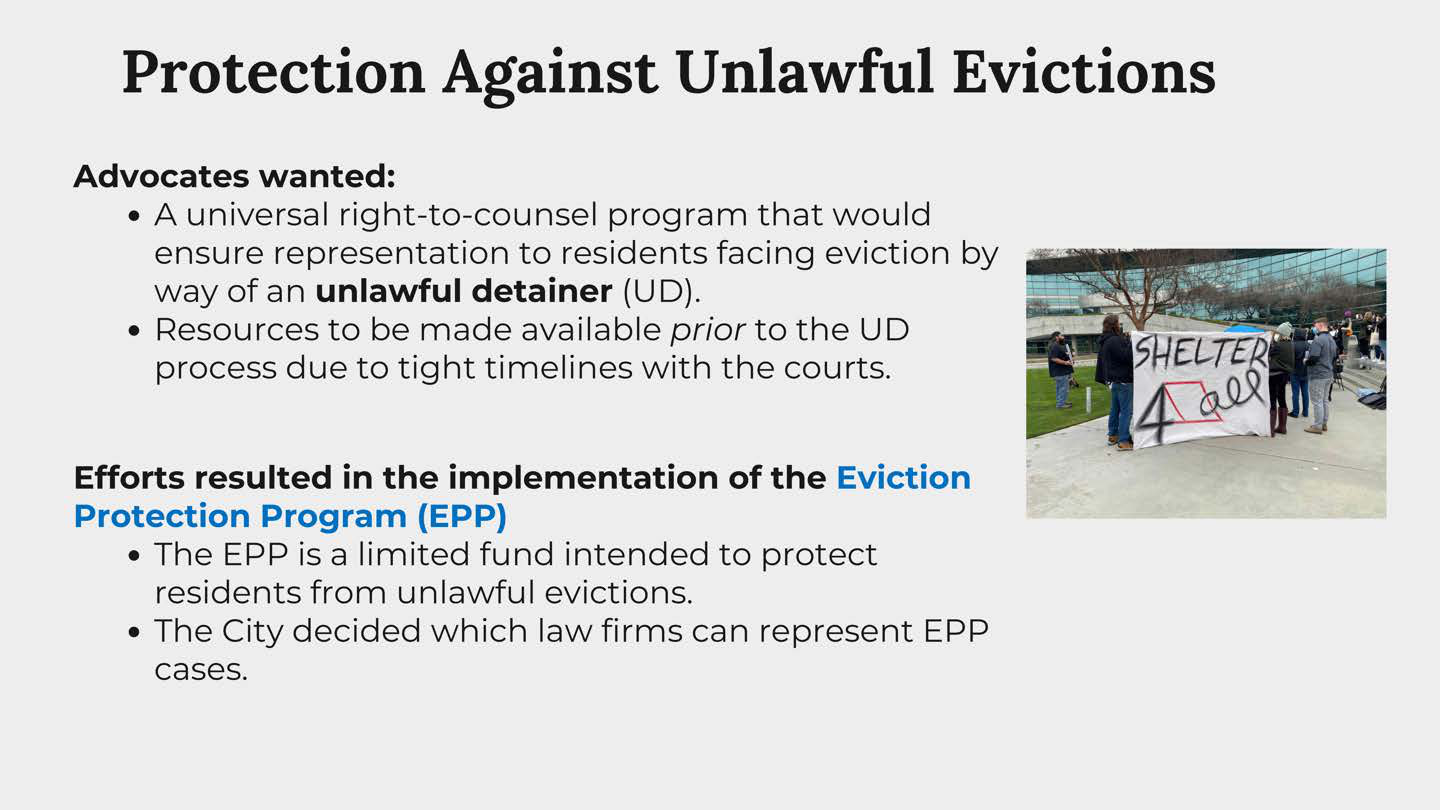
Efforts resulted in the implementation of the Eviction Protection Program (EPP)
- The EPP is a limited fund intended to protect residents from unlawful evictions.
- The City decided which law firms can represent EPP cases.
Beyond the EPP: Next Steps
Advocates wanted to implement a program that would give tenants Right to Counsel Program which would allow:
- All residents to access legal representation, without the limitations of a fund. (a universal right to counsel)
- Residents to have more choice in their legal representation
Tenant and Landlord Power Dynamic
“There is a power dynamic between the landlord and tenant. The tenant now who must go the city to get their side of the story heard and there is a lot of mistrust and apprehension, since most marginalized people are undocumented.”
- Janine Nkosi Ed.D., Director of Housing Justice Initiatives, Faith in the Valley and Fresno State Instructor
ERAP: Aligning Pandemic Funds to Meet Local Needs
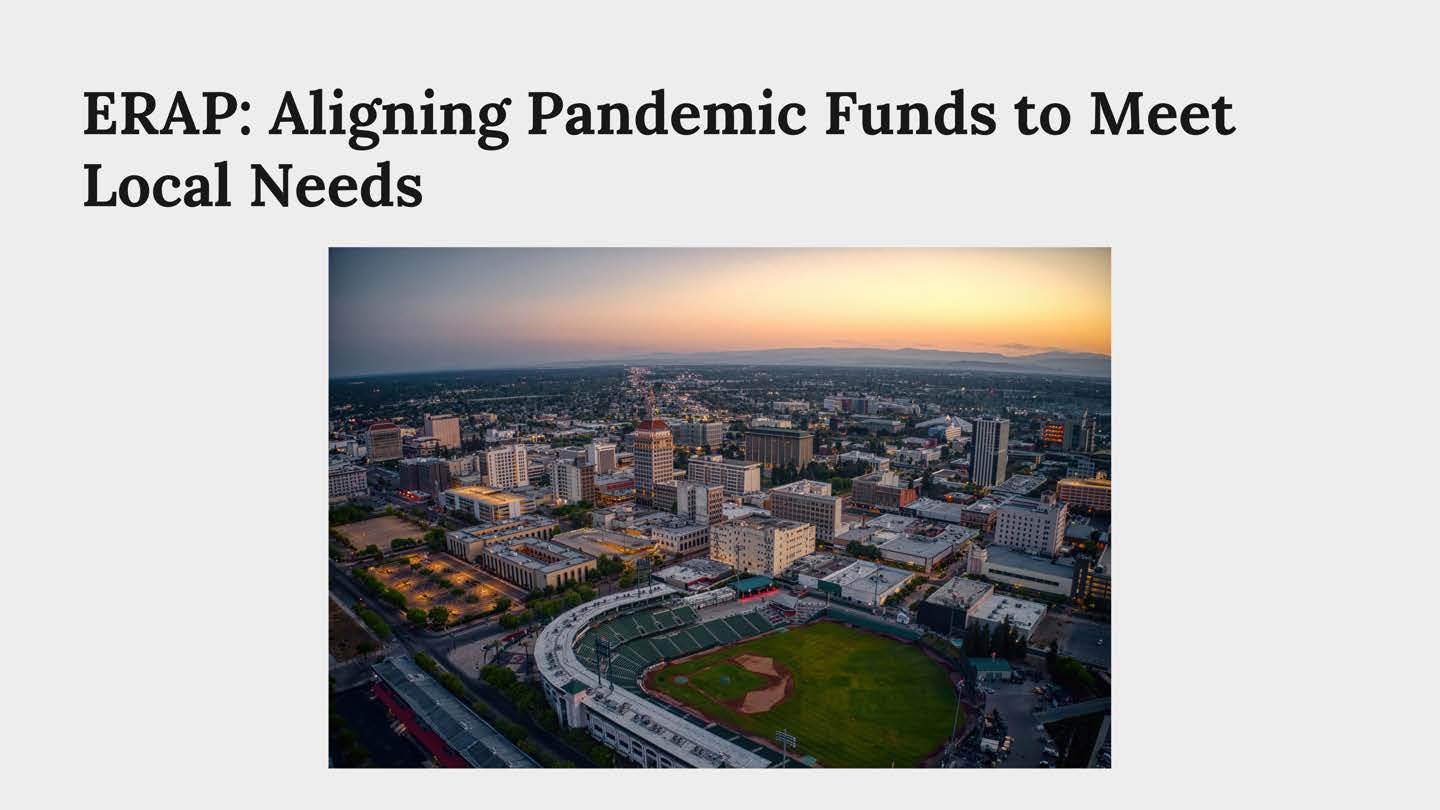
"At the time, cities are getting close to $100 million. Working with folks we were asked, what are the priorities?" Grecia Elenes, former Regional Policy Manager, LCJA
Emergency Rental Assistance Program
As the pandemic continued, stay-at-home orders hurt families and landlords.
- Community leaders with residents began to establish community-based priorities.
- The community wrote a formal letter to City leadership.
- Advocates and residents attended public comment sessions.
Efforts resulted in the implementation of the Emergency Rental Assistance Program (ERAP).
ERAP established in the City of Fresno
The City, along with CBOs, provided rent and utility relief to renters and landlords impacted by the pandemic.
- $54 million in funding from the federal and state government provided for emergency rental assistance
- Qualifying renters and landlords can be eligible for rent and utility assistance
Source: Fresno ERAP
Barriers & Challenges Implementing ERAP
The ERAP program was a novel program that ran into many challenges, some included:
- Lack of expertise and time to implement the program smoothly
- No central leadership for the program
- Lack of cultural humility
- Barriers for applying (technology and citizenship status)
- Long waiting periods
- Anti-immigrant narratives spreading fear in local communities
Ongoing Advocacy on ERAP Implementation
“The ERAP needs to be extended beyond COVID-19. Most people are only a paycheck away, or a medical bill or an accident away, from financial ruin.” —Grecia Elenes, former Regional Policy Manager, LCJA
- Advocates state that ERAP should be a permanent program.
- Advocates argue ERAP should be extended to homeowners struggling with mortgages.
- Advocates are fighting for a comprehensive program that fills in the gaps for housing affordability.
Conclusion
Two programs were created to fight predatory landlords and protect renters:
City leadership had little oversight over the eviction process, leading advocates to state that landlords often had the upper hand in evictions.
- The Eviction Protection Program provided a fund to represent tenants facing a UD.
The pandemic and subsequent stay at home orders started to affect people’s ability to pay rent and mortgage payments.
- Through the Emergency Rental Assistance Program, the City set aside $54 million for rent and utility relief.
Ongoing Housing Movement in Fresno
These programs continue to build on previous work to improve housing security in Fresno.
These efforts garnered significant media attention, raising public awareness.
- Brought additional residents into the conversation about housing rights and participating in local and state efforts
- Advocates believe that residents should continue to have the option of joining public meetings virtually to increase the community input and participation.
Solutions to Housing Insecurity
New housing actions in the City of Fresno:
- The city is currently working to implement down payments grants with new funds.
- As of June 2023, Fresno is developing 60 units of affordable housing to help with the housing crisis in North Fresno.
Advocates and tenants continue to push for more permanent solutions to housing insecurity through:
- financial education classes
- Down payment and closing cost assistance programs
- expanding affordable housing options
Thank you!!
For more information, visit us at cvhpi.org.
Thank you to the key informants who provided the needed data for this case study.
Thank you to our funders who made this work possible.
This HTML version was generated with AI assistance and may contain errors or omissions. The original approved PDF remains the official document of record. An alternative accessible format is available upon request from the document creator in accordance with Title II of the ADA.