Utilizing Community-Based Participatory Research to Assess the Role of Civic Infrastructure in Economic Development of Marginalized Communities
LaMecia Ward, MPH, CHES
Central Valley Health Policy Institute
California State University, Fresno
Introduction
LaMecia Ward MPH, CHES
Pronouns: she/her/hers
Research Associate
Central Valley Health Policy Institute
California State University, Fresno

Presenter Disclosures
LaMecia Ward MPH, CHES
- The following personal financial relationships with commercial interests relevant
to this presentation existed during the past 12 months:
No relationships to disclose
DRIVE Background
The Fresno Developing the Regions Inclusive Vibrant Economy (DRIVE) Initiative aims to directly address factors contributing to economic and racial inequity by building local power through a civic infrastructure (CI) network. The civic infrastructure (CI) network, included:
- Two large community-based organizations
- Nine small resident-led hyper-localized grassroots (hubs)
Fresno DRIVE has assembled the hubs for three main reasons:
- build robust community voice and power
- Serve as an access point for referrals and services
- Lead neighborhood-sourced-and-staffed hyper-local improvement projects
Purpose
- Establish a baseline understanding of what residents felt about their neighborhood.
- This study focused on the residents’ perspective on the ability to build civic infrastructure
within their neighborhoods based on current assets and challenges.
- Each hub is associated with a neighborhood in Fresno that geographically serves one
of Fresno Unified School District elementary schools.
- Addams
- Birney
- Calwa
- Jackson
- King
- Lincoln
- Webster South and North
- Winchell
- Each hub is associated with a neighborhood in Fresno that geographically serves one
of Fresno Unified School District elementary schools.
Methods
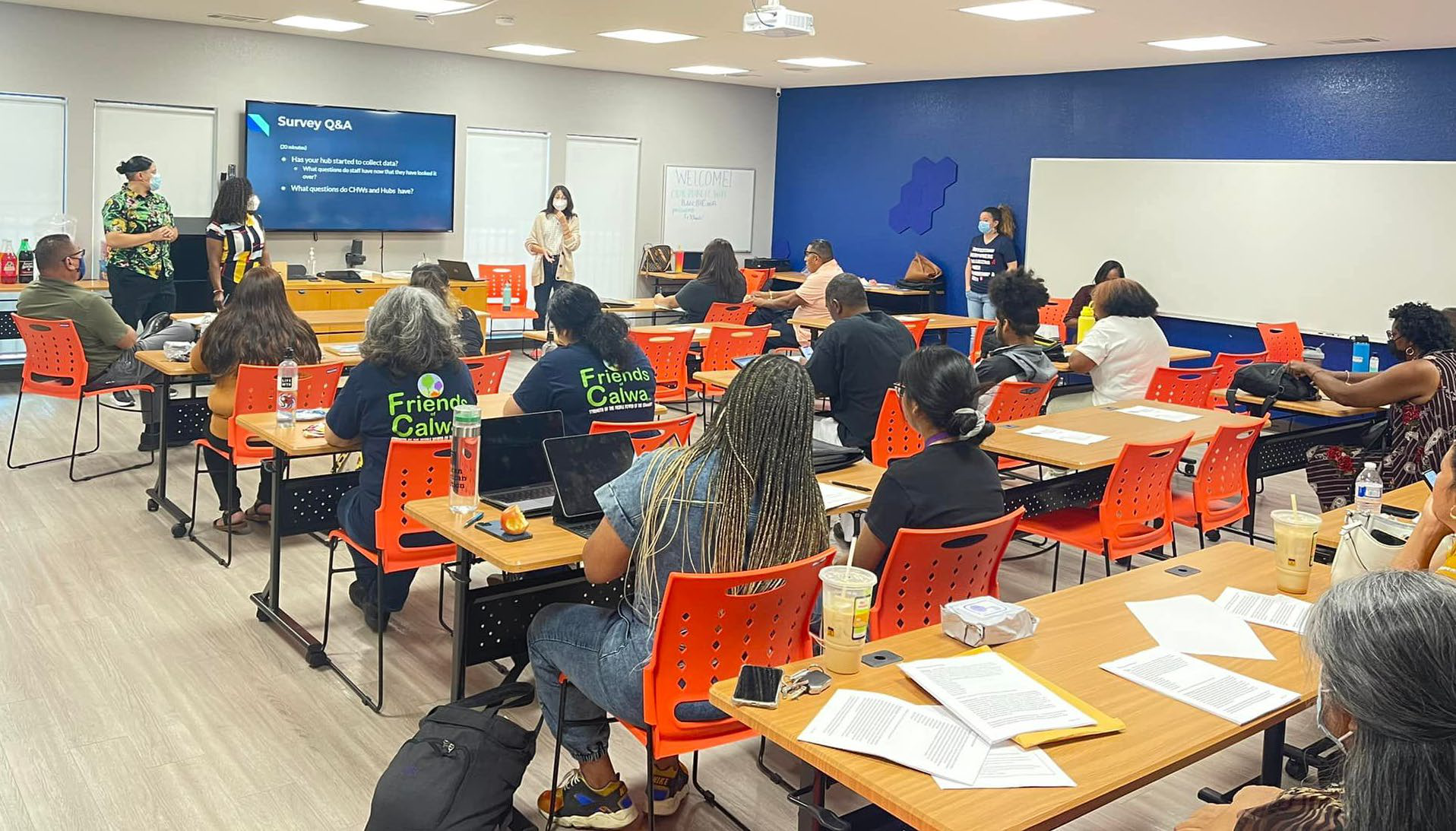
- Monthly Trainings
- - Quantitative Data Collection
- - Quantitative Analysis
-
Quantitative Instrument
- Self-efficacy scale was computed as a mean of the following five Likert scale items
developed by Romppel et al. (2013).
- “I can find the means and ways to get what I want.”
- “It is easy for me to stick to my aims and accomplish my goals.”
- “Thanks to my resourcefulness, I know how to handle unforeseen situations.”
- “I can solve most problems if I invest the necessary effort.”
- “I can remain calm when facing difficulties because I can rely on my coping abilities.”
- “No matter what comes my way, I’m usually able to handle it.”
- Neighborhood Equality was a dichotomous single-item measure.
- “Do you feel that your neighborhood is treated equally to other neighborhoods by the local Fresno government?”
Demographics
| Neighborhood | Percentage |
|---|---|
| Webster | 19.9% |
| Winchell | 14.0% |
| Jackson | 13.2% |
| Addams | 11.8% |
| Lincoln | 11.8% |
| King | 11.0% |
| Birney | 9.6% |
| Calwa | 8.8% |
| Race & Ethnicity | Percentage |
|---|---|
| Hispanic or Latino | 68.7% |
| Black or African American | 10.3% |
| White | 9.6% |
| Asian or Pacific Islander | 8.8% |
| Multiracial or Biracial | 1.5% |
| Age Groups | Percentage |
|---|---|
| 35-49 | 28.7% |
| 18-34 | 21.3% |
| 50-64 | 20.6% |
| 65 and above | 8.8% |
| Gender | Percentage |
|---|---|
| Female | 66.9% |
| Male | 31.6% |
Findings: Self-efficacy
| Age Groups | Mean of Self-efficacy |
|---|---|
| 18-34 | 2.4 |
| 35-49 | 2.3 |
| 50-64 | 3 |
| 65 and above | 2.6 |
Note: *F = 2.9; P = 0.041
| Race/Ethnicity | Mean of Self-Efficacy |
|---|---|
| Hispanic or Latino | 1.9 |
| Black or African American | 2.3 |
| White or Caucasian | 2.5 |
| Asian or Pacific Islander | 1.7 |
Note: *F = 2.6; P = 0.015
| Neighborhood Site | Mean of Self-efficacy |
|---|---|
| Addams | 2.7 |
| Webster | 2.1 |
| Jackson | 2.1 |
| King | 2.0 |
| Lincoln | 2.0 |
| Calwa | 1.9 |
| Winchell | 1.9 |
| Birney | 1.3 |
Findings: Neighborhood Equality
| Neighborhood Site | Mean of Neighborhood Equality |
|---|---|
| Birney | 0.62 |
| Webster | 0.52 |
| Jackson | 0.39 |
| Lincoln | 0.31 |
| Winchell | 0.28 |
| Calwa | 0.17 |
| King | 0.15 |
| Addams | 0.00 |
Lessons Learned
- The survey both serves as a model of how to involve hub leaders and residents in research.
- Local CBOs and the government need to build trust with residents to increase civic
engagement.
- Younger people may need further motivation for engagement.
- Data indicates that residents need help trusting their local government and that there is a need for built civic infrastructure among these communities.
Limitations and Implications for Future Research
- The residents’ participation in the PE Community Member Survey did not fully represent those living near the specified school areas.
- Self-reported information that could have potentially led to response bias.
- There is a potential for expanding research on data that was collected.
Recommendations
- Conduct a follow-up survey to compare with baseline data and track the level of community
changes over time:
- To comprehensively understand, comparing data across all neighborhood sites is important.
- Receive snapshots of each neighborhood’s progression to address neighborhood issues and their collective self-efficacy.
- Identify shifts in community members’ beliefs and attitudes toward their neighborhoods.
THANK YOU!
Authors: LaMecia Ward, MPH, Sonia Mendoza, BS, Emanuel Alcala, PhD, Tania-Pacheco-Werner, PhD, John A. Capitman, PhD,
Questions, please contact LaMecia Ward at LaMecia@csufresno.edu
A special thank you to our funders!
Center Valley Community Foundation (CVCF)