Necessitation of data disaggregation of Asian American and Pacific islanders in Fresno County, California health databases to improve health outcomes research
Stephanie Chan, MPH, Tiffany Jow, MS, Lulette Lipumano-Sanchez, DDS, Sohan Banerjee, BA, Atziri Barboza, BA, Ricardo Rubio Arteaga, BA, Miguel Garcia Raya, BS, Gladys Zamora, BA, Ricardo Garcia, Danielle Mireles, PhD, & Tania Pacheco-Werner, PhD
Background
The disproportional impact on Asian American and Pacific Islander (AAPI) groups during the COVID-19 pandemic is obscure. In Fresno County, many Asian Americans self-identify as Hmong (32.3% of the AAPI population) or Asian Indian (20.1%), with all other listed AAPI identities below 12.1%. Because data tracking and policy recommendations for AAPI communities in Fresno County are difficult to ascertain, we sought to investigate how different AAPI groups were impacted by the COVID-19 under the lens of AAPI community health workers (CHWs).
Generalizing AAPI communities may overlook their unique lived experiences. Therefore, we assert disaggregation of AAPI health data to encourage improved and tailored solutions in AAPI health policy developments.
Methods
- Data collected from REDCap shows number of AAPI communities outreached by AAPI CHWs.
- PreSurveys provided to CHWs who signed up to participate in focus groups (n=14).
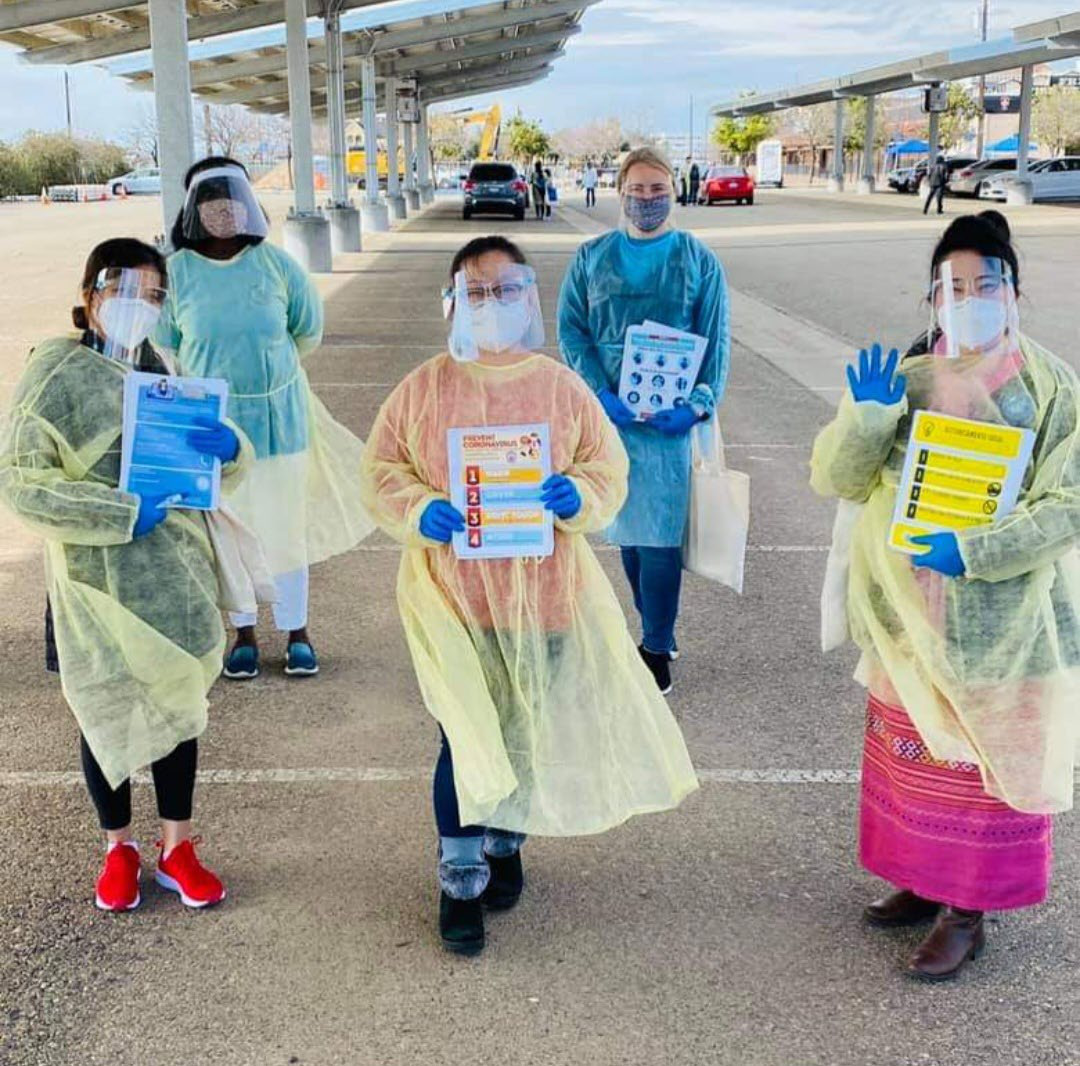
- A total of 14 AAPI CHW participants attended, with 7 Hmong CHWs and 7 Punjabi CHWs.
- Paired samples t-tests determined the significance of mean responses between Hmong and Punjabi CHWs.
- Qualitative data analysis anchored onto grounded theory of analysis to assess focus group data.
Results
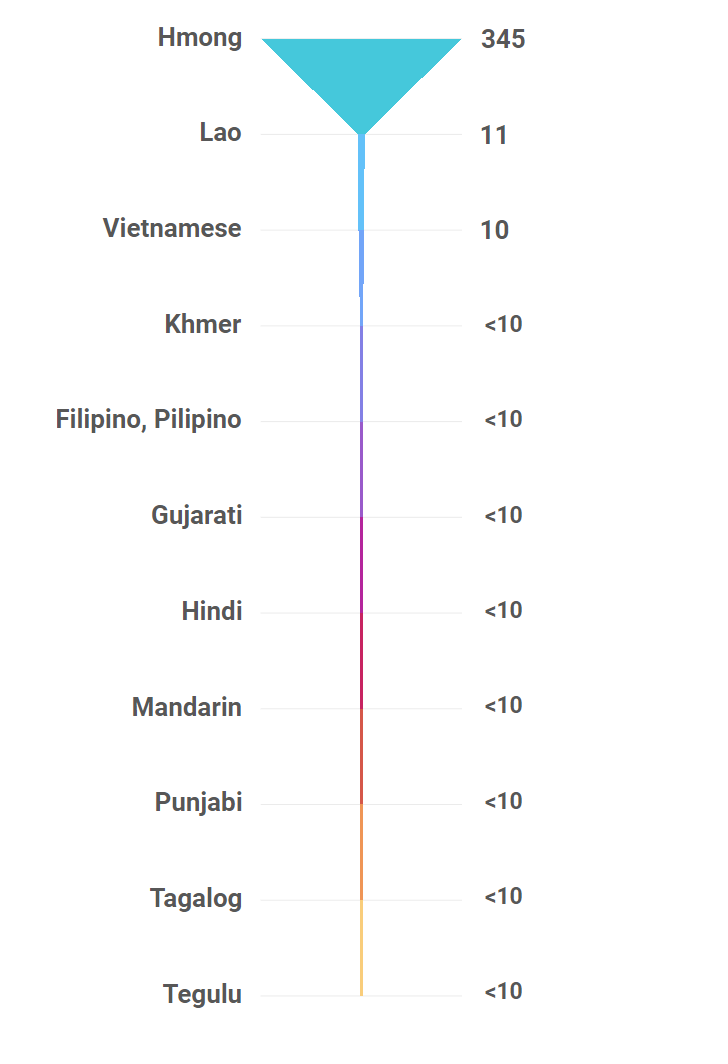
- A diverse group of AAPI communities were outreached during contact tracing processes, with the largest non-English-speaking AAPI language group being Hmong (n=345) (Fig. 1).
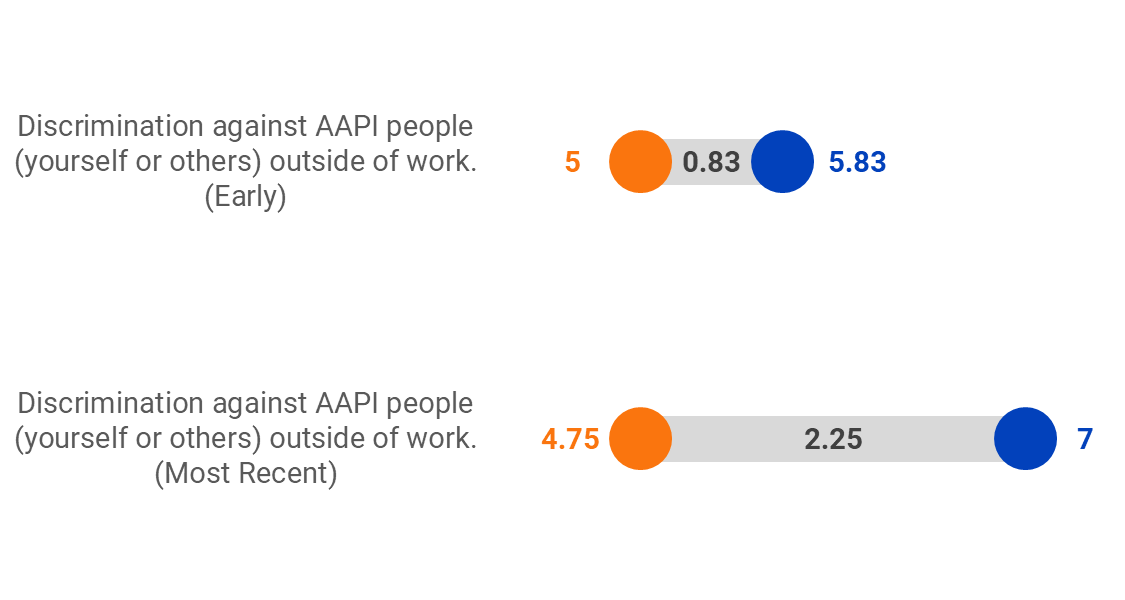
- On average, Hmong CHWs experienced increased discrimination by the end of the pandemic more often than Punjabi CHWs (p<0.05) (Fig. 2).
- Focus groups indicate that only Hmong CHWs discussed experiences of discriminations by stranger(s), in communities.
- Punjabi CHWs experienced more motivation to improve their mental well-being than Hmong CHWs (p<0.05) (Fig. 3).
- Focus groups indicated that only Punjabi CHWs showed apprehension or distrust towards systems designed to aid communities.
Community Health Worker Experiences
A lot of our Punjabi community did not believe in COVID in the beginning. They’d rather do prayers, and, you know, instead of getting the vaccine. But then when there was a lot of education material provided a lot of was a lot of outreach through websites, that's how they started believing in it, and they started getting vaccinated, and it was good to see that our Punjabi community started believing in COVID and started getting vaccinated instead of going to get hospitalized and losing their lives.
- Punjabi CHW
| Language | Number outreached |
|---|---|
| Hmong | 345 |
| Lao | 11 |
| Vietnamese | 10 |
| Khmer | <10 |
| Filipino, Pilipino | <10 |
| Gujarati | <10 |
| Hindi | <10 |
| Mandarin | <10 |
| Punjabi | <10 |
| Tagalog | <10 |
| Tegulu | <10 |
I think for us how we can support the communities is continuing to do the work that we do. We still see people come through our doors who get their first dose, and we like to hear their stories of why they waited so long. They know us, they trust us. It’s hard, and I don’t know where COVID-19 is going to lead. It’s been going on 3ish years now, but the work we’re doing is important.
- Hmong CHW
Means for Responses
During this time period of the COVID-19 pandemic, how often did you experience the following personally?
| Experience | Early | Middle | Most Recent |
|---|---|---|---|
| Motivation to improve mental health & emotional well-being | 7.93 | 6.57 | 7.79 |
| Lack of motivation to improve mental health & emotional well-being | 2.29 | 1.93 | 1.71 |
| Discrimination against AAPI people (yourself or others) outside of work. | 4.64 | 3.36 | 2.29 |
Discrimination experiences by CHW group
Discrimination against AAPI people (yourself or others) outside of work.
| Time period | Punjabi CHWs | Hmong CHWs | Mean Difference |
|---|---|---|---|
| Early | 5 | 5.83 | 0.83 |
| Most Recent | 4.75 | 7 | 2.25 |
Acknowledgments:
Thank you to our CEP partners and the Fresno County and the City of Fresno for their contributions for this study. Fresno County and the City of Fresno funded this project as a localized effort to prevent the spread of COVID-19 and address health disparities related to the pandemic among vulnerable populations in Fresno County. It is due to their contribution that we could conduct equity work among the Fresno County, CA Asian American and Pacific Islander community.
For more information, contact Stephanie Chan chanjingyu@mail.fresnostate.edu
QR code link: https://bit.ly/49lz6KI?r=qr
CEP COVID-19 Equity Project
Fresno State Central Valley Health Policy Institute
Immigrant Refugee Coalition