Advancing Health Literacy in Fresno Neighborhoods
A Community-Based Perspective on
Needed Developments and
Investments within Fresno
Evaluation Brief Prepared By:
- Davenna Morales, BS
- Dustin Hedrick, BA
- Emanuel Alcala, PhD
- Tania Pacheco-Werner, PhD
Cultural Community Wellness Coalition
Fresno State — Central Valley Health Policy Institute

Printed page 2
Acknowledgment
Special thanks to our funders, with whom this work was made possible. For the City of Fresno Advancing Health Literacy project, this is attributed to funding from the City of Fresno. Within the Fresno County Advancing Health Literacy project, funders include the Office of Minority Health (OMH) of the U.S. Department of Health and Human Services (HHS). We extend our appreciation to all of the community-based organizations that were involved in both the City and County Advancing Health Literacy projects, and to the Fresno County Department of Public Health. We are extremely grateful to the community health workers (CHWs) who were the face of the AHL intervention and worked hard to make a difference in the Fresno community and surrounding regions. We also thank them for their participation in interviews and focus groups, without which this brief would not have been possible. We also thank all community members who participated in the health presentations and outreach events and engaged with AHL staff.
Suggested Citation
Morales, D., Hedrick, D., Alcala, E., & Pacheco-Werner, T. (2023). Advancing Health Literacy in Fresno Neighborhoods: A Community-Based Perspective on Needed Developments and Investments within Fresno. Central Valley Health Policy Institute. California State University, Fresno.
Printed page 3
Background
Fresno: A Story of Disparity and Systemic Burden
At the heart of the San Joaquin Valley, the most productive agricultural region in the country, sits the City of Fresno. Despite the economic prosperity within this region, Fresno and surrounding rural areas have a standing history of structural inequities severely limiting resident access to social and healthcare services [1], [2]. Recently, these areas have been disproportionately affected by the COVID-19 pandemic, which exacerbated inequalities in health care, income, and education [1]-[3]. In 2022, the Fresno Economic Opportunities Commission (EOC) reported that among the 999,101 residents living in Fresno County, 20.6% are living in poverty [2]. That is greater than 1.5 times the rate in California (11.8%) and nationally (12.3%) [2]. For Fresno residents, this manifests in worsening living conditions, higher rates of underlying medical conditions, increased risk of contracting the COVID-19 virus, hospitalization, and mortality [4]. As of January 21, 2022, Fresno County recorded 185,292 COVID-19 cases and 2,429 deaths [4]. Despite previous efforts to address disparities in COVID-19 testing and vaccination rates, many people remain unvaccinated. Reasons for these disparities can include distrust, a lack of information/misinformation, and structural barriers when accessing care and services [5], [6]. It is within this context that the Advancing Health Literacy (AHL) program was developed and implemented to address disparities in testing, vaccine uptake, COVID-19 cases, and chronic disease management within Fresno, California.
Systemic Burdens Faced by Fresno Residents
The following zip codes, 93210, 93640, 93657, and 93706, were considered to be within the jurisdiction of service for the Fresno County AHL program. According to the Climate and Economic Justice Screening Tool (CEJST), the selected zip codes exhibit burdens exceeding the 90th percentile in housing costs and linguistic isolation when compared to the rest of the nation. Housing cost is defined as the share of households that are both earning less than 80% of the Housing and Urban Development’s Area Median Family Income and are spending more than 30% of their income on housing costs. Linguistic isolation is defined as the share of households where no one over age 14 speaks English very well. The barriers in these communities are compounded by the fact that there are obstacles in a categories (housing and linguistic isolation).
Printed page 4
| Geography | Housing Burden Percent |
|---|---|
| Zip Code of Interest: 93210 | 45% |
| Zip Code of Interest: 93640 | 49% |
| Zip Code of Interest: 93657 | 46% |
| Zip Code of Interest: 93706 | 58% |
| National Average | 24.85% |
| California Average | 30.09% |
Figure 1 shows the percentage of residents who experience housing burden by zip code in comparison to California and the Nation as a whole. The percentage of people experiencing housing burden is far greater within the zip codes of interest in comparison to the average percentage across the nation and in the state of California, 24.85% and 30.09% respectively. Data Source: Climate and Economic Justice Screening Tool (2022).
| Geography | Linguistic Isolation Percent |
|---|---|
| Zip Code of Interest: 93210 | 45% |
| Zip Code of Interest: 93640 | 51% |
| Zip Code of Interest: 93657 | 22% |
| Zip Code of Interest: 93706 | 22% |
| National Average | 4.2% |
| California Average | 9.13% |
Figure 2 illustrates the percentage of households that speak a language other than English. The zip codes of interest are at least double in percentage compared to the national and state averages of 4.2% and 9.13%, respectively. Data Source: Climate and Economic Justice Screening Tool (2022).
Printed page 5
Figure 1 and Figure 2 demonstrate how disparate these zip codes are in housing burden and linguistic isolation in relation to the nation and state. This inequality is especially evident in linguistic isolation where rates in these zip codes are more than double that of the rest of the state, and in some cases three times that of the national average. The disparities present in these zip codes, while extreme, are not outliers in Fresno County; they illustrate the needs of the Central Valley. Barriers such as these compound the existing health disparities present, as well as increasing mistrust in the system and CHW burden.
Approach
Advancing Health Literacy (AHL) Intervention Approach
The AHL intervention was designed and executed through two separate initiatives. The City of Fresno initiative targeted zip codes within Fresno City limits. Through a partnership with local community-based organizations (CBOs), the City intervention focused on delivering health education presentations and connecting residents with resources via referrals to mitigate challenges they faced. During additional outreach events hosted by CBOs, CHWs were able to connect with Fresno community members and increase their awareness of COVID-19 and chronic medical conditions, and receive COVID-19 vaccinations.
The efforts of the Fresno County AHL program centered on the partnership between the Fresno County Department of Public Health and CHWs at local clinics and CBOs. The approach of the County intervention was to address social determinants of health and build strong relationships with residents to mitigate negative health issues and systemic barriers experienced by the region. CHWs within this project would deliver health assessments, attempt to connect participants with services via referrals, and provide health education materials based on their needs.
Both projects used a targeted neighborhood-based approach that deployed trained and culturally appropriate CHWs to conduct outreach, facilitate health education, and connect with patients having one or more barriers to health literacy (as related to social determinants of health and access to health care services). Patients were identified by social needs assessments, which additionally aided in further identifying present barriers.
Printed page 6
Zip Codes Targeted Within Each Project
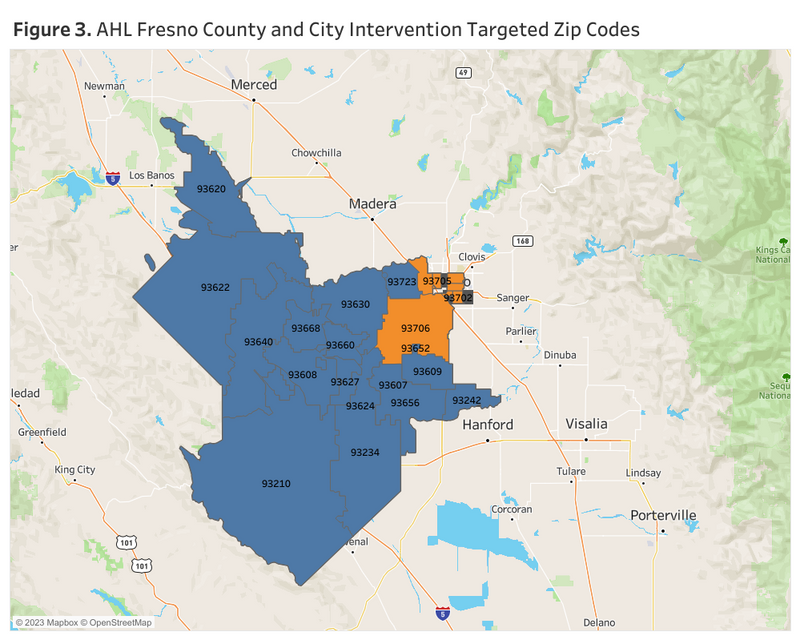
Map description: Orange identifies “AHL City Project Targeted ZIp Codes”; blue identifies “AHL County Project Targeted ZIp Codes.” The blue areas extend through western Fresno County, while the orange areas are concentrated around Fresno.
Readable zip-code labels in blue areas are 93210, 93234, 93242, 93607, 93608, 93609, 93620, 93622, 93624, 93627, 93630, 93640, 93656, 93660, 93668, and 93723. Readable labels in orange areas include 93652, 93702, 93705, and 93706. Some labels near Fresno overlap and cannot be reliably transcribed. The labels shown on the map differ from the zip-code list in the source paragraph below; both are retained without reconciling them.
© 2023 Mapbox © OpenStreetMap
Figure 3 depicts the zip codes included within the City and County AHL projects. The AHL City program focused on seven zip codes that were selected based on low COVID-19 vaccination rates, with particular attention paid to marginalized communities. These zip codes include: 93701, 93702, 93703, 93705, 93706, 93722, and 92726. The AHL Fresno County program focused on clients serviced by rural clinics and CBOs, and had eighteen zip codes ranging within rural Western Fresno County regions such as Coalinga, Huron, Mendota, Kerman and Carruthers. Within these regions, CHWs on both projects conducted outreach and connected with clients to provide resources and educate them on the AHL intervention. Collectively, these efforts covered a wide portion of Fresno County.
Printed page 7
Methods
Primary qualitative data was collected from both projects to capture the experiences of AHL CHWs. For the County, anonymous CHW phone interviews were conducted by a research assistant on the AHL project. During the eight one-on-one interviews, CHWs were asked questions concerning experiences using direct and indirect referral types, strenuous aspects of CHW workload, experiences, and challenges of fieldwork. Each CHW was asked the same series of questions in a roughly 30 to 60-minute interview. CHW responses were documented by the interviewer, and this raw qualitative data was managed solely by them. Analytical processes were conducted using thematic analysis within a social determinants of health framework. The interviewer identified common themes that aligned with the interview questions and themes that emerged unexpectedly during CHW discussions. Results were then shared with County partners and the CHWs themselves. The interviewer de-identified the interview data before sharing results to retain CHW’s anonymity amongst the other evaluators and all other AHL partners.
Similarly, four focus groups were also conducted with City CHWs [n=23]. Close to the end of the grant period, City project CHWs were asked questions about the sustainability of the AHL program, standing challenges, and insights concerning the overall program effectiveness. This process provided data that similarly coincided with previous interview findings from the County project and provided further insight into the CHW experience within the AHL intervention as a whole. It also emphasized the successes achieved by the CHWS and the impact of their efforts on Fresno residents. Secondary quantitative data was collected from the Climate and Economic Justice Screening tool and is presented as data tables and figures within the background section [8]. The evaluation procedures and protocol were approved by Fresno State’s College of Health and Human Services’ Internal Review Board (IRB).
Objective and Purpose
The primary objective of conducting focus group and one-on-one interviews with CHW’s was to understand and highlight key challenges and successes of program implementation. The purpose of this evaluation brief is to increase awareness of the most significant barriers to health for Fresno community residents through the lens of CHWs, emphasize the need for CHW professionalization and sustainability, and provide policy recommendations that center the CHW perspectives shared within this brief.
Printed page 8
Results
Summary of CHW Identified Needs
The diagram shows three directed relationships:
- Lack of Services leads to Client Mistrust and Misunderstanding.
- Lack of Services leads to CHW Burden and Burnout.
- Client Mistrust and Misunderstanding leads to CHW Burden and Burnout.
Figure 4 illustrates the theorized pathways connecting the lack of services in Fresno to client mistrust and CHW burden and burnout. The overwhelming lack of services within Fresno that caused challenges within the AHL intervention, contributing to both client mistrust and CHW burnout.
The following CHW identified categories consist of the most common barriers reported by residents, and issues that obstructed CHW effectiveness within the intervention. These categories are lack of services, client mistrust and misunderstanding, and CHW burden and burnout. Each of these categories are summarized below, and contain sub-themes discussed in greater detail in the following sections.
Lack of Services
The most frequently mentioned challenge by CHWs was the lack of services inhibiting their ability to conduct successful referrals, especially within rural communities of Fresno County. The lack of investment and development within the western and rural regions of Fresno has created large gaps in housing and infrastructure and has left these communities without access to appropriate healthcare services. CHWs shared that the most common challenges faced by community members were housing, transportation, and communication barriers.
Client Mistrust and Misunderstanding
Historical neglect of these regions has also contributed to residents being reluctant to participate in assessments or complete intake forms requiring personal information. This mistrust is due to feeling that the information taken may be abused and no tangible change has come from their previous involvement in other measures. Out of those who are willing to participate, many do not understand what the services provide or are hesitant to answer questions about mental health.
Printed page 9
CHW Burden and Burnout
As CHWs navigated the challenges of connecting residents to impacted services, many reported feeling overwhelmed and strained due to their workload. Often, overcoming barriers such as transportation needs proved to be overly taxing on the CHWs as they also attempted to address the emotional needs and distrust of Fresno residents. The lack of professionalization of the CHW role also impacted sustainability as it was challenging to continue CHW work beyond the duration of the grant period. This resulted in high turnover, burnout, and difficulty creating a sustainable impact.
Printed page 10
Lack of Services
Housing
Within the housing sector, long waitlists and the lack of affordable housing in Fresno created barriers for community members seeking services, which CHW’s were not fully able to overcome through referrals. Community members would share that they were already on lists for the limited housing available or have exhausted all resources that the referrals could provide. Due to no referral services meeting immediate needs, many would often decline services. From a health intervention perspective, initially, this negatively impacted the ability of AHL CHWs to build lasting client relationships due to community members feeling that the CHWs were unable to provide assistance. For clients seeking additional services beyond housing but still experiencing homelessness, linking them with adequate resources and health education proved increasingly difficult as these clients do not have an address that CHWs can use to send them resources.
Transportation
Transportation proved to be a prominent barrier to accessing services throughout Fresno County. Those who live outside of the City of Fresno or areas with available services must be referred to the nearest big City, making transportation a barrier for those who do not have a car, access to driving services or have limited gas funds. Often, clients would refuse services that were too far away, citing, “I only have enough gas to get me to school or work.” This theme extended to medical services, food assistance, and seeking social services. For uninsured community members, there are no tangible medical transportation resources, as motiv-care accepts only those insured through Medi-Cal. Those who rely on public transportation cite that it is not a reliable or safe mode of transport, especially for older community members.
I only have enough gas to get me to school or work.
We have resources to refer to, but we hit a wall because services are not available and clients are told no
Printed page 11
Communication Barriers
Fresno is a linguistically diverse area that is home to a wide variety of demographics. Throughout the program implementation, CHWs from cultural or ethnic backgrounds different from the client noted difficulty in establishing relationships or communicating effectively. In contrast, CHWs from the same background more easily gained client trust, built strong relationships and felt more successful connecting clients to services.
Client Mistrust and Misunderstanding
Community Mistrust of Interventions and Organizations
CHWs reported that clients, especially those within rural areas, were initially hesitant to speak with CHWs due to fear of sharing personal identifiers or information. Sometimes, clients would give wrong or non-existent addresses, phone numbers, and PO Boxes, making client follow up difficult. Clients would come in and share difficulties they were facing, like transportation hardships, but would refuse to participate in health assessments. Fresno residents also reported feeling that no lasting change was made to improve their quality of life despite previously sharing information which cemented distrust and feelings of hopelessness.
They feel like they are being used, they say 'we have given our information before and nothing changes' and so they are hesitant to sit down and talk to us
Misunderstanding of Services
Fresno residents often expressed confusion about the resources certain referrals could provide. For example, a community member experiencing homelessness might express that they do not need housing assistance because they currently do not have housing. This misunderstanding is reflective of the low health literacy rates within Fresno County and emphasizes the importance of health interventions focusing on increasing population knowledge about social services and health literacy.
Printed page 12
Stigma in Mental Health Services
Within the Latino community in Fresno, there is a stigma surrounding mental health and a lack of understanding of what mental health services entail or when they are needed. Clients would say they are “sad most days” or share marital or familial difficulties but refuse a mental health referral, as they did not feel a referral was relevant. Many would also become uncomfortable with questions concerning mental health and substance abuse and would want to skip these questions or shut down. Collectively, these challenges would create difficulties for CHWs attempting to connect them with services.
Clients would say 'I'm not crazy' when asked questions about mental health because they were scared of being judged or didn't understand what mental health means
CHW Burnout
Workload Balance
Within rural areas of Fresno, overcoming barriers such as transportation often fell on the CHWs as they traveled to meet clients in remote areas. Often, this included duties such as attending appointments with clients and helping them find outside resources such as Instacart to meet basic needs. One of the resounding themes was the feeling of disappointment or frustration when CHWs are unable to meet client needs due to systemic barriers. Due to the added time constraints created by traveling far distances, CHWs found difficulty pivoting between recruitment and outreach, meeting with clients and completing assessments, and following up with clients. Some CHWs noted that due to these challenges, sometimes tasks such as documentation or client follow-up can suffer. Due to client mistrust, documenting personal information in front of the client may cause clients to shut down or become more hesitant to disclose information. For some CHWs, this can present an additional challenge while balancing their additional duties and documenting information.
Another notable challenge was short grant periods creating constant fluctuations in CHW workload that transfer skills from previous projects. Due to this, CHWs feel that their workflow is often interrupted by the sudden end of a short grant period. It takes them a while to gain their footing in their tasks, and as soon as they feel comfortable and start gaining trust with the community, the grant period is over and not much from the program is sustained.
Printed page 13
Collectively, these challenges resulted in CHWs feeling strained or burned out, contributing to observed turnover in both projects. In a cyclic manner, burnout and workload strain yielded turnover, further compounding the workload imbalances experienced by CHWs and leaving them feeling that lasting change was hard to sustain.
Insufficent Training
Throughout the project duration, the low health literacy levels of clients and insufficient organization collaboration in the development and delivery of health education materials resulted in CHWs having to do outside research to answer client questions. Additionally, CHWs also had different experience levels when entering the project and therefore demonstrated different needs based on their experience entering the field and interacting with clients. Many CHWs requested training concerning trauma-informed care, cultural humility, navigating the healthcare system and insurance, and case management. These findings further emphasized the need for streamlined training and an outline of CHW duties and goals to better equip CHWs with the skills needed to have an effective impact. Wanting career development such as certificate training to be able to enroll clients in Calfresh and Medi-Cal, was also a common theme, as these would help CHWs better offset the needs of clients directly rather than through referrals. The CHW training requests and field experiences emphasize the importance of professionalization of the CHW role and the creation of streamlined job guidelines that can be transposed across interventions.
AHL Intervention Successes Shared by CHWs
The successes within the AHL intervention capture the excitement many community members shared due to having a project that valued their perspective, voice, and lived experiences when attempting to help them attain social services and increase their health literacy. In addition to building strong collaborative relationships with Fresno residents, CHWs often innovated ways to circumnavigate systemic barriers and hardships faced by their clients by connecting them to readily available services that may offer relief indirectly by meeting other needs.By the end of the program duration, community members readily expressed gratitude and appreciation to the CHWs and their respective organizations and were eager to become involved in future projects.dditionally, the AHL project initiatives provided a more in-depth understanding of the needs of Fresno residents and how to meet community members “where they are.”
Printed page 14
This was achieved by centering the CHW and community members’ perspectives that allowed housing, transportation, literacy, and educational shortfalls to be exposed. All of which have resounding effects on the livelihoods of the Fresno population.
We have people asking 'What's next?' and are eager to get involved in future projects. It's become a community where residents feel at home
Discussion
Need for CHW Professionalization
Establishing a Strong CHW Workforce
As previously mentioned, grant funding often introduces fluctuations in CHW workload and uncertainties around how to transfer skills from previous projects. Additionally, moving between projects with different goals can create inconsistencies in the training and experiences of the CHWs, compounding the difficulties in creating a sustainable impact within the Fresno community. Therefore, the development of core CHW training and competencies is needed by organizations that employ CHWs to create support for CHWs and greater sustainability for this line of work, regardless of setting. Through this, we can better solidify CHW expectations and workload as they move through grant work, place emphasis on institutional knowledge, and support a workforce equipped with transferable skills relevant across a range of grant work.
Sustainability of Interventions and CHW Workforce
One of the greatest barriers preventing CHW sustainability is lack of consistent funding and unclear core roles and competencies [12]. Attempting to address sustainability shortcomings can include organizational support, such as having strong supervisory structures and creating CHWs workforce development programs and training [11], [12]. Recognizing CHWs as essential members of healthcare is also crucial in advancing consistent funding opportunities that expand beyond the “soft money” aspect of grant work and create a supportive environment where CHWs can create lasting change [11]-[13].
Printed page 15
Integrating the CHW workforce into Medi-Cal and Medicare processes allows CHWs to be compensated for their services, such as care coordination, social support, case management, conducting SDOH assessment screenings, and more. Building institutional support for CHWs can include CHWs regularly interacting with healthcare teams, CHWs having access to health records, developing protocols that remind physicians and healthcare providers to read CHW notes, and expanding the CHW work scope to include enrolling clients into social services [12].
There is not much long-term, lasting change due to turnover and grants ending. Once CHWs are ‘getting used to what to say and how to say it, funding ends.
Additionally, by fostering CHW relationships with healthcare providers, administrators, and insurance providers, we improve their understanding of the CHW role and the unique perspective they provide in patient-centered care [11], [12].
Regarding intervention sustainability, advocating to incorporate CHW perspectives into outlining grant goals, preparing health education materials, and giving feedback on program shortcomings can all help improve the intervention impact in targeted communities. Within the AHL intervention, the perspective shared by the CHWs provided great insight into what barriers affect Fresno residents and truly captured the story of the resident’s experience. As CHWs are from the communities they serve and are well aware of the outstanding systemic challenges, they are also an invaluable resource when constructing population targeted interventions, evaluating policy, and advocating for community needs.
Printed page 16
Major Policy Recomendations
Systemic barriers such as those highlighted in this brief cannot be addressed in a “one size fits all” approach. Policy-driven programs and reform set the framework for which groups within our society are most in need of help and are able to receive it [14]. As such, we must approach policy reform and recommendations from a social determinant of health standpoint and center equitable solutions that are uniquely tailored to the specific needs of our Fresno community. Further conversations and advocacy surrounding CHW impact and professionalization are also needed to strengthen and expand the impact CHWs are able to have when helping people overcome barriers. The following recommendations are based on the results shared within this brief and emphasize the importance of CHWs in community-based efforts and reinforce the need for CHW professional development.
Housing, Transportation and Infrastructure
As shown by the data collected from the CHWs, the overwhelming lack of services within the Fresno region affects multiple facets of our community’s livelihood. Investment in affordable housing will help relieve the long waitlist periods and better meet the immediate housing needs of residents. Transportation infrastructure expansion in areas such as public transportation is needed to overcome many of the challenges highlighted within this brief. Overall, it is necessary to invest in needed services within Fresno regions that experience the highest disparities in food resources, healthcare, and social services. By making these services locally available, they are more accessible to the populations that need them most, and this can also help overcome access barriers such as within transportation. In terms of quality of life, historical lack of investment and neglect of the communities the CHWs worked with is closely tied to the distrust and hopelessness expressed by these residents. In order to effectively help Fresno’s underserved population and allow them to feel like valued community members, policy and investment in equitable housing, transportation, and infrastructure must be a priority.
Overcoming Community Distrust
Creating local services that CHWs can refer to is essential in establishing client trust, and the current limited local options make clients more hesitant to accept. Investing in housing, transportation, infrastructure and social services is necessary to build trust within the Fresno Community. Building trust within the Fresno community, investing in housing, transportation, infrastructure and social services is necessary.
Printed page 17
Intervention programs must establish trust with their clients. This may be difficult due to the following:
- Historical negligence and clients being hesitant about giving personal information and questioning the intentions of the programs
- Having large immigrant population that fear repercussions if seeking medical care
- Having large homeless population that is unable to receive housing services due to impacted agencies
CHW Professionalization
- Creation of certified CHW programs that allow for the professionalization of the CHW field and workforce
- Pushing for CHW reimbursement via “hard money means” such as through insurance and healthcare policy reform that recognizes CHWs as part of the healthcare team
- Supporting CHW career development by subsidizing certifications and expanding upon services that they can provide (ex: allowing them to enroll clients in Medi-Cal and CalFresh services)
Significance and Concluding Remarks
The efforts of the City and County AHL projects highlighted Fresno community’s resounding desire and need for development and leadership involvement in Fresno and the surrounding rural regions. As shown by the CHW accounts, many residents feel hopeless or discouraged due to no lasting change or improved conditions, and they are turned away from social services due to high rates of need. In turn, this creates a culture where residents are hesitant or refuse to seek services due to previous unsuccessful experiences and historical neglect of their communities. By examining the CHW reflections on the AHL intervention, it becomes apparent that despite CHWs building relationships and relaying health information, health literacy is not the entire answer. The issues outlined throughout this brief are intersectional in nature. In order to achieve equity in Fresno, progress must be made in all of these areas: policy change, investment in infrastructure, and sustainable CHW interventions.
Printed page 18
References
-
Zuk, M. Z. (2013). Health Equity in a New Urbanist Environment: Land Use Planning and Community CapaCity Building in Fresno, CA (PhD). University of California, Berkeley.
-
K. Morgan, “Strategic Planning- Poverty in Fresno County,” Fresno Economic Opportunities Commission, Nov. 13, 2022. https://fresnoeoc.org/strategic-planning-poverty-in-fresno-County/ (accessed Sep. 11, 2023).
-
August 2021 fact sheet: How Fresno’s economic inequalities exacerbated the COVID 19 Pandemic
https://clc.ucmerced.edu/sites/clc.ucmerced.edu/files/documents/vps_valley_economic_fact_sheet.pdf (accessed Sep. 6, 2023). -
S. O. California, “Tracking COVID-19 in California,” Coronavirus COVID-19 Response. https://covid19.ca.gov/state-dashboard/
-
D. Morales, T. Beltran, and S. Morales, “Gender, socioeconomic status, and COVID‐19 vaccine hesitancy in the US: An intersectionality approach,” Sociology of Health & Illness, vol. 44, May 2022, doi: 10.1111/1467-9566.13474.
-
H. Megally et al., “A Neighborhood Approach to Mitigate COVID-19 Transmission in BIPOC and People with Disabilities: Benefits and Lessons Learned Using the Community Health Worker Model,” Central Valley Health Policy Institute. California State University, Fresno, 2021.
-
Transportation Disadvantaged Census Tracts (Historically Disadvantaged Communities) Interim Definition Methodology | US Department of Transportation. (2023, April 27). https://www.transportation.gov/priorities/equity/justice40/transportation-disadvantaged-census-tracts-historically-disadvantaged
-
“Climate and Economic Justice Screening Tool,” Climate and Economic Justice Screening Tool, Nov. 22, 2022. https://screeningtool.geoplatform.gov (accessed Sep. 11, 2023).
-
“Linguistic Isolation | OEHHA,” 2023. https://oehha.ca.gov/calenviroscreen/indicator/linguistic-isolation (accessed Sep. 11, 2023).
-
“Transportation Disadvantaged Census Tracts (Historically Disadvantaged Communities) Interim Definition Methodology | US Department of Transportation,” Apr. 27, 2023. https://www.transportation.gov/priorities/equity/justice40/transportation-disadvantaged-census-tracts-historically-disadvantaged (accessed Sep. 11, 2023).
-
R. Mehra, L. M. Boyd, J. B. Lewis, and S. D. Cunningham, “Considerations for building sustainable community health worker programs to improve maternal health,” Journal of primary care & community health, https://www.ncbi.nlm.nih.gov/pmc/articles/PMC7495927/ (accessed Oct. 30, 2023).
-
Printed page 19
C. Allen, J. N. Brownstein, A. Mirambeau, and B. Jayapaul-Philip, “Technical assistance guide for states Implementing community health worker strategies,” Centers for Disease Control and Prevention, 2014. Accessed: Oct. 30, 2023. [Online]. Available: http://www.chronicdisease.org/resource/resmgr/1305/domain3/docs/chwstatestrategies.pdf
-
M. Alvillar, J. Quinlan, C. Rush, and D. Dudley, “Recommendations for developing and sustaining community health workers,” Journal of Healthcare for the Poor and Underserved, vol. 22, no. 3, pp. 745–750, 2011, Available: https://www.researchgate.net/profile/Carl-Rush/publication/51571150_Recommendations_for_Developing_and_Sustaining_Community_Health_Workers/links/09e4151252a5d0c6f1000000/Recommendations-for-Developing-and-Sustaining-Community-Health-Workers.pdf
-
T. L. Pacheco, M. A. Ramirez, and J. A. Capitman, “Policy Barriers to Health Care Access Fuel Discriminatory Treatment,” Journal of Ambulatory Care Management, vol. 35, no. 1, pp. 2–14, Jan. 2012, doi: https://doi.org/10.1097/jac.0b013e31822c8d66.