Children of the San Joaquin Valley: Preventable Childhood Illness in Kings County

Background and Implications
Addressing childhood illness is a key public health objective, given that many of the conditions developed in childhood will negatively impact the individual well into adulthood. This report examines how pediatric preventable emergency department visits and hospitalizations are related to individual and neighborhood factors in Kings County.
Summary of Findings
In the San Joaquin Valley, non-white low-income children, ages zero to five, are most at risk for experiencing emergency department visits and hospitalizations.
The most frequent preventable emergency department visits and hospitalizations for these children are respiratory conditions related to home and neighborhood conditions, such as exposure to second-hand smoke, mold and mildew in housing, proximity to major roadways, and other air polluting sources in neighborhoods.
Children in Kings County are 2.6 times more likely to be hospitalized than children from other regions in California (259/10,000; 97/10,000 respectively). These elevated rates are likely due to lower social-economic status and less access to equal preventive care opportunities.
The communities highlighted in Figure 1 have the highest rates of child hospitalization in Kings County.
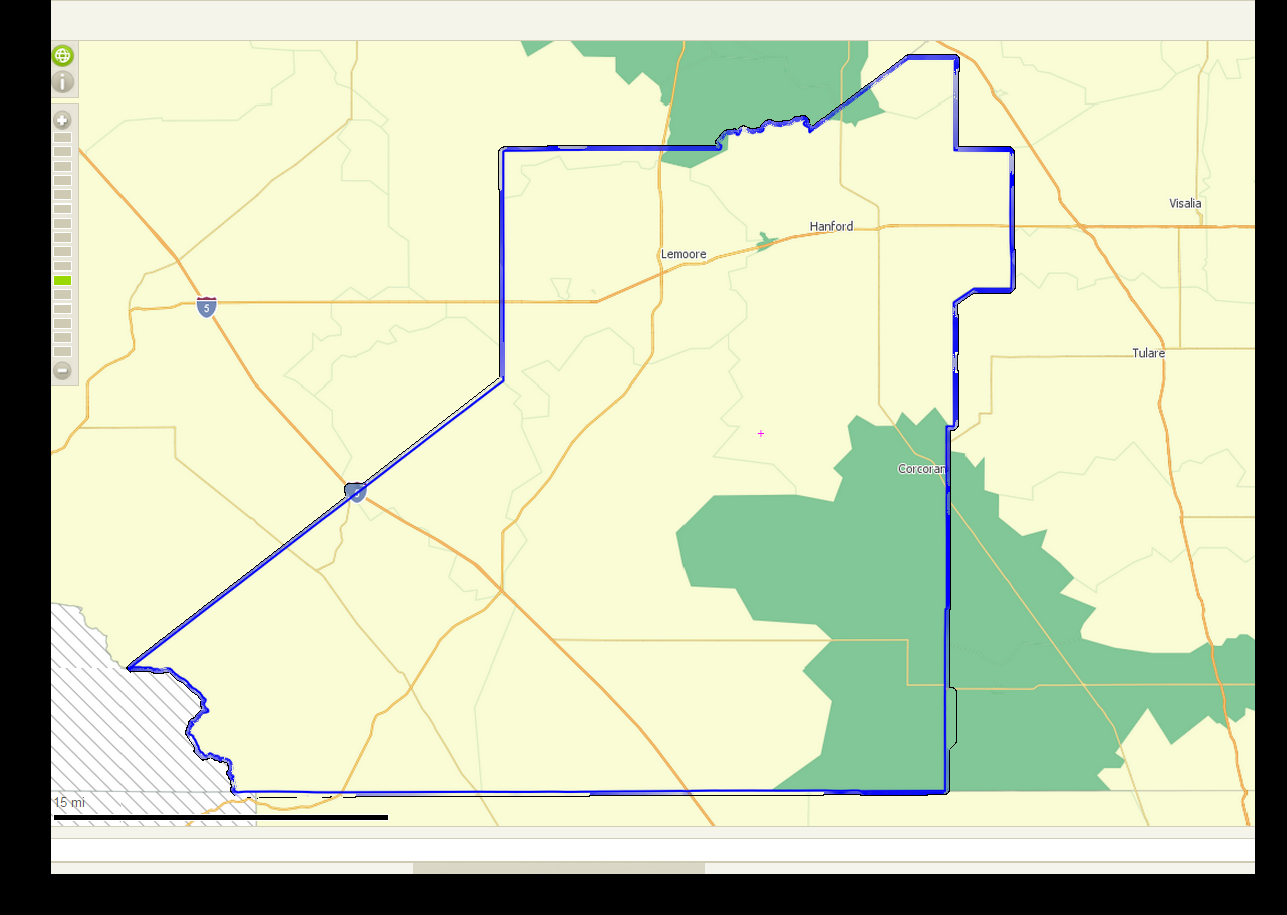
Rate of Childhood Hospitalization /10,000 in the Population
 < 380
 ≥ 380
Hospitalization rates computed from 2009-2011 data from the California Office of Statewide Health Planning and Development (OSHPD). Cases included were children ages 0-14. The legend cut-point is above the mean for California as a whole. Map was created with HealthyCity.org
In Table 1, the majority of emergency department visits are for diagnoses that are considered preventable. These are primarily respiratory conditions for which early preventive care and possibly public health programs could reduce the incidence and severity. Though still relatively infrequent events in the county, these cases account for more than $1.9 million in health care costs. As indicated by the decreased proportion of preventable hospitalizations, most of these children are not admitted, though when they are, more than $1.4 million is spent on hospital-based health care for these cases.
| Hospital Use | Frequencya | % | Rateb | Cost/Yearc,d |
|---|---|---|---|---|
| Emergency Department | ||||
| Emergency Department Total | 14,656 | 100% | 138 | $2,931,200 |
| Preventable | 9,660 | 66% | 91 | $1,932,000 |
| Non-Preventable | 4,996 | 34% | 47 | $999,200 |
| Hospital Discharge | ||||
| Hospital Discharge Total | 2,763 | 100% | 26 | $6,062,943 |
| Preventable | 662 | 24% | 6 | $1,452,648 |
| Non-Preventable | 2,101 | 76% | 20 | $4,610,294 |
The most frequent preventable and non-preventable conditions include pneumonia, asthma, and bronchitis.
a indicates the sum of the three year (2009-2011) interval.
b indicates the rate per 1,000 in the population.
c emergency department visits are estimated to cost $600 per visit.
d hospitalizations are estimated to cost $6,583 per visit.
Current Programs and Services in Kings County
The Targeted Case Management (TCM) program
The Targeted Case Management (TCM) program offers case management services to residents who fall into any of the following categories:
- Individuals with a communicable disease
- children under the age of 21
- individuals at risk of institutionalization
- individuals in jeopardy of negative health or psycho-social outcomes
- medically fragile individuals
Public Health Nurses provide case management to these clients including connecting them to services ranging from transportation assistance to insurance coverage to referrals as appropriate.
Childhood Immunizations
KCDPH has worked to sign Memorandums of Understanding (MOU) with a number of private insurance companies to provide critical preventive immunizations to not only Medi-Cal patients and the uninsured through the Vaccines for Children (VFC) program, but to many insured children in Kings County as well.
Services for Men and Women
KCDPH provides Family Planning Access, Care, and Treatment (FPACT) services. Family PACT benefits include sexually transmitted infection (STI) testing and treatment, and HIV screening services to eligible low-income men and women to decide for themselves the number, timing, and spacing of their children. Available to all residents by both appointment and walk-in basis, in Hanford, and sexually transmitted disease (STD) clinics with confidential services, HIV/TB/Cocci case management, and immunizations. STD testing and immunizations are also available in Avenal and Corcoran. KCDPH has worked with a number of private insurance companies to provide preventive immunizations as well as STD testing and treatment. This enables KCDPH to offer these services to Medi-Cal patients, the uninsured, as well as to insured residents of Kings County.
Leading Partners in County Coalitions
KCDPH actively supports and participates in the Asthma, Breastfeeding, Diabesity, and Tobacco Coalitions, as well as the Kings Partnership for Prevention (KPFP), which brings together more than 20 community partners to affect various community concerns including childhood obesity, diabetes, asthma, tobacco, and substance abuse.
Leveraging Current Programs to Educate Families on Well-being
KCDPH partners with institutions on a wide range of areas including childhood/pediatric illness while serving the needs of the resident. KCDPH utilizes every health services program with clients to provide outreach and education and/or prevent childhood illness including Child Health and Disability Prevention Program (CHDP), California Children’s Services (CCS), Field Nursing through Referrals, Women, Infant, & Children (WIC) Program, Intervention and Prevention (I&P) clinics, and First 5.
Proposed Strategies to Promote and Protect the Well-being of Kings County
Strategic Planning
KCDPH is in the third year of a strategic plan utilizing the Malcolm Baldrige Criteria for Performance Excellence to prepare for Public Health Accreditation. This process includes working with the KPFP on a community needs assessment and ultimately a community health improvement plan.
Partnerships
Continued partnership with KPFP will allow KCDPH to continue to form key partnerships like relocating First 5 Kings County into the health department and co-locating WIC services with First 5 to group services for populations, especially where access may be limited.
KCDPH is constantly striving to continue offering health services by expanding outreach, participating in health fairs, working on community health assessments, working on the community health improvement plan, and seeking out funding opportunities. Our mission is to promote and protect the health and well-being of our community. Our vision is optimal health for all. All current and future activities aspire to our mission and vision.
SAN JOAQUIN VALLEY PUBLIC HEALTH CONSORTIUM
www.sjvphc.org
330 Campus Dr., Hanford, CA 93230
Phone: (559) 584-1401