Longevity for San Joaquin Valley Elders: Individual and Neighborhood Characteristics in Kings County

San Joaquin Valley Public Health Consortium
Health Equity for All
Background and Implications
For seniors in the San Joaquin Valley, both demographic and socio-economic characteristics are linked to longevity. Individual and neighborhood characteristics combine to produce disparities in health that accumulate over a life time. Race/ethnicity serves as a proxy measure of both individual and social determinants of health such as access to healthcare, fresh produce, and environmental air quality. This report examines premature mortality prior to age 65 as well as years of life lost after age 65 within Kings County compared to the state.
Summary of Findings
Figure 1 illustrates all deaths (n=2,410) in Kings County between 2009 and 2013. Compared to California, Kings County experiences greater premature loss of life. In Kings County, 36% of these deaths were prior to age 65 as opposed to the 28% for the state. There are also notable racial/ethnic differences in premature mortality within Kings County. While 28% (below state average) of White and 22% of Asian deaths occurred prior to the age of 65, African Americans and Latinos experience higher than average premature mortality at 56%, and 48%, respectively. Sixty-two percent of Native American, Hawaiian/Pacific Islander, biracial, and self-identified other racial/ethnic groups combined also experience premature death.
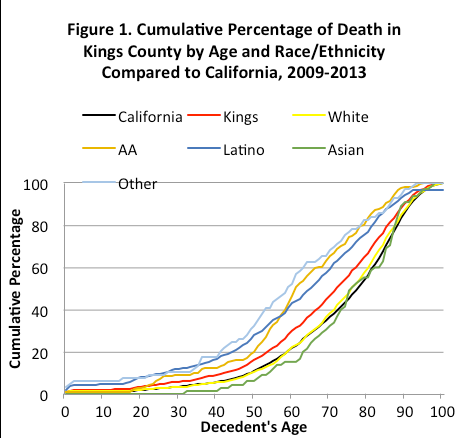
The line chart shows Decedent’s Age on the horizontal axis, from 0 to 100, and Cumulative Percentage on the vertical axis, from 0 to 100. Its lines represent California, Kings, White, African American (AA), Latino, Asian, and Other. Exact values are not printed beside the plotted points.
The following percentages of deaths before age 65 are reported in the accompanying text.
| Population | Percentage of deaths before age 65 |
|---|---|
| California | 28% |
| Kings County, all racial/ethnic groups | 36% |
| Kings County, White | 28% |
| Kings County, Asian | 22% |
| Kings County, African American | 56% |
| Kings County, Latino | 48% |
| Kings County, Native American, Hawaiian/Pacific Islander, biracial, and self-identified other racial/ethnic groups combined | 62% |
Years of life lost was computed for older adults (65+) in Kings County in relation to California’s age- and gender-specific life expectancy estimates. Older adults in California, on average, have 7.2 years of life lost at the time of death. In comparison to the state average, older adults in the San Joaquin Valley and in Kings County die prematurely by 1.01 and 1.07 years, respectively.
Figure 2 illustrates years of life lost by gender and racial/ethnic groups within Kings County in comparison to other regions. All gender and racial/ethnic groups, on average, have years of life lost greater than or equal to state with the exception of Other Females. Within Kings County African Americans and Latinos—regardless of gender—are dying prematurely in older adulthood. Risk for years of life lost is likely due to lower socio-economic status, less access to equal preventive care opportunities, and less walkable communities.
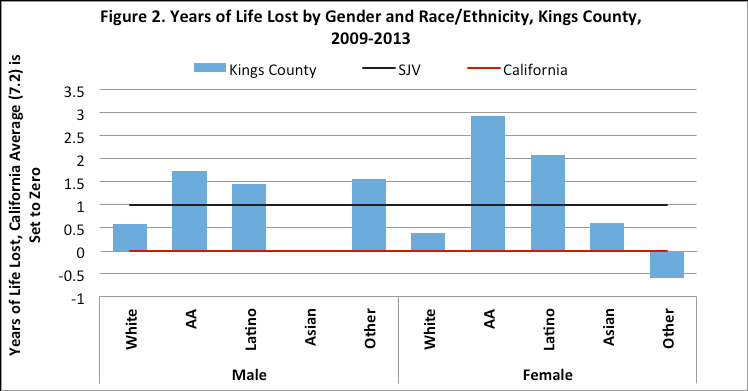
The chart sets the California average of 7.2 years of life lost to zero. Blue bars show differences from that average for Kings County groups. The vertical scale runs from -1 to 3.5 years in increments of 0.5. A black line represents the San Joaquin Valley (SJV) average, and a red line represents the California average. Exact bar values are not printed. The male Asian category is labeled, but no bar is visible.
| Race/ethnicity | Male | Female |
|---|---|---|
| White | Above California average | Above California average |
| African American (AA) | Above California average | Above California average |
| Latino | Above California average | Above California average |
| Asian | No visible bar; exact value not shown | Above California average |
| Other | Above California average | Below California average |
Current Programs and Services in Kings County
Targeted Case Management (TCM)
The Targeted Case Management (TCM) program offers case management services to residents who fall into any of the following categories:
- Individuals with a communicable disease
- children under the age of 21
- individuals at risk of institutionalization
- individuals in jeopardy of negative health or psycho-social outcomes
- medically fragile individuals
Public Health Nurses provide case management to these clients including connecting them to services ranging from transportation assistance to insurance coverage to referrals as appropriate.
Childhood Immunizations
KCDPH has worked to sign Memorandums of Understanding (MOU) with a number of private insurance companies to provide critical preventive immunizations to not only Medi-Cal patients and the uninsured through the Vaccines for Children (VFC) program, but to many insured children in Kings County as well.
Services for Men and Women
KCDPH provides Family Planning Access, Care, and Treatment (FPACT) services. Family PACT benefits include sexually transmitted infection (STI) testing and treatment, and HIV screening services to eligible low-income men and women to decide for themselves the number, timing, and spacing of their children. Available to all residents by both appointment and walk-in basis, in Hanford, and sexually transmitted disease (STD) clinics with confidential services, HIV/TB/Cocci case management, and immunizations. STD testing and immunizations are also available in Avenal and Corcoran. KCDPH has worked with a number of private insurance companies to provide preventive immunizations as well as STD testing and treatment. This enables KCDPH to offer these services to Medi-Cal patients, the uninsured, as well as to insured residents of Kings County.
Leading Partners in County Coalitions
KCDPH actively supports and participates in the Asthma, Breastfeeding, Diabesity, and Tobacco Coalitions, as well as the Kings Partnership for Prevention (KPFP), which brings together more than 20 community partners to affect various community concerns including childhood obesity, diabetes, asthma, tobacco, and substance abuse.
Leveraging Current Programs to Educate Families on Well-being
KCDPH partners with institutions on a wide range of areas including childhood/pediatric illness while serving the needs of the resident. KCDPH utilizes every health services program with clients to provide outreach and education and/or prevent childhood illness including Child Health and Disability Prevention Program (CHDP), California Children’s Services (CCS), Field Nursing through Referrals, Women, Infant, & Children (WIC) Program, Intervention and Prevention (I&P) clinics, and First 5.
Proposed Strategies to Promote and Protect the Well-being of Kings County
Strategic Planning
KCDPH is in the third year of a strategic plan utilizing the Malcolm Baldrige Criteria for Performance Excellence to prepare for Public Health Accreditation. This process includes working with the KPFP on a community needs assessment and ultimately a community health improvement plan.
Partnerships
Continued partnership with KPFP will allow KCDPH to continue to form key partnerships like relocating First 5 Kings County into the health department and co-locating WIC services with First 5 to group services for populations, especially where access may be limited.
KCDPH is constantly striving to continue offering health services by expanding outreach, participating in health fairs, working on community health assessments, working on the community health improvement plan, and seeking out funding opportunities. Our mission is to promote and protect the health and well-being of our community. Our vision is optimal health for all. All current and future activities aspire to our mission and vision.
SAN JOAQUIN VALLEY PUBLIC HEALTH CONSORTIUM
www.sjvphc.org
330 Campus Dr., Hanford, CA 93230
Phone: (559) 584-1401