Longevity for San Joaquin Valley Elders: Individual and Neighborhood Characteristics in Madera County
Background and Implications
For seniors in the San Joaquin Valley, both demographic and socio-economic characteristics are linked to longevity. Individual and neighborhood characteristics combine to produce disparities in health that accumulate over a life time. Race/ethnicity serves as a proxy measure of both individual and social determinants of health such as access to healthcare, fresh produce, and environmental air quality. This report examines premature mortality prior to age 65 as well as years of life lost after 65 within Madera County compared to the state.
Summary of Findings
Figure 1 illustrates all deaths (n=3,125) in Madera County between 2009 and 2013.
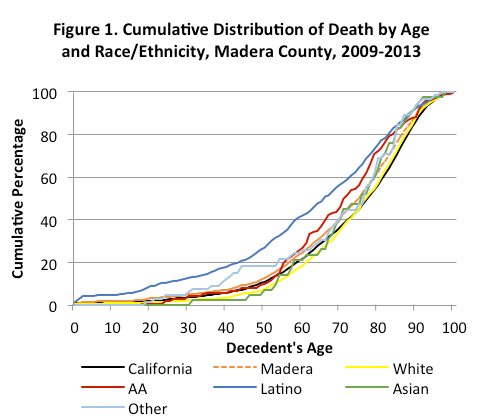
Compared to California, Madera County experiences greater premature loss of life. In Madera County, 31% of these deaths were prior to age 65 as opposed to the 28% for the state. There are also notable racial/ethnic differences in premature mortality within Madera County. While 25% (below state average) of White and 24% of Asian deaths occurred prior to the age of 65, African Americans and Latinos experience higher than average premature mortality at 35%, and 48%, respectively. Twenty-nine percent of Native American, Hawaiian/Pacific Islander, biracial, and self-identified other racial/ethnic groups combined also experience premature death.
| Population | Percentage of deaths before age 65 |
|---|---|
| California | 28% |
| Madera County, all racial/ethnic groups | 31% |
| Madera County, White | 25% |
| Madera County, Asian | 24% |
| Madera County, African American | 35% |
| Madera County, Latino | 48% |
| Madera County, Native American, Hawaiian/Pacific Islander, biracial, and self-identified other racial/ethnic groups combined | 29% |
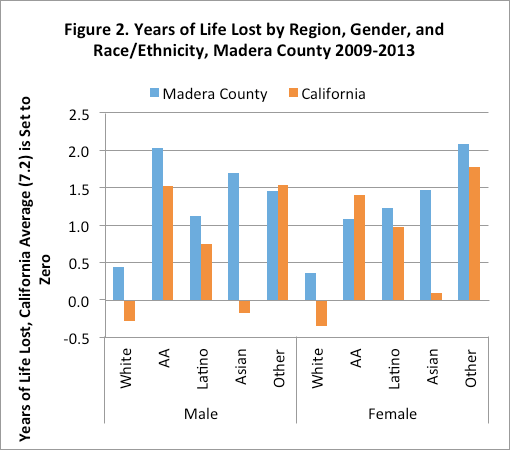
Figure 2 illustrates years of life lost in Madera County’s senior population in relation to California’s age- and gender-specific life expectancy. This graph provides insight into which racial/ethnic groups, on average, are not living as long as expected. African-Americans and those in the “other” category are disproportionately affected, and the disparity worsens within Madera County. In contrast, White and Asian males are living longer than expected throughout the state.
Senior Care Program:
The Senior Care Program offers basic health screenings and lab work to Madera citizens who don’t yet qualify for Medicare and who are not eligible for Medi-Cal. These are seniors who are 55 years of age and older, and cannot afford basic services. The clinic at the Madera County Public Health Department (MCPHD) will run blood sugar tests, conduct a metabolic panel, including lipids, prostate specific antigen (PSA), and thyroid/thyroxine test, give vision and hearing screenings, and administer flu and other vaccines at low cost. Clients are referred to their regular doctor for abnormal test results. The clinic also offers breast and cervical cancer screenings, and provides services to seniors at health fairs and senior centers.
Since many retired seniors fall in the gap of not qualifying for Medicare or Medi-Cal and cannot afford to pay out of pocket for basic services, the Senior Care Program provides needed services to our community. Many are thankful because without the program they may not have discovered potential health risks. For example, one client needed immunizations and a flu shot but found they were too expensive at the locations she tried, even with her insurance. Per referral, she came to the clinic at the MCPHD and nearly cried from gratitude that she could afford the services.

Nutritional Education:
The Madera County Public Health Department (MCPHD) provides nutritional education at various senior centers. We provide education and demonstrate how to make a nutritious meal on a budget. Seniors are shown how to make healthier choices at grocery stores by integrating more vegetables and less fat. Each month a new fruit or vegetable is highlighted and seniors have the opportunity to taste as well as share their experience preparing the food. Participating seniors value this program because it offers them a chance to learn new recipes and interesting ways to cook their favorite foods in a fun and social environment. Our nutritional education program also offers seniors the opportunity to connect healthy eating with managing and preventing chronic disease.
Access to Fruits and Vegetables:
Each summer, the Public Health Department partners with local agencies and growers to host a Farmer’s Market. During the market season, MCPHD works with the Fresno-Madera Area Agency on Aging to make sure that vulnerable seniors have access to fresh fruit and vegetables. Without our coordination, vulnerable seniors may face barriers in accessing the Farmer’s Market. Our staff also uses the Farmer’s Market as an opportunity to connect with seniors and link them to supportive services.
SAN JOAQUIN VALLEY PUBLIC HEALTH CONSORTIUM
www.sjvphc.org
14215 Road 28, Madera, CA 93638
Phone: (559) 675-7893