Longevity for San Joaquin Valley Elders: Individual and Neighborhood Characteristics in Merced County

Background
For seniors in the San Joaquin Valley, both demographic and socio-economic characteristics are linked to longevity. Individual and neighborhood characteristics combine to produce disparities in health that accumulate over a lifetime. Race/ethnicity serves as a proxy measure of both individual and social determinants of health such as access to healthcare, healthy food options, and environmental air quality. This report examines premature mortality prior to age 65 as well as years of life lost after 65 within Merced County compared to the state.
Summary of Findings
Figure 1 illustrates all deaths (n=7,707) in Merced County between 2009 and 2013. Compared to California, Merced County experiences greater premature loss of life; 33% of deaths were prior to age 65 as opposed to the 28% for the state. There are also notable racial/ethnic differences in premature mortality within Merced County. While 24% (below state average) of White deaths occurred prior to the age of 65, Asians, African Americans and Latinos experience higher than average premature mortality at 39%, 39%, and 47%, respectively. Forty-eight percent of Native American, Hawaiian/Pacific Islander, biracial, and self-identified other racial/ethnic groups combined also experience premature death.
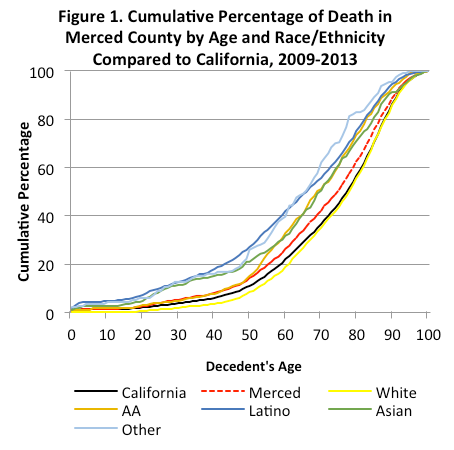
The horizontal axis is Decedent’s Age, from 0 to 100. The vertical axis is Cumulative Percentage, from 0 to 100. The lines represent California, Merced, White, African American (AA), Latino, Asian, and Other. Exact values are not printed beside the plotted points.
| Population | Percentage of deaths before age 65 |
|---|---|
| California | 28% |
| Merced County, all racial/ethnic groups | 33% |
| Merced County, White | 24% |
| Merced County, Asian | 39% |
| Merced County, African American | 39% |
| Merced County, Latino | 47% |
| Merced County, Native American, Hawaiian/Pacific Islander, biracial, and self-identified other racial/ethnic groups combined | 48% |
Figure 2 illustrates years of life lost in Merced County’s senior population in relation to California’s age- and gender-specific life expectancy. This graph provides insight into which racial/ethnic groups, on average, are not living as long as expected. African-Americans and those in the “other” category are disproportionately affected, and the disparity worsens within Merced County. In contrast, Whites and Asian males are living longer than expected throughout the state.
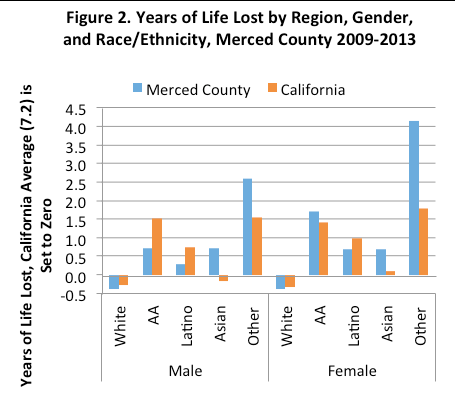
The chart sets the California average of 7.2 years of life lost to zero. Blue bars represent Merced County, and orange bars represent California. Positive bars are above the 7.2-year reference, and negative bars are below it. The vertical scale runs from -0.5 to 4.5 years in increments of 0.5. Exact bar values are not printed.
| Gender and race/ethnicity | Merced County | California |
|---|---|---|
| Male, White | Below reference | Below reference |
| Male, African American (AA) | Above reference | Above reference |
| Male, Latino | Above reference | Above reference |
| Male, Asian | Above reference | Below reference |
| Male, Other | Above reference | Above reference |
| Female, White | Below reference | Below reference |
| Female, African American (AA) | Above reference | Above reference |
| Female, Latino | Above reference | Above reference |
| Female, Asian | Above reference | Above reference |
| Female, Other | Above reference | Above reference |
How Does Public Health Promote Elder Health?
Low-income seniors tend to be in poorer health and use health care less often. The quality of the health and social services available to older adults and their caregivers affects their ability to manage chronic conditions and long-term care needs effectively. Behaviors such as participation in physical activity, self-management of chronic diseases, or use of preventive health services can improve health outcomes. In Merced County, the Public Health Department supports seniors who are experiencing health challenges as well as those who are still independent and active.
Multi-Purpose Senior Services Program
The Multi-Purpose Senior Services Program (MSSP) provides social and health care management for frail seniors who may be eligible for placement in a nursing facility but wish to remain in the community. The goal of the program is to arrange for and monitor the use of community services to prevent or delay premature institutional placement of these frail seniors.
A Public Health Nurse teams up with social workers from the local Social Services Agency. The Public Health Nurse certifies the medical needs and provides case management to help each senior stay as healthy as possible by receiving the health care and other services needed. In 2015, 170 seniors received case management services through MSSP.
Older Adult System of Care
The Older Adult System of Care Program (OASOC) provides services to seniors that may be unserved, underserved, homeless, or at risk of homelessness, institutionalization, or hospitalization. The program coordinates treatment with primary care providers and provides peer-support and education, such as fall prevention classes. A Community Health Nurse teams up with social workers from the local area agency on aging to assess client medical needs and provide case management. The OASOC program brings together many community and support services with a focus on promoting a safe and healthy environment for seniors at home and within the community. In 2015, the OASOC added the Community Health Nurse for the first time and the reception from the seniors to the classes provided by the nurse has been well received.
Chronic Disease Self-Management Program
The Chronic Disease Self-Management Program (CDSMP) is a recognized best-practice model developed at Stanford University. CDSMP is a series of classes that help adults with chronic health conditions such as diabetes or heart disease, and/or their caregivers, to better manage their condition. Classes focus on healthy eating, being physically active, signs and symptoms of depression, what questions to ask the doctor, etc. Public Health staff have been trained as Master Teachers in CDSMP and have trained others including other Public Health staff and local health care provider staff. In 2015, the Public Health Department held 10 six-week class series in both Spanish and English for 64 participants, many of whom attended the series more than once.
Improving Physical Activity Opportunities
Public Health works with schools districts, City and County Planning and Public Works Departments and community-based organizations to increase physical activity opportunities through infrastructure improvements (roads, sidewalks, crossings, lighting) and through open use agreements that open up school grounds and buildings after school hours to community residents to use for recreation. In 2015, Public Health and its partners helped the community of Winton receive an Active Transportation grant to improve walkability and bikeability in and around the town center. The local school district also opened the school grounds and buildings for community use, including popular Zumba classes held after-hours.
“It is a good idea to have this class at the school site because I feel more comfortable going there.”
Zumba Class Participant, 2015
This report was produced by the California State University, Fresno, Central Valley
Health Policy Institute in partnership with the San Joaquin Valley Public Health Consortium.
The Merced County Department of Public Health is a member of the Consortium.
SAN JOAQUIN VALLEY PUBLIC HEALTH CONSORTIUM
www.sjvphc.org
September, 2016
260 E. 15th St, Merced, CA 95341
(209) 381-1200