Reproductive Health in the San Joaquin Valley: An Analysis of Teen Birthing and Adverse Birth Outcomes 2009-2013
SOCIAL AND ENVIRONMENTAL DETERMINANTS OF POPULATION HEALTH IN THE SAN JOAQUIN VALLEY
Fresno State, Central Valley Health Policy Institute
Promoting healthy and appropriately timed pregnancies and births are key objectives for public health. While substantial achievements have been made, the United States is now behind many peer high-income nations in achieving key World Health Organization maternal and child health. This reflects great variability in outcomes across the US and California. An evidence-based consensus has emerged that both modifiable individual factors and modifiable neighborhood exposures dramatically impact reproductive health outcomes. This report examines reproductive health outcomes and determinants in the San Joaquin Valley (SJV), focusing on teen births and birth outcomes.
Teen Child-Bearing
Because pregnancy and child-bearing by teenagers is associated with long term negative social, economic and health outcomes for the teen mother, her child and the larger society, reductions in teen pregnancy and births has been a major focus of public health initiatives. By 2014 the teen birth rate was about 24 births/1,000 adolescent females, almost 1/3 of the 1990 rate. California teen child-bearing varies by race/ethnicity, social class, and place of residence. The recent California legal mandates to provide comprehensive reproductive health education and confidential access to health care have broadened access to effective programs, but many also face barriers to accessing care.
Birth Outcomes: Preterm Birth
For newborns, there are multiple measures of well-being that are complexly correlated. Adverse birth outcomes include low birth weight (LBW), preterm birth (PTB), infant morbidity (failure to thrive and other diagnosed medical conditions) and infant mortality (birth - one year). Recent studies have pointed to PTB as the most consistent indicator of poor maternal and infant health. PTB is associated with other poor infant health outcomes and long-term economic and social challenges for individuals and communities. PTB has been attributed to maternal age, chronic health conditions, and high risk behaviors. According to March of Dimes data, women who become pregnant in the SJV face a much higher risk of PTB compared to other regions within the state, particularly women of color and those who reside in low-income communities.
A common set of individual and neighborhood factors have been linked to adverse maternal and child health outcomes such as PTB. Many of these same factors have been linked to teenage pregnancy and child-bearing. Women with individual risk factors such as poverty, low education, challenging work, and racial/ethnic "minority" status face greater stresses before and during pregnancy, have less access to preventive care and pregnancy care, and have more adverse birth outcomes. Similarly, living in poor, segregated, conflict-filled and polluted neighborhoods seems to increase risk for adverse birth outcomes beyond the effect of individual factors. These stark differences are explored in research utilizing the life course perspective, a combination of early programming, and cumulative pathway theories.
Current San Joaquin Valley Public Health Consortium Programs Supporting the Health of Young Women
San Joaquin Valley Public Health Consortium (SJVPHC) member local health departments have extensive programming centered on women and children. The success of these initiatives hinge on state and federal policies and funding priorities. Notable reductions in funding for public health maternal and child health initiatives in California have also influenced the range and scope of interventions supporting this vulnerable population. Despite these factors, Table 1 shows diverse examples from the SJV county local health departments of ongoing initiatives and activities to promote the health of young women. By examining variations across the SJV, this analysis can help local health departments and their partners identify additional avenues to improve the health of young women.
| County | Examples of Current Initiatives |
|---|---|
| Kings |
|
| Fresno |
|
| Madera |
|
| Merced |
|
| San Joaquin |
|
| Stanislaus |
|
| Tulare |
|
Data Sources and Approach
This report utilizes data from a variety of statewide governmental agencies. Hospital discharge data and the birth statistical master files for the years 2009-2013 were obtained from the Office of Statewide Health Planning and Development (OSHPD) and the California Department of Public Health (CDPH), respectively. The Office of Environmental Health Hazard Assessment (OEHHA) identified and grouped key indicators to produce the CalEnviroScreen (CES) score. Pollution burden and population characteristics are the two indices that create the cumulative impact score from the CES 2.0. Indicators that compose the pollution burden score, including particulate matter 2.5 (PM2.5) and diesel particulate matter, were used to highlight neighborhood level influences on women’s health. The Regional Opportunity Index (ROI) is an index that helps to target resources and economic opportunity in California’s communities developed by UC Davis Center of Regional Change. All data files mentioned above provided information on place of residence (zip code or census tract), age, sex, and other non-identifiable demographics. All rates and population estimates were based on 2010 Census files.
Findings: Teen Births
The SJV counties has some of the highest rates of teen birth observed in the state of California, but they have seen dramatic reductions in teen birthing in recent years. Figure 1 illustrates that all eight counties of the SJV have significantly higher rates of teen births than the state as a whole. The Figure also demonstrates a clear downward trend over time for California and the SJV Counties. An 11% decrease in teen births was observed for California over the five year period, while a similar trend was observed for each of the the SJV counties. In addition to having higher rates of teen births than other parts of the State, the rates also vary notably by residence in the Valley as shown in Figure 2.
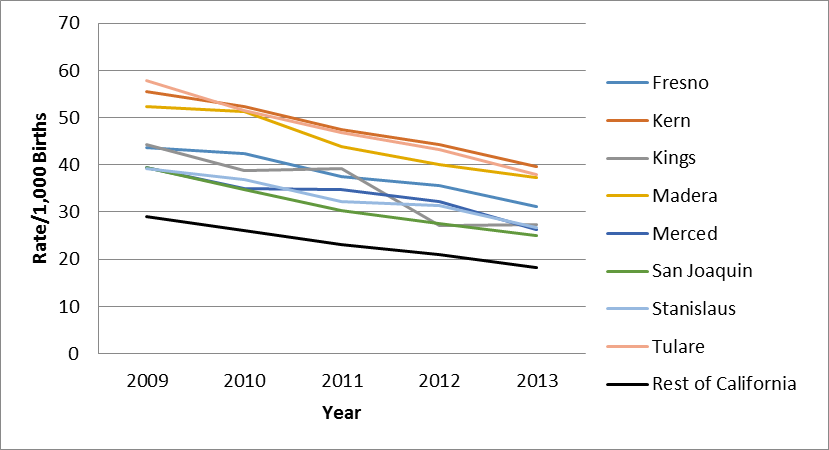
The horizontal axis shows 2009 through 2013. The vertical axis is labeled Rate/1,000 Births and ranges from 0 to 70 in increments of 10. The lines represent Fresno, Kern, Kings, Madera, Merced, San Joaquin, Stanislaus, Tulare, and the rest of California. All eight counties show an overall decline and remain above the rest of California. Exact values are not printed beside the plotted points.
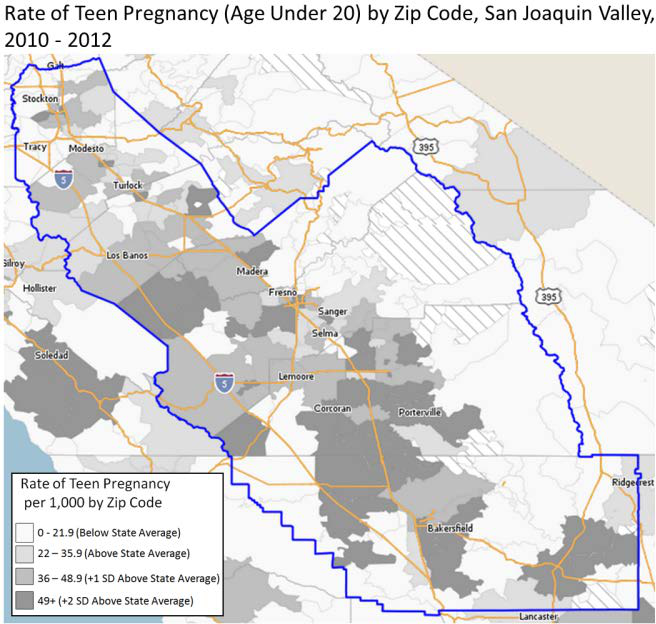
Map title: Rate of Teen Pregnancy (Age Under 20) by Zip Code, San Joaquin Valley, 2010-2012.
Map legend: Rate of Teen Pregnancy per 1,000 by Zip Code. SD means standard deviation.
- 0-21.9: Below State Average
- 22-35.9: Above State Average
- 36-48.9: +1 SD Above State Average
- 49+: +2 SD Above State Average
Our analysis suggests, teen pregnancy varies by individual level indicators as well as across communities in the SJV. We examined the odds ratios and 95% confidence intervals in multivariate analysis. Women of color are at significantly higher risk for teen births, when compared to white women. Specifically, Latinas, African-Americans, Asians, and “Other” were at 2.28, 1.63, 2.10, and 2.10 times more likely for teen births than Whites, respectively. Foreign-born women were found to be 0.45 times less likely to have a teen birth than US-born women. Mothers on Medi-Cal and other public insurance types are 4.57 and 2.87 times more likely to have a teen birth than mothers with private coverage, respectively. Neighborhood poverty is positively associated with teen birth rates. In communities where at least 18% of the population was living two times below the Federal Poverty Level, the odds for teen birth were 1.38 times greater than in affluent communities. In communities considered to be in extreme poverty, where at least 33% of individuals were living two times below the Federal Poverty Level, the odds for teen birth were 1.46 times greater than in affluent communities.
Preterm Birth
During the study period, the proportion of PTBs was greater within the SJV region, 9.4%, than the state, 8.8%. Overall, the SJV has higher rates of premature birth than the state. There was considerable variation by residence and other factors within the SJV, as well. Figure 3 displays individual and neighborhood level indicators significantly associated with preterm birth (PTB), as determined by a hierarchical regression model. Odds ratios and 95% confidence intervals are displayed in order to show the magnitude of the relationship between each indicator and PTB. Indicators are categorized into two groups, modifiable and non-modifiable.
Mothers who were older than 29 years of age were found to be at significantly higher risk for PTB, in comparison to mothers between the age of 25 and 29. Mothers between the age of 20 and 24 were significantly less likely for PTB. African-Americans were at significantly greater risk than Whites, with an OR of 1.58. Asians and “other” races/ethnicities were also at significantly greater risk than Whites, with 1.33 and 1.28 odds ratio, respectively. Modifiable indicators were found to have a greater association with PTB when compared to non-modifiable. Having a previous PTB, hypertension, or smoking increased risk for PTB. Mothers on Medi-Cal and other forms of public insurance were at 1.21 and 1.33 times more likely to have a PTB than mothers who had private insurance. Although individual-level indicators explained for the majority of variation in PTB, particulate matter 2.5 (PM2.5) and economic opportunity measured at the zip code level were significantly associated with PTB even after controlling for individual level differences. PM2.5 was significant and positively associated with PTB. The indicator for poverty—economic opportunity—was significant and negatively associated with PTB. This suggested that in communities where economic opportunity was highest, the lowest rates of PTB were observed.
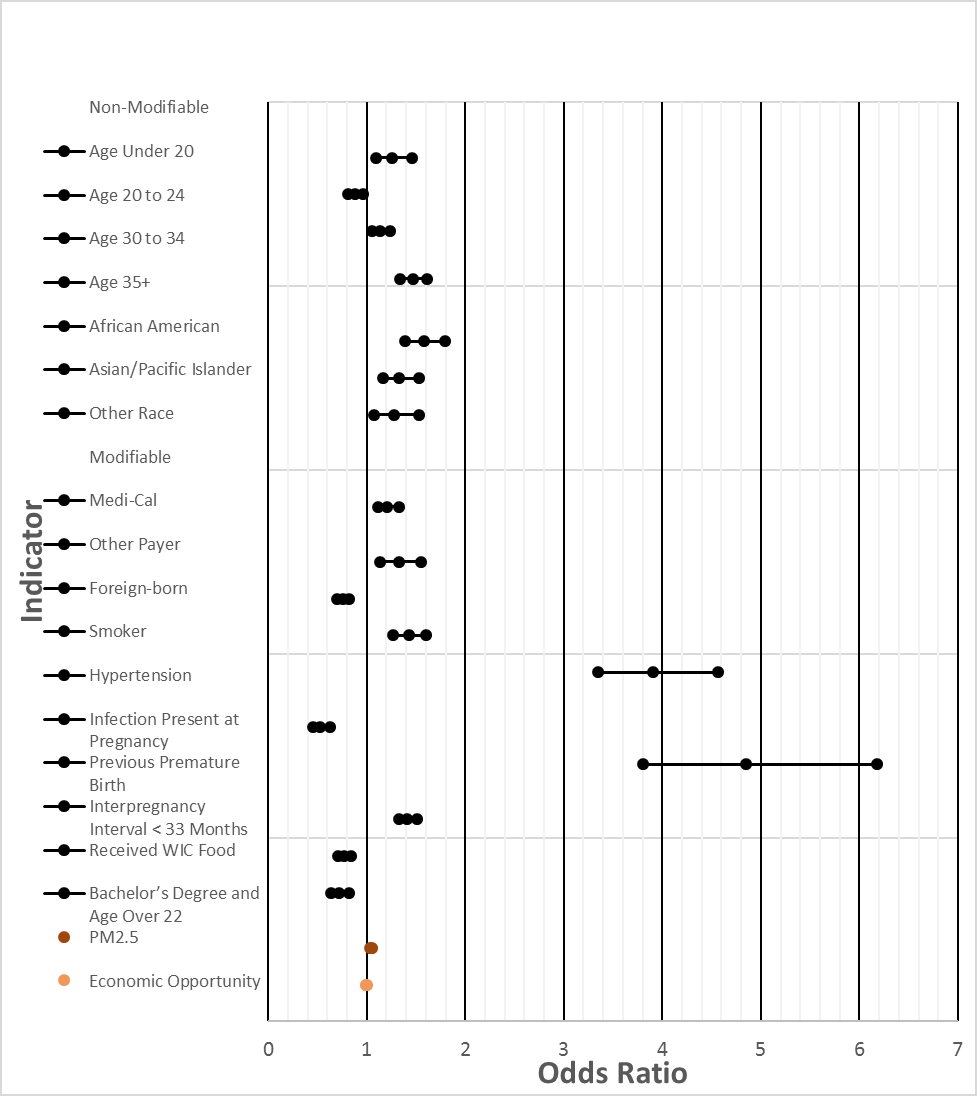
The horizontal axis shows odds ratios from 0 to 7 in increments of 1. Points show odds ratios and horizontal lines show 95% confidence intervals. An odds ratio above 1 indicates higher odds relative to the reference group; an odds ratio below 1 indicates lower odds. The graph does not print exact estimates or confidence limits.
| Indicator | Position of odds ratio relative to 1 |
|---|---|
| Non-Modifiable | |
| Age Under 20 | Above 1 |
| Age 20 to 24 | Below 1 |
| Age 30 to 34 | Above 1 |
| Age 35+ | Above 1 |
| African American | Above 1 |
| Asian/Pacific Islander | Above 1 |
| Other Race | Above 1 |
| Modifiable | |
| Medi-Cal | Above 1 |
| Other Payer | Above 1 |
| Foreign-born | Below 1 |
| Smoker | Above 1 |
| Hypertension | Above 1 |
| Infection Present at Pregnancy | Below 1 |
| Previous Premature Birth | Above 1 |
| Interpregnancy Interval < 33 Months | Above 1 |
| Received WIC Food | Below 1 |
| Bachelor’s Degree and Age Over 22 | Below 1 |
| PM2.5 | Above 1 |
| Economic Opportunity | Below 1 |
Discussion and Recommendations
Although rates of teen birthing are elevated in the SJV relative to California, the 2009-2013 period saw continued year-to-year reductions in these rates throughout the region. Teen birthing varied by individual and neighborhood factors, with individual and neighborhood poverty as the strongest predictors. Despite notably high rates of pregnancy care engagement, the SJV has higher rates of adverse birth outcomes than California as a whole. A number of the individual and neighborhood factors associated with PTB rates explain elevated risk compared to other CA region and variability within the region. Women of color with low education and prior PTBs as well as those in communities with high diesel pollution and low economic opportunity were at greatest risk for PTB.
The local health departments have taken varied strategies to promote reproductive health in order to have maximum impact on communities. Generally, these strategies have targeted modifiable characteristics of individuals. The San Joaquin Valley local health departments have a long history of providing free STI/HIV testing as well as in reducing tobacco marketing. The findings within this report suggest that the San Joaquin Valley continues to host reproductive disparities which are pervasive among women who are of color, low education status, low socioeconomic status, and young.
Potential Initiatives to Reproductive Health
The SJV Public Health Consortium identified three specific opportunities that county public health departments can champion at the county level:
- Promote high quality and culturally responsive reproductive clinical care in patient-centered systems, informed by scientific consensus and national best practice evidence. In the SJV, several counties are fostering opportunities to train and retain physicians, advanced practice nurse and other practitioners that are multi-lingual and culturally sensitive. They are developing new partnerships to increase access to quality, coordinated and evidence-based care.
- Provide individually oriented education, health promotion, screening and interventions for women of reproductive age to reduce risk factors for adverse outcomes. The “promotora” or community health worker (CHW) model is being implemented to provide social, economic and health support for women. CHWs visit women in home settings to promote preventive measures including breastfeeding, nutrition, homemaker assistance, healthcare system navigation, etc. Developing sustainable funding for these programs is a high priority goal for several SJV counties.
- Investigate and increase the responsiveness of policies and programs to social, economic and environmental factors that impact pregnancy and early childhood outcomes. This multi-level, interdisciplinary goal requires new collaborations and unique partnerships. Some counties in the SJV are coordinating across sectors to consider the built environment and adopt health-friendly policies and improve the physical infrastructure for healthy living. Those invited to engage and frame new policies include government agencies, businesses, employers, developers, and families.
References
- Abood M. California Coalition for Rural Housing | Publications [Internet]. California Coalition for Rural Housing. [cited 2017 Apr 10];Available from: http://www.calruralhousing.org/publications
- Goldschmidt W, Nelson G. As you sow: Three studies in the social consequences of agribusiness [Internet]. Allanheld, Osmun Montclair, NJ; 1978 [cited 2017 Apr 10]. Available from: http://library.wur.nl/WebQuery/clc/141097
- Ramirez SM, Villarejo D. Poverty, housing, and the rural slum: policies and the production of inequities, past and present. American journal of public health 2012;102(9):1664–1675.
- Bacon C, Getz C, Kraus S, Montenegro M, Holland K. The social dimensions of sustainability and change in diversified farming systems. Ecology and Society [Internet] 2012 [cited 2017 Apr 10];17(4). Available from: http://www.ecologyandsociety.org/vol17/iss4/art41/
- Avalos A. Migration, unemployment, and wages: The case of the California San Joaquin Valley. Contemporary Economic Policy 2010;28(1):123–135.
- Kingsley GT. Concentrated Poverty and Regional Equity: Findings from the National Neighborhood Indicators Partnership Share Indicators Initiative. 2013;
- Baumgardner F, Hinson J, Panek S. Annual Revision of Gross Domestic Product by Metropolitan Area Advance Statistics for 2015 - U.S. Bureau of Economic Analysis Search Results [Internet]. [cited 2017 Apr 10];Available from: https://search.bea.gov/search?utf8=%E2%9C%93&affiliate=u.s.bureauofeconomicanalysis&query=Annual+Revision+of+Gross+Domestic+Product+by+Metropolitan+Area+Advance+Statistics+for+2015
- Diringer J, Ziolkowski C, Paramo N. Hurting in the Heartland: Access to Healthcare in the San Joaquin Valley. Rural Health Advocacy Institute, California Rural Legal Assistance Foundation Sacramento, CA 1996;
- Diringer J, Curtis KA, Paul CM, Deveau DR. Health in the Heartland: The Crisis Continues: a Report on Health Status and Access to Care in the San Joaquin Valley. Central Valley Health Policy Institute, California State University, Fresno; 2004.
- Bengiamin M, Chang X, Capitman JA. Understanding traditional Hmong health and prenatal care beliefs, practices, utilization and needs. 2011 [cited 2017 Apr 10];Available from: http://health-equity.pitt.edu/3854/
- Bengiamin M, Capitman J, Nyandoro K. Publications [Internet]. [cited 2017 Apr 10];Available from: https://www.fresnostate.edu/chhs/cvhpi/publications/
- Schwarte L, Samuels SE, Capitman J, Ruwe M, Boyle M, Flores G. The Central California Regional Obesity Prevention Program: changing nutrition and physical activity environments in California’s heartland. American journal of public health 2010;100(11):2124–2128.
- Bengiamin M, Capitman JA, Chang X. Healthy people 2010: A 2007 profile of health status in the San Joaquin Valley. Fresno, CA: California State University, Fresno, 2008.
- Lessard LN, Alcala E, Capitman JA. Pollution, poverty, and potentially preventable childhood morbidity in central California. The Journal of pediatrics 2016;168:198–204.
- Padula AM, Mortimer K, Hubbard A, Lurmann F, Jerrett M, Tager IB. Exposure to traffic-related air pollution during pregnancy and term low birth weight: estimation of causal associations in a semiparametric model. American journal of epidemiology 2012;kws148.
- Hew KM, Walker AI, Kohli A, et al. Childhood exposure to ambient polycyclic aromatic hydrocarbons is linked to epigenetic modifications and impaired systemic immunity in T cells. Clinical & Experimental Allergy 2015;45(1):238–248.
- Margolis HG, Mann JK, Lurmann FW, et al. Altered pulmonary function in children with asthma associated with highway traffic near residence. International journal of environmental health research 2009;19(2):139–155.
- Nadeau K, McDonald-Hyman C, Noth EM, et al. Ambient air pollution impairs regulatory T-cell function in asthma. Journal of Allergy and Clinical Immunology 2010;126(4):845–852.
- Joint Center for Political and Econoic Studies and the San Joaquin Valley Place Matters Team. Place Matters for Health in the San Joaquin Valley: Ensuring Opportunities for Good Health for All. March 2012.
- London J, Huang G, Zagofsky T. Land of risk/land of opportunity: Cumulative environmental vulnerability in California’s San Joaquin valley. Davis, CA: UC Davis Center for Regional Change [Internet] 2011 [cited 2017 Apr 10];Available from: http://www.kerncog.org/images/docs/pubinfo/SJV_EJ_areas_2011.pdf
- Huang G, London JK. Cumulative environmental vulnerability and environmental justice in California’s San Joaquin Valley. International journal of environmental research and public health 2012;9(5):1593–1608.
- CalEnviroScreen 3.0 | OEHHA [Internet]. [cited 2017 Apr 10];Available from: https://oehha.ca.gov/calenviroscreen/report/calenviroscreen-30
- Health in All Policies Taskforce - California Strategic Growth Council [Internet]. [cited 2017 Apr 10];Available from: http://sgc.ca.gov/Initiatives/Health-In-All-Policies.html