Adolescent Health in the San Joaquin Valley: Individual and Neighborhood Factors in Stanislaus County
Health Equity for All
Background and Implications
Promoting healthy pregnancies and births while reducing teen pregnancies is a key objective for public health. Research indicates that early investment in initiatives that tackle these issues improves the health and well-being of the overall community. This report examines current trends in teen birth, how teen birth is related to individual and neighborhood characteristics in Stanislaus County, and the cost associated with related health outcomes.
Summary of Findings
Social determinants such as low socioeconomic status, dropping out of high school and lack of employment opportunities are associated with higher rates of teen births. Figure 1 illustrates that Stanislaus County has a higher teen birth rate than the state. However, the county has reduced teen births at a rate similar to the state. A 31% decline in teen (females ages 15 - 19) births from 2009 to 2013 was found in Stanislaus County. In 2009, the rate was 39/1,000 compared to a rate of 27/1,000 in 2013. The county saw a total of 6,636 teenage births between 2009 and 2013. Latinas account for 64% of teen births, but only compose 48% of the general population.
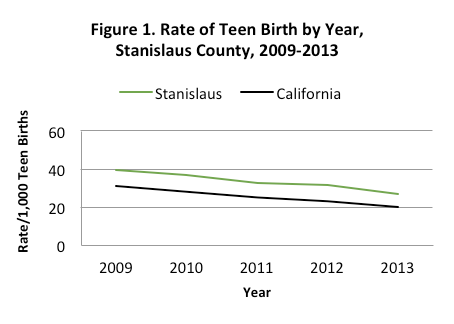
The horizontal axis shows 2009 through 2013. The vertical axis is labeled Rates/1,000 Live Births and ranges from 0 to 60 in increments of 20. The green line represents Stanislaus County and the black line represents California. Both decline, and Stanislaus County remains higher throughout the period. Exact values are not printed beside the plotted points.
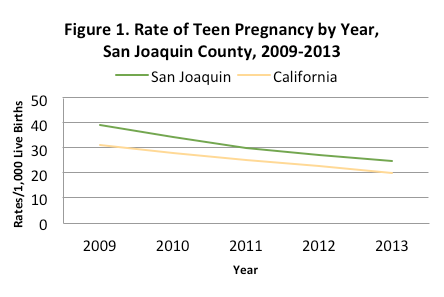
The prevention of teen pregnancy provides a cost benefit for youth and the community as a whole. Table 1 shows conservative estimates of costs to taxpayers due to teen birth. The National Campaign to Prevent Teen and Unplanned Pregnancy estimates that the average societal cost of each teen birth is $1,462. By reducing the rate of teen births, Stanislaus County has saved nearly one million dollars in projected costs since 2009.
| Year | Ratea of Teen Births | Total Costs of Teen Childbearingb (in dollars) | % Decline in Teen Birth Rate Compared to Previous Year | Estimated Savings Due to Decline Teen Birth Rate |
|---|---|---|---|---|
| 2009 | 39 | $1,260,244 | - | - |
| 2010 | 37 | $1,179,834 | 5 | $80,410 |
| 2011 | 32 | $1,036,558 | 14 | $223,686 |
| 2012 | 31 | $1,008,780 | 3 | $251,464 |
| 2013 | 27 | $855,270 | 13 | $404,974 |
a rate per 1,000 live births
b based on average cost of teen birth in California $1,462 (2010)
How Does Public Health Reduce Teen Pregnancy and Related Health Outcomes?
Stanislaus County has both primary and secondary prevention methods for reducing teen pregnancy and related health outcomes. Stanislaus County Health Services Agency (HSA)’s mission is to
- Promote wellness and healthy lifestyles,
- Prevent illness and injury,
- Provide quality care and treatment, and
- Preserve access to healthcare for the underserved through leadership, continuous improvement, and teamwork.
This applies to individuals of all ages.
Health Care Services
HSA provides primary and specialty health care services to the community via its network of federally qualified health center look-alike outpatient clinics located throughout the county. These include Family PACT and reproductive health services, a special teen-friendly clinic at McHenry Medical Office in Modesto, and testing and counseling for sexually transmitted infections at the STD Clinic on Scenic Drive in Modesto.
HSA’s services for young adults (13-21 years) include:
- Free STI/HIV testing
- Birth control
- Reproductive health exams
- One-on-one counseling
Teen Pregnancy Prevention
HSA’s Public Health Division works to promote lifestyles and infrastructure that extend the length of life and enhance the quality of life for all county residents. The Teen Pregnancy Prevention (TPP) program contracts with school districts to provide comprehensive sexual health education that complies with California legal codes. TPP administers an evidence-based curriculum that includes life skills intervention with scientifically-appropriate information regarding adolescent sexual behavior trends, sexually-transmitted infections, birth control methods and healthy relationships, as well as providing information on local clinical services. Education is delivered to youth at a variety of mainstream and alternative education school sites, in Juvenile Hall, and at the Independent Living Program (ILP) for foster youth. To comply with California’s 2015 Healthy Youth Act, the curriculum expanded to include additional education on adolescent growth and development, body image, gender roles, sexual orientation, and relationships including dating, marriage and family.
Parent Education and Support for Pregnant and Parenting Teens
HSA Public Health works with parents to provide them the skills and knowledge to talk with their children about sexuality. HSA Public Health also administers the Adolescent Family Life Program (AFLP) and Cal-Learn programs which provide case management to pregnant and parenting teens.
Program goals include:
- High school graduation or completion of GED
- Promotion of child health and development
- Prevention of subsequent pregnancies
HSA works closely with the Stanislaus County Teen Pregnancy Prevention Collaborative, whose membership includes diverse public and private organizations, to promote health and well-being for adolescents.
What Are Future Goals Related to Teen Pregnancy and Other Health Outcomes?
Future goals include improving education attainment for youth and reducing teen pregnancy rates and STI transmission, focusing on addressing health inequities seen for youth of lower socioeconomic status, racial and ethnic minorities, and youth exposed to neighborhood violence and unstable family environments.
- To attain these goals, HSA has proposed expanding comprehensive sexual health education to all junior and senior high public school students.
- HSA is expanding coordination with Golden Valley Health Centers to provide Family PACT tours of clinics that help adolescents access appropriate reproductive health and other clinical services.
- HSA also plans to work with Haven Women’s Center, the Stanislaus County Office of Education and school districts to expand healthy relationship education and intimate partner violence prevention.
This report was produced by the California State University, Fresno, Central Valley Health Policy Institute in partnership with the San Joaquin Valley Public Health Consortium. Stanislaus County Public Health Division is a member of the Consortium.