Longevity for San Joaquin Valley Elders: Individual and Neighborhood Characteristics in Tulare County

Health Equity for All
Background
For seniors in the San Joaquin Valley, both demographic and socio-economic characteristics are linked to longevity. Individual and neighborhood characteristics combine to produce disparities in health that accumulate over a life time. Race/ethnicity serves as a proxy measure of both individual and social determinants of health such as access to healthcare, fresh produce, and environmental air quality. This report examines premature mortality prior to age 65 as well as years of life lost after 65 within Tulare County compared to the state.
Summary of Findings
Figure 1 illustrates all deaths (n=13,964) in Tulare County between 2009 and 2013. Compared to California, Tulare County experiences greater premature loss of life. In Tulare County, 33% of these deaths were prior to age 65 as opposed to the 28% for the state. There are also notable racial/ethnic differences in premature mortality within Tulare County. While 25% (below state average) of White and 28% of Asian deaths occurred prior to the age of 65, African Americans and Latinos experience higher than average premature mortality at 45%, and 49%, respectively. Fifty-eight percent of Native American, Hawaiian/Pacific Islander, biracial, and self-identified other racial/ethnic groups combined also experience premature death.
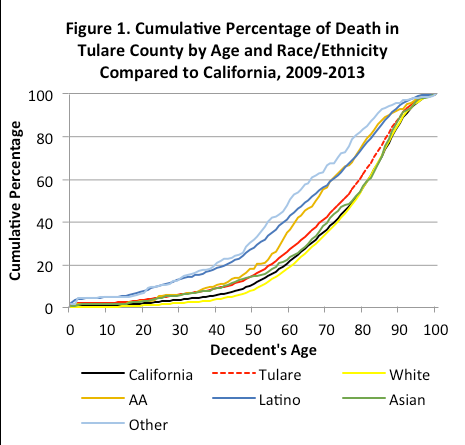
The horizontal axis shows Decedent’s Age from 0 to 100 in increments of 10. The vertical axis shows Cumulative Percentage from 0 to 100 in increments of 20. The legend identifies California, Tulare, White, AA, Latino, Asian, and Other. AA means African American. Exact values are not printed beside the plotted points.
| Population | Percentage of deaths before age 65 |
|---|---|
| California | 28% |
| Tulare County | 33% |
| White | 25% |
| Asian | 28% |
| African American | 45% |
| Latino | 49% |
| Native American, Hawaiian/Pacific Islander, biracial, and self-identified other racial/ethnic groups combined | 58% |
Figure 2 illustrates years of life lost in Tulare County’s senior population in relation to California’s age- and gender-specific life expectancy. This graph provides insight into which racial/ethnic groups, on average, are not living as long as expected. African-Americans and those in the “other” category are disproportionately affected. In contrast, Whites and Asian males are living longer than expected throughout the state.
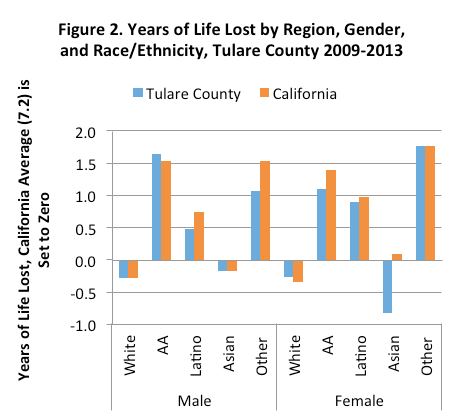
Blue bars represent Tulare County and orange bars represent California. The vertical axis ranges from -1.0 to 2.0 in increments of 0.5. California’s average of 7.2 years of life lost is set to zero. Bars above zero indicate more years of life lost than that average; bars below zero indicate fewer years lost. Exact bar values are not printed.
| Gender and race/ethnicity | Tulare County | California |
|---|---|---|
| Male — White | Below | Below |
| Male — African American | Above | Above |
| Male — Latino | Above | Above |
| Male — Asian | Below | Below |
| Male — Other | Above | Above |
| Female — White | Below | Below |
| Female — African American | Above | Above |
| Female — Latino | Above | Above |
| Female — Asian | Below | Above |
| Female — Other | Above | Above |
Data was from the California Department of Public Health’s Death Statistical Master Files.
Current Elder Health Activities in Tulare County
Multipurpose Senior Service Program (MSSP)
Tulare County’s Multipurpose Senior Service Program (MSSP) provides social and health care management for frail elderly clients who are certifiable for placement in a nursing facility but who wish to remain in the community. The goal of the program is to arrange for and monitor the use of community services to prevent or delay premature institutional placement of these frail clients. The services must be provided at a cost lower than that for nursing facility care.
Tulare County residents who qualify for this MSSP services benefit by being able to stay in the comfort of their own homes and can receive assistance with services such as:
- Housing assistance
- Chore and personal care assistance
- Transportation
- Meal services
- Communication services
Nutritious Meals
Tulare County Aging Services and the Kings/Tulare Area Agency on Aging (K/T AAA) help provide nutritious tasty meals to seniors, age 60 or older. The meals are served at one of several senior centers throughout the county, and in some cases may even be delivered to the senior at home. The program has a communal dining program which serves lunch in local senior or community centers, where participants also have the opportunity to enjoy each other’s company, make new friends, take classes, or play games. This advances senior health not only through nutrition but also through promoting social interaction and preventing isolation. Menus are prepared by a licensed, registered dietician, which ensures that meals are both well-balanced and nutritious. Seniors receiving meals are requested to give a small donation per meal but a donation is not required. Donations are always anonymous, and eligible seniors will never be refused a meal due to inability to donate, thus ensuring access to the low-income and needy aging population.
Home-Delivered Meals
For seniors who may be unable to attend the local senior centers, due to recent hospitalization, long-term illnesses, or incapacitating conditions, the Home-Delivered Meals program may be able to help. Homebound seniors who do not have friends, relatives, or paid help to provide assistance with meal preparation may be eligible to receive a five-day supply of frozen meals, delivered once a week. For home-delivered meals, a small anonymous donation per meal is suggested, but is again not required, thus preserving access to the program for indigent seniors.
Health Insurance Counseling and Advocacy Program (HICAP)
It is known that access to adequate quality medical care improves both longevity and quality of life, and that receiving frequent, high-quality primary medical reduces mortality among seniors. In order to promote access to care, the Tulare County Health Insurance Counseling and Advocacy Program (HICAP) conducts community presentations and conferences as well as individual counseling sessions. HICAP counselors are trained in both Medi-Cal and Medicare as well as health care coverage that can take care of gaps in Medicare and/or Medi-Cal. Counselors can help seniors compare benefits when purchasing a plan, or advise them what services that they already qualify for until Medi-Cal and/or Medicare and even help them to get extra help in paying for prescriptions or filing an appeal to a denial.
Adult Protective Services
The Tulare County Adult Protective Services (APS) program partners with Tulare County Aging Services and K/T AAA to ensure that isolated seniors receive the care they need. Seniors could be isolated through abuse or neglect, but also due to individual choice or lack of knowledge of available services and/or possible sources of assistance. APS can refer senior to services that address their health care, mental health, and nutritional needs, or to help them gain access to services through referrals to programs which provide transportation or someone to help them with taking medicines, managing their affairs, or other activities which directly impact their ability to receive health-related services, either within their homes or in the wider community.
Future Elder Health Activities in Tulare County
Tulare County Health & Human Services Agency hopes to be able to expand all aging services in order to reach more seniors. We are currently conducting a Community Health Assessment (CHA) and developing a Community Health Improvement Plan (CHIP) in partnership with community stakeholders and the Public Health Institute (PHI). The process includes extensive public engagement and forging strong relationships with community partners which will allow us both to develop new initiatives and improve existing ones throughout the county.