SWRK 181-I Practice Assignments
SWRK 181-I Learning Agreement Assignment
1. Agency Assessment Guidelines (EPAS Competency 7 – Assessment)
Students enrolled in SWRK 181-I, Field Instruction A, are required to complete an assessment of the field placement agency in conjunction with the content from their concurrent macro practice course, SWRK 180. Refer to your current SWRK 180 syllabus and course materials for additional information. Share your assessment of the agency with your field instructor/agency supervisor.
Areas to Include in Agency Assessment:
- The agency’s mission and goals.
- A description of the organizational structure of the agency.
- A description of the community context in which services are delivered by the agency.
- Information on specific vulnerable populations served by the agency.
- A description of agency services.
- Discuss how social work values are implemented by the agency.
2. Ethnographic Observation and Meeting Analysis (EPAS competency 7 – Assessment)
Students enrolled in SWRK 181-I, Field Instruction A, will attend a formal meeting related to his/her field placement agency. This meeting should consist of community members, or an organization or political body such as the Board of Supervisors or City Council. The purpose of this assignment is to understand how formal meetings function as venues of decision-making. Use the observations from the questions below to guide the ethnographic observation and meeting analysis.
Conduct an ethnographic observation of an agency or public decision-making meeting. As you observe this formal, decision-making, focus your observation according to the following questions:
- Who are the participants?
- What is the agency agenda?
- What are the main issues being presented?
- Who are the decisions makers and how does the decision-making process function formally at this meeting?
- How do you see power at work in the meeting?
- How was the meeting used to address the needs of vulnerable populations?
- What happened during the meeting in term of the decisions made?
3. Community Assets Map (EPAS Competency 8 – Intervention)
Community assets mapping is the process of identifying resources (human, financial, material, social) among vulnerable populations in communities. It focuses on assets, rather than solely on deficits, in vulnerable populations and communities.
The field internship assignment requires the intern to gather information about a community served by the placement agency. The required areas of information include:
- A description of the community in terms of place, population, demographic data, and other basic identifying information.
- Information about the community’s history (the influence and power of residents, any problems or issues experienced by residents):
- Identification and classification of the strengths and assets of the community (e.g. churches, banks, grocery stores, community groups, etc.) How can assets be used for community improvement, how organizations which serve the community together or should work together and major challenges faced by the community.
- Formulate a brief strategy for community betterment..
SWRK 182-I Practice Assignments
SWRK 182-I Learning Agreement Assignments
1. Assessment of an Individual Client/Consumer (EPAS Competency 7 – Assessment)
Conduct an assessment of an individual client/consumer from your field placement agency using content learned in SWRK 183. The assessment may be completed using the sample assessment form in the BA Field Manual (See DSWE website) or the agency form if one is available. The assessment should include the following content areas:
- Identifying Information: Basic identifying information such as the name of the client/consumer (fictitious to maintain confidentiality), age, ethnicity, marital status, occupation, etc.
- Reason for Referral: A brief description of the problem(s)/need(s) that brought the consumer/client to the agency in which you are placed (this should include the individual/agency who referred the client/consumer to your agency)
- History of Presenting Problem(s)/Need(s): A brief history of the presenting problem(s)/need(s). If you have permission, gather information from other relevant sources such as family, school, etc. Be sure to include specific information about the onset, frequency, duration and severity of the presenting concern(s).
- Current Functioning: A description of the client’s strengths and functioning in major domains such as school, occupation, social, emotional and health. Include cultural aspects of the client that may be pertinent such as religion/spirituality, disability, sexual orientation etc.
- Family and Support System: A description of the client’s family and support systems (this should include extended family, relevant cultural information and other support systems such as human services/legal system, etc.)
- Community Context: A description of the home, neighborhood and community context.
- Goal(s): List the goals for service mutually identified with the client/consumer and specifically linked to the presenting needs/concerns.
2. Three Generational Genogram (EPAS Competency 7 – Assessment)
Meet with an individual client/consumer of your field placement agency and develop a three generational genogram as part of the assessment process. The genogram is completed for a client, and is not based on the student intern and his/her family. You may refer to information from SWRK 160 and SWRK 183. Be sure to include the following components:
- Include grandparents, parents, siblings and the client/consumer. If the client/consumer has children or grandchildren, include them as part of the three generations.
- Carefully draw the genogram on a separate piece of paper, using information from SWRK160 and SWRK 183 and available resources such as: http://www.genopro.com/family-tree-software/
- Carefully print all relevant information regarding the following: names and birth dates of family members, and dates and descriptions of significant events.
- The genogram should include relationships and family life cycle events such as births, adoptions, deaths, marriages, intimate relationships, and separations/divorces.
3. Process Recording Format (EPAS Competency 6 – Engagement)
The following format and example of process recording is taken from Wilson (1981).*
| Supervisor’s Comments | Dialogue | Student’s Gut Level |
|---|---|---|
| In this column, the supervisor enters his comments opposite the material recorded in “dialogue” column. He may point out technique used by the student, comment on the meaning of a client’s response, raise questions for the student to think about, suggest alternate responses or techniques, and so forth. | This is where the student records the content of what took place in the interview, using style described on p 118-119. | The recorder puts down any feelings he was aware of as the dialogue was taking place. For example, “I felt anxious.” |
| EXAMPLE: | ||
| I’m sure your being more comfortable affected interview positively. | Mrs. B: I got a letter from my husband on Monday and he said to go ahead and file for divorce. | I felt a little more confident that last time. |
| I wonder why the sudden change? | W (Worker): So you are filing for divorce? | I was surprised – Mrs. B. was very willing to talk this |
| I’ll believe it when I see it! | Mrs. B.: Yeah – I’m going to go ahead and do it. W: Are you planning on filing soon, or are you going to wait a while? |
I’m feeling more at ease. |
| I wonder what other feelings she has about what’s happened? | Mrs. B: Pretty soon, I hope I may as well get a divorce since he’s going to be in jail for 15 years. | |
| What are the four kids doing while you all are talking? | Sister: I think she out to go ahead and get one. W: Where is your husband now? Mrs. B.: In Puerto Rico. W: What jail is he going to? Mrs. B: I don’t know. |
|
| Your bias is showing (for her to get the divorce!) | W: Would transportation to Legal Aid be a problem – if so, I’ll be glad to take you. | |
| She should know if she’s filed before. | Mrs. B: How much would the divorce cost me? W: I’m not real sure-probably nothing or maybe just a small amount. I’ll check on it for you Mrs. B.: OK. I’ve filed for divorce once before. |
|
| I wonder if she filed thru Legal Aid? | W. When did you file? Mrs. B: Back in 1973. |
I feel like I’m getting somewhere-not far, but somewhere. |
Note: Names and identifying details in all recording examples have been altered to preserve confidentiality.
* Wilson, S (1981). Field Instruction. New York: The Free Press, pp. 119-20.
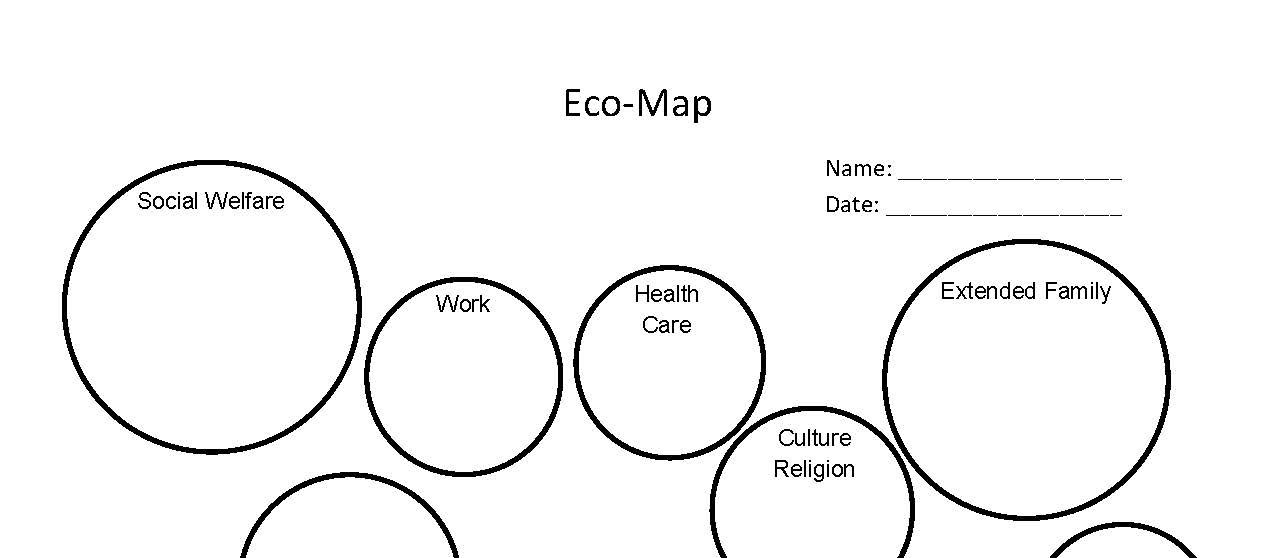
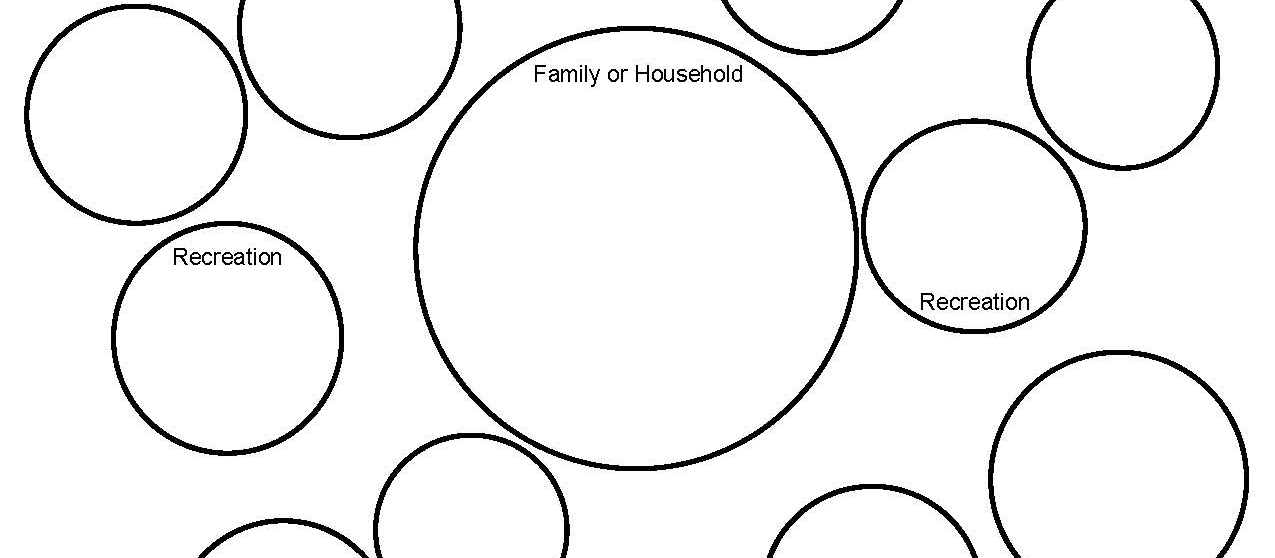
4. Eco Map (EPAS Competency 7 – Assessment)
Meet with an individual client/consumer of your field placement agency and develop an Eco Map as part of the assessment process. You may want to refer to information from SWRK 160, SWRK 183, and other available resources such as: https://www.smartdraw.com/ecomap/
The Eco Map should include the following components:
Identify and characterize the significant social systems and influences in the life of the client/consumer. Include the following domains:
- Neighborhood – The physical area in which the home exists (not a house or apartment, but the area in which the house or apartment exists).
- Community Services – Includes Medical, Mental Health, Substance Abuse, Domestic Violence, Child Welfare, Legal, Court, etc.
- Social Groups – Church, Civic, YMCA/YWCA, Faith/Culture, etc.
- Education
- Significant Personal Relationships (can include friends, family, etc )
- Employment
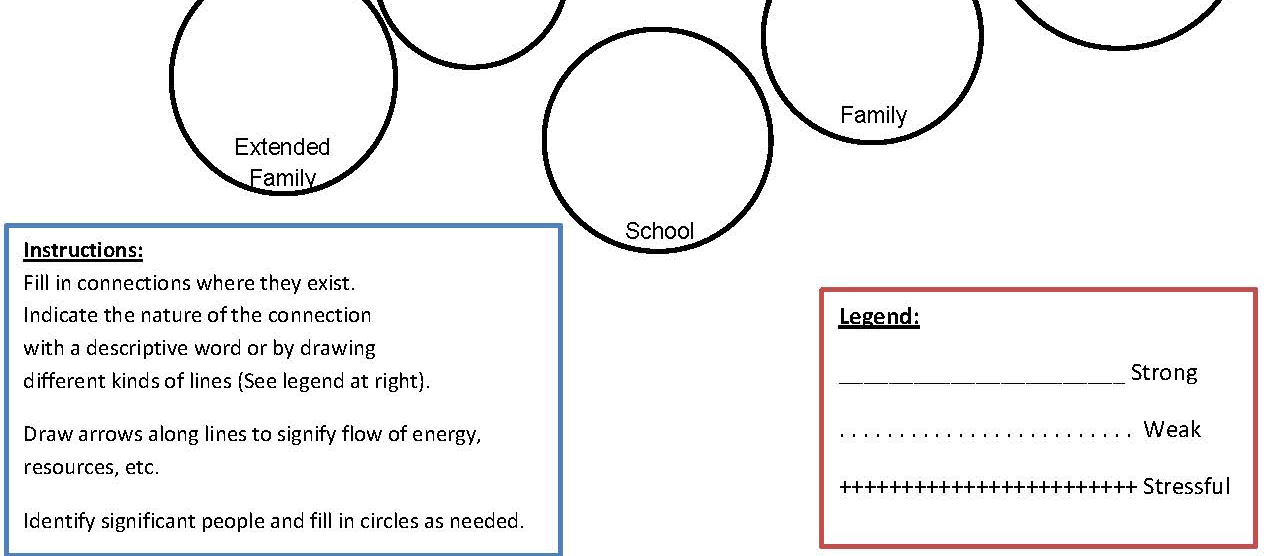
Indicate the direction of energy or resource flow between the client/consumer and other people and systems.
Depict the information gathered using an Eco Map format such as the one on the following page:
6. Approaches to Evaluation of Practice (EPAS Competency 9 – Evaluation of Practice)
Evaluation is an important component of professional social work practice. In order to deliver effective services, one needs to gather information, assess whether or not the social work interventions provided have helped to address the identified goals, and then make necessary changes based on this evaluation. There are a variety of approaches to evaluation of practice. Two specific strategies are presented here. Regardless of the method, it is important to remember to conduct evaluation of practice in a collaborative manner with clients/consumers so that they are mutually involved in the process.
Goal Attainment Scaling
This approach to evaluation of one’s own practice is very specific to the individual (or system) with whom you are working. The procedure is to identify a goal and then create a “scale” with anchors that the practitioner and client/consumer use to reflect how the client/consumer is doing and/or how close he/she is to attaining the goal on a regular basis over a period of time.
For example, a client has a problem with feeling anxious in situation X. The goal is to be anxiety-free. During weekly visits, the client rates on a scale of 1-10 how he/she felt during the week when faced with situation X. A scale may be as follows:
- 10) Extreme anxiety, sweaty palms, heart racing, thoughts racing, immobilized; just thinking about situation X leads to symptoms, client avoids situation X
- 9) Thinking about situation X DOES NOT lead to symptoms, as situation X nears extreme anxiety builds: sweaty palms, heart racing, thoughts racing, immobilized; client would like to avoid situation X
- 8) High anxiety, begins experience, quits early (this may be part of intervention plan)
- 7) High anxiety, has to stop before halfway point
- 6) High anxiety makes it to halfway point
- 5) Moderate symptoms ongoing in situation X, has to stop experience half way through
- 4) Moderate symptoms ongoing in situation X, fear that I can’t complete, but does complete
- 3) Symptoms ongoing in situation X but can ignore them and complete experience
- 2) Intermittent feelings (heart beating faster, some sweating) while in situation X
- 1) No anxiety symptoms throughout experience of situation X
Another example could be with an agency where the goal of intervention is to fundraise. Here one can set the fundraising goal and use a “thermometer” at regular intervals to mark progress of the effort.
Single System Design
This approach to evaluating progress for a single client system requires that the social worker, in collaboration with the client/consumer, identify a target for change and a way to measure that change over the course of the intervention. Then one determines a suitable interval for taking measures and tracks that change over time. The pattern of change gives one an idea of how the client/system is doing regarding the target and, potentially, if the intervention worked. Targets must be observable by others or client/self, measurable and occur frequently enough to offer a picture of change over time.
Example #1: A client/consumer is seeing a social worker for depression. A common depression scale is used to measure level of depression. A baseline is obtained from intake measure and in first session with the social worker. Thereafter, the client/consumer completes the measure on a weekly basis while intervention is ongoing. The results are plotted on a chart and discussed as part of client’s progress.
Example #2: Client is a child who has frequent tantrums (e.g., 10/week). Measure is based on number of tantrums observed; note that what constitutes a tantrum has to be defined by social worker, parents and teacher. Baseline of tantrums determined from teacher/parents. Intervention applied and parents/teacher keeps track of tantrums. Charted on a weekly basis for change.
This HTML version was generated with AI assistance and may contain errors or omissions. The original approved PDF remains the official document of record. An alternative accessible format is available upon request from the document creator in accordance with Title II of the ADA.